· The Rapid Architect Team · AI · 5 min read
AI End-of-Year Advice for Small Businesses in 2025
As 2025 ends, leverage the One Big Beautiful Bill Act’s 100% bonus depreciation to invest in AI tools now—deducting software, cloud systems, and equipment immediately. Automate bookkeeping, predict demand, and boost cybersecurity before December 31. These tax-smart AI upgrades cut costs today and fuel growth in 2026. Act fast.

End-of-Year Advice for Small Businesses in 2025: Focusing on AI and Technology Integration
Podcast Discussion
As 2025 draws to a close on November 30, small businesses (SMBs) face a unique landscape shaped by economic optimism amid persistent challenges like inflation (affecting 46% of owners) and hiring difficulties (34% report unfilled roles). The One Big Beautiful Bill Act (OBBBA), signed in July, has introduced favorable tax changes, including permanent 100% bonus depreciation for qualifying assets like software and equipment, making now an ideal time to invest in technology—especially AI—to optimize taxes while boosting efficiency. Research shows 75-88% of SMBs are already using AI in at least one function, with 91% of adopters seeing revenue growth this year. Below, I’ll outline key end-of-year advice, tailored to 2025’s context, with a strong emphasis on AI and tech adoption to drive growth into 2026.
1. Review and Optimize Finances with Tech-Enabled Tax Strategies
- Gather and Automate Records: Compile invoices, receipts, mileage logs, and home office expenses before December 31. Use AI-powered accounting tools like QuickBooks AI or Microsoft 365 Copilot to automate categorization and flagging of deductions—reducing errors by up to 30% and saving hours on manual entry.
- Maximize 2025 Deductions: Under OBBBA, claim 100% bonus depreciation on AI software, computers, or cloud infrastructure purchased and placed in service by year-end. Expanded Section 179 allows full expensing of equipment up to $1.22 million (adjusted for inflation). For accrual-basis businesses, defer bonuses to March 2026 for deductions while timing employee payouts for their tax benefit.
- AI Tie-In: Integrate predictive AI analytics (e.g., from Google Workspace or IBM watsonx) to forecast cash flow and identify uncollectible debts for bad debt deductions. This could save 10-24% in taxes, per CLA estimates.
- Action Step: Consult a tax advisor by mid-December to model scenarios; 77% of AI-using SMBs report daily efficiency gains here.
2. Conduct an Inventory and Operations Audit, Leveraging AI for Insights
- Physical and Digital Counts: Perform a full inventory audit to reconcile stock levels—critical with holiday rushes and supply chain disruptions extended by 2025 tariffs. Review supplier relationships for 2026 pricing.
- Tech Integration: Deploy AI tools like Sortly’s inventory AI or Zoho’s built-in forecasting to predict demand trends, reducing overstock by 20-40%. McKinsey notes AI agents are scaling in IT and knowledge management, helping SMBs automate audits.
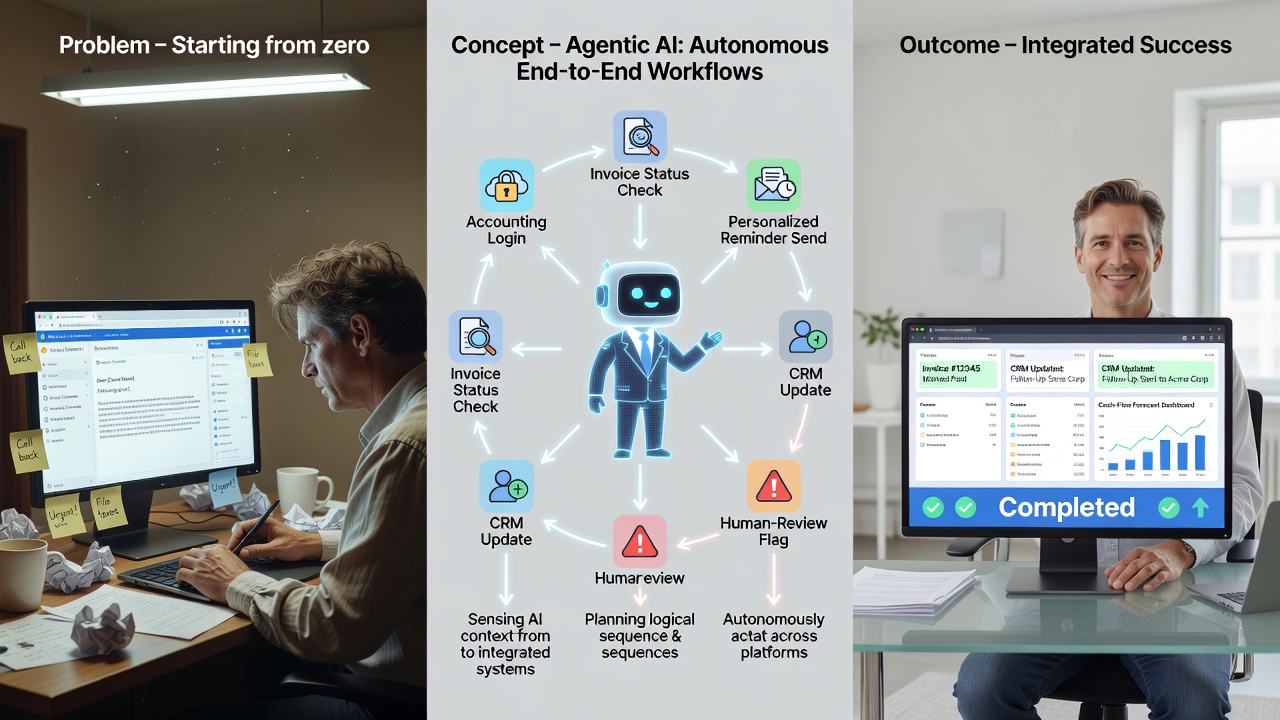
- AI Tie-In: Use agentic AI (e.g., personalized agents from Salesforce or Optifai) for real-time anomaly detection in operations—33% enterprise adoption projected by 2028, but SMBs can start small for 53% sales productivity boosts.
- Action Step: Close books by early December; aim for a “full-year outlook” including AI-driven sales forecasts to guide 2026 inventory.
3. Enhance Cybersecurity and Fraud Prevention Amid Holiday Spikes
- Assess Vulnerabilities: With fraud attempts surging during holidays, update software, enable multi-factor authentication, and train staff on phishing. Inflation and tariffs have heightened cyber risks for 2025.
- Tech Integration: Adopt AI-driven security like Microsoft 365’s Copilot for threat detection or Zoom’s AI-enhanced encryption—27% of SMBs are accelerating tech investments due to AI.
- AI Tie-In: Ethical AI tools prioritize data privacy (e.g., GDPR-compliant chatbots), building customer trust; 98% of SMBs now use AI, but only 51% of customers fully trust it without transparency.
- Action Step: Run a quick AI vulnerability scan by December 15; SBA recommends this for all SMBs.
4. Plan for Growth: Budget for AI Adoption and Talent Upskilling
- Set 2026 Goals: Reflect on 2025 performance—most owners are optimistic about the economy. Update marketing assessments and consider rightsizing for sustainability.
- Tech Integration: Allocate 10-15% of budget to AI tools; affordable options like subscription-based agents (e.g., Adobe’s MAX 2025 AI for creators) enable hyper-personalization without overhauls.
- AI Tie-In: Focus on trends like AI reasoning models and custom silicon for ROI—60% of executives report efficiency gains from responsible AI. For hiring challenges, use AI for resume screening or predictive analytics to fill 47% of qualified applicant gaps.
- Action Step: Create a 90-day AI playbook: Start with one tool (e.g., chatbots, adopted by 80% by year-end) for customer service, scaling to agents for tasks like research.
5. Build Customer Relationships and Prepare for Compliance
- Engage Authentically: Personalize outreach via email or social media; meet customers where they are, as social platforms drive brand awareness.
- Tech Integration: Use AI for sentiment analysis in newsletters or CRM (e.g., Optifai’s action-first CRM reduces input time by 40%).
- AI Tie-In: Conversational AI handles 24/7 support while maintaining brand voice—key for 2025’s predictive trend analysis.
- Action Step: Issue 1099s by January 31, 2026; ensure fiscal year alignment (most SMBs use calendar year).
| Key 2025 AI/Tech Opportunity | Benefit for SMBs | Tax Perk (via OBBBA) | Adoption Tip |
|---|---|---|---|
| AI Accounting Tools (e.g., QuickBooks AI) | Automates records; 77% daily use | 100% bonus depreciation on software | Start with free trials; integrate by Dec 31 |
| Agentic AI for Operations (e.g., Salesforce Agents) | 53% productivity boost; scales tasks | Full expensing for cloud setup | Pilot for inventory; 23% scaling in 2025 |
| Cybersecurity AI (e.g., Microsoft Copilot) | Reduces fraud risks | Deduct hardware upgrades | Train team via built-in modules |
| Personalized Chatbots (e.g., Google Workspace) | 80% adoption for customer service | Section 179 for servers | Customize for holidays; monitor ROI |
In summary, 2025’s end is a launchpad: Use OBBBA incentives to invest in AI now for immediate tax savings and 2026 competitiveness. With 76% of SMBs feeling positive about AI, focus on ethical, scalable tools to address inflation and talent woes. Connect with SBA resources or a local banker for personalized guidance—preparation today ensures resilience tomorrow.