· The Rapid Architect Team · AI · 6 min read
The Time for Researching AI Projects is Over: It's Time to Implement and Iterate
The research phase of AI adoption is over. Your competitors aren't waiting for perfect solutions or exhaustive ROI analyses. They're implementing, learning, and iterating. While you're still reading articles and attending webinars, they're gaining market share, improving efficiency, and delighting customers. The era of endless research has passed—now is the time for action.
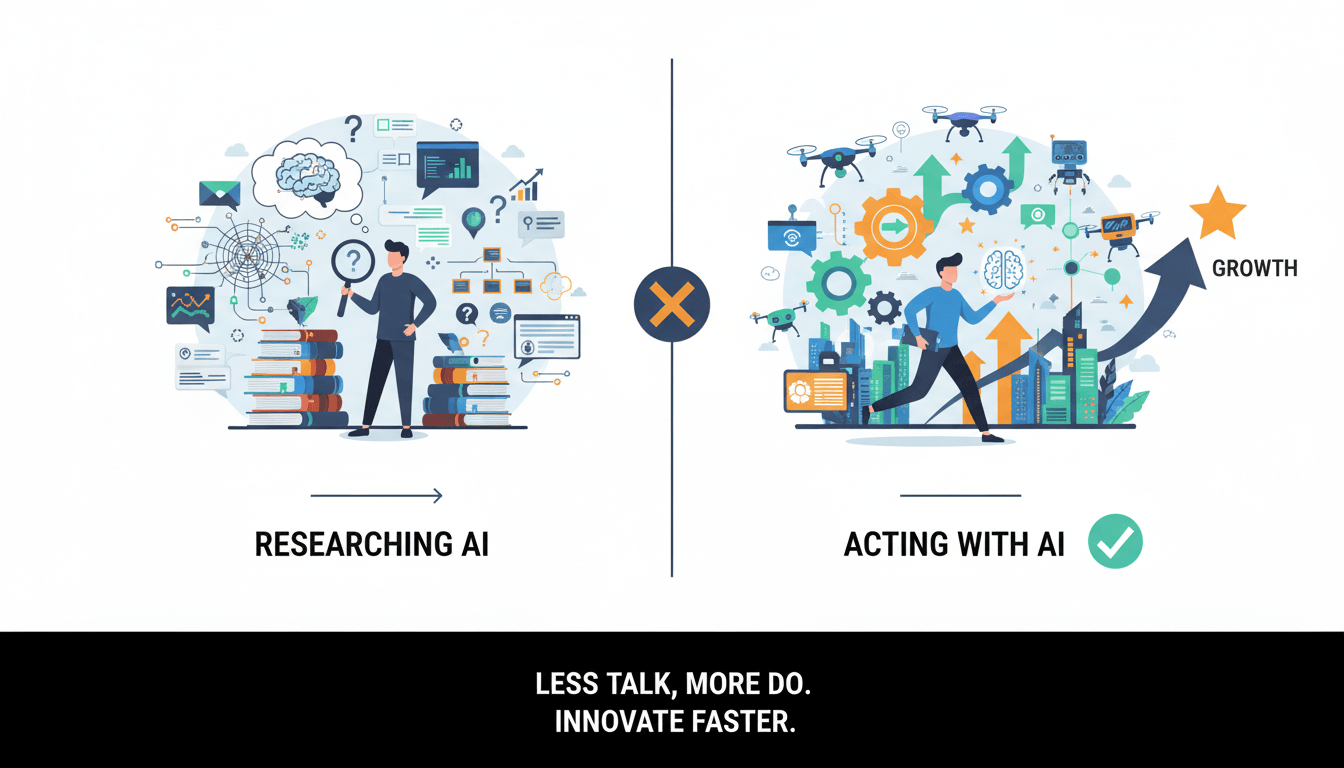
The Time for Researching AI Projects is Over: It’s Time to Implement and Iterate
Podcast Discussion
Why Your Competitors Are Already Winning with AI While You’re Still “Researching”
Dear fellow business owner,
If you’re still in the “research phase” of AI adoption, you’re already falling behind. The era of endless research, pilot projects, and “wait and see” approaches to artificial intelligence is over. Your competitors aren’t waiting for perfect solutions or exhaustive ROI analyses. They’re implementing, learning, and iterating. And they’re gaining market share, improving efficiency, and delighting customers while you’re still reading articles and attending webinars.
This isn’t another “AI is the future” article. This is a wake-up call. The future of AI in business isn’t a distant possibility—it’s happening right now, and the businesses that embrace implementation over research are the ones that will thrive.
The Research Paralysis Trap
We’ve all been there. You hear about AI’s transformative potential, you get excited, you start researching, and suddenly you’re stuck in analysis paralysis. You’re reading white papers, attending webinars, talking to vendors, and creating elaborate business cases—yet nothing actually gets implemented.
This research trap is particularly dangerous for small and medium-sized businesses because:
- Time is your most valuable resource: Every hour spent researching is an hour not spent implementing and gaining competitive advantage
- The AI landscape evolves rapidly: By the time you finish your research, the technology and market have moved on
- Perfect research doesn’t exist: There will always be more to learn, more case studies to review, and more vendors to evaluate
The truth is, no amount of research will give you the practical insights that come from actual implementation. You wouldn’t research swimming for years before getting in the water. You’d jump in, get wet, and learn to swim. AI adoption requires the same approach.
Why Implementation Trumps Research in the AI Era
1. AI Technology Matures Rapidly
The AI landscape has evolved from experimental to practical at an unprecedented pace. Today’s AI tools are:
- More accessible: No longer require PhDs or massive budgets
- More specialized: Solutions tailored to specific business functions and industries
- More integrated: Working seamlessly with your existing software stack
- More proven: Thousands of businesses are already seeing tangible results
The tools that were bleeding-edge and unreliable just two years ago are now stable, affordable, and backed by proven use cases. The research phase should have been short—now it’s time to act.
2. Competitive Urgency
Your competitors aren’t waiting. According to a recent PwC survey, 52% of businesses have accelerated their AI investments due to the competitive landscape. These aren’t just large corporations—SMBs across industries are implementing AI to:
- Automate customer service with chatbots
- Optimize supply chains with predictive analytics
- Personalize marketing with AI-driven insights
- Improve decision-making with data analysis
- Enhance product development with machine learning
While you’re researching, they’re capturing market share, reducing costs, and building moats around their businesses.
3. The Power of Iterative Learning
Implementation isn’t a one-time event—it’s a continuous process of learning and improvement. The most successful AI adopters understand that:
- First implementations are rarely perfect: They serve as learning opportunities
- User feedback is invaluable: Real-world usage reveals opportunities for improvement
- Technology evolves: What you implement today can be enhanced tomorrow
This iterative approach is far more effective than spending months trying to design the “perfect” solution upfront.
Starting Small: Your First AI Implementation
The thought of implementing AI can be overwhelming. Where do you start? The key is to begin with high-impact, low-complexity projects that deliver quick wins. Here are proven starting points for SMBs:
1. Customer Service Automation
Implement a chatbot for your website or social media channels. Modern AI-powered chatbots can:
- Answer frequently asked questions 24/7
- Qualify leads and schedule appointments
- Handle basic customer service inquiries
- Gather customer feedback
Implementation tip: Start with a simple bot that handles 5-10 common questions. Use the insights to expand its capabilities.
2. Marketing Personalization
Use AI-driven email marketing platforms to personalize your communications. These tools can:
- Segment your audience based on behavior and preferences
- Optimize send times for maximum engagement
- Generate personalized content recommendations
- Predict which customers are most likely to convert
Implementation tip: Begin with one segment of your email list and test different personalization approaches.
3. Sales Intelligence
Implement AI-powered sales tools that help your team:
- Identify promising leads
- Predict deal outcomes
- Automate data entry
- Provide real-time coaching suggestions
Implementation tip: Focus on one aspect, such as lead scoring, to demonstrate quick value.
4. Operational Efficiency
Use AI to optimize routine processes:
- Inventory management: Predict demand and automate reordering
- Scheduling: Optimize staff schedules based on demand patterns
- Accounting: Automate expense tracking and invoice processing
Implementation tip: Start with one department or process to minimize disruption.
Overcoming Common Implementation Barriers
Barrier 1: “We Don’t Have the Technical Expertise”
Reality: You don’t need a team of data scientists to start. Today’s AI tools are designed for business users, not just technical experts. Look for:
- No-code/low-code platforms: Tools that require minimal technical knowledge
- Vendor support: Reputable AI providers offer implementation assistance
- Training resources: Many platforms include tutorials and support
Barrier 2: “It’s Too Expensive”
Reality: AI implementation doesn’t have to break the bank. Options include:
- Subscription-based tools: Pay-as-you-go models with no large upfront investments
- Industry-specific solutions: Targeted tools that deliver maximum value for your sector
- Phased implementation: Start small and expand as you realize value
Barrier 3: “We Don’t Have Enough Data”
Reality: You have more data than you think. Even basic customer interactions, sales records, and website analytics can provide valuable insights. Many AI tools can work with limited datasets and improve as you gather more information.
Barrier 4: “We Don’t Know Where to Start”
Reality: Begin with your biggest pain points. What processes are costing you the most time or money? Where are your customers expressing frustration? These are your best starting points.
Measuring Success: What to Track
As you implement AI, focus on these key metrics:
Immediate Metrics (0-3 months)
- Time saved on automated tasks
- Customer response time improvements
- Basic engagement rates (for marketing AI)
- User adoption rates
Medium-Term Metrics (3-6 months)
- Cost reduction in targeted areas
- Customer satisfaction improvements
- Revenue impact from new capabilities
- Process efficiency gains
Long-Term Metrics (6-12 months)
- Competitive positioning
- Market share changes
- Innovation capacity
- Employee satisfaction and retention
Remember, the goal isn’t perfection—it’s progress. Celebrate small wins and use them to build momentum for larger initiatives.
Building Your AI Implementation Roadmap
Phase 1: Foundation (Months 1-3)
- Identify 1-2 high-impact use cases
- Select appropriate AI tools
- Implement and train users
- Establish basic measurement frameworks
Phase 2: Expansion (Months 4-9)
- Scale successful implementations
- Identify new opportunities based on learnings
- Integrate AI more deeply into workflows
- Refine measurement and optimization processes
Phase 3: Transformation (Months 10-18)
- Implement enterprise-wide AI strategies
- Develop custom AI solutions
- Build internal AI capabilities
- Create competitive advantages
The Cost of Inaction
While researching AI, your business is missing opportunities:
- Revenue loss: Competitors are capturing customers you could have served better
- Efficiency gaps: Manual processes are costing you time and money
- Talent attraction: Top employees want to work with innovative technologies
- Future readiness: You’re falling behind in digital transformation
The businesses that thrive in the AI era won’t be those that researched the most—they’ll be those that implemented the fastest and learned the quickest.
Your Call to Action
Stop researching and start implementing. Today.
- Identify one pain point that AI could solve
- Research three potential solutions (not thirty)
- Make a decision within one week
- Implement within one month
- Measure and iterate
The AI revolution isn’t coming—it’s here. And it’s not waiting for perfect research or exhaustive planning. It’s rewarding businesses that take action, learn from mistakes, and continuously improve.
Your competitors are already in the game. Isn’t it time you joined them?