· The Rapid Architect Team · AI · 8 min read
AI Is Creating Jobs on Main Street: How Small Businesses Are Flipping the Narrative
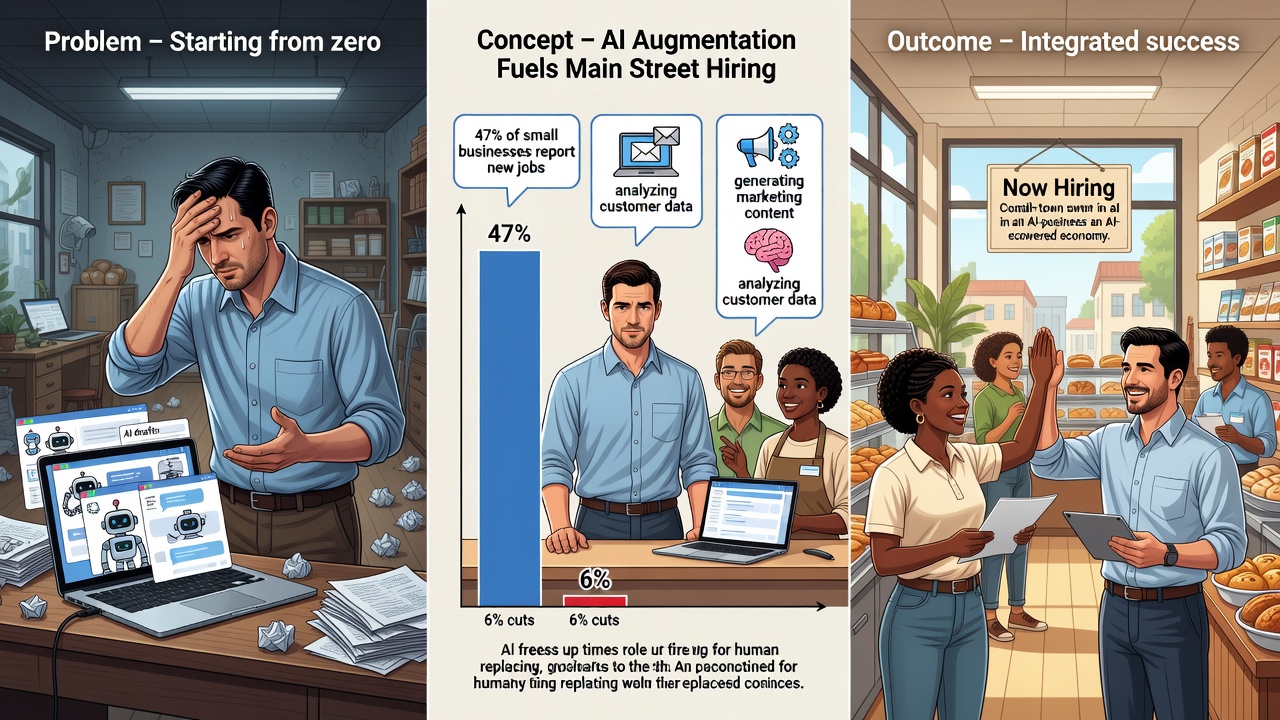
New data from the U.S. Chamber of Commerce Foundation reveals that 47 percent of small businesses using AI report it is creating jobs today, while only 6 percent say it enables headcount cuts. This blog post explores the evidence, explains why Main Street firms see AI as a growth engine rather than a replacement tool, and provides practical steps SMB leaders can take to hire more confidently in an AI-powered economy.
Podcast Discussion
Introduction
For years the dominant story about artificial intelligence has been one of fear: robots and algorithms taking over roles, leading to mass layoffs. Yet for America’s 33 million small businesses, that story simply does not match reality on the ground. Recent research from the U.S. Chamber of Commerce Foundation turns the narrative on its head. Forty-seven percent of small firms using AI say the technology is creating jobs today, compared with just 6 percent that report any headcount reductions [1]. Small businesses leveraging AI are four times more likely to report net hiring gains than reductions.
This reversal matters deeply for Main Street decision-makers. While large corporations often discuss artificial intelligence in terms of cost-cutting, small employers are discovering it as an employee multiplier that frees time, improves output, and opens capacity for new revenue streams. The result is not fewer jobs but more ambitious work and stronger teams. In this post we examine the data, highlight the divergence between corporate and small-business approaches, and share concrete tactics SMB owners can use to turn artificial intelligence adoption into hiring momentum. Owners who integrate artificial intelligence thoughtfully often see teams grow because the technology unlocks new service lines and client capacity that were previously impossible to staff.
The Headline Numbers That Challenge Conventional Wisdom
The U.S. Chamber of Commerce Foundation survey, conducted with Ipsos, delivers clear evidence that artificial intelligence functions as a net job creator for small employers. Nearly half of AI-using small businesses report new positions being added, while only 6 percent mention cuts [1]. Half of all workers at small businesses already use artificial intelligence tools, primarily to save time, raise quality, and handle larger workloads rather than to eliminate roles [2].
These figures stand in stark contrast to headlines focused on Fortune 500 automation projects. National coverage from outlets such as The Guardian and Stacker has begun highlighting the split: small firms view artificial intelligence as a way to retain staff and scale operations, not shrink them [6][5]. The data has even reached Capitol Hill, with the 47 percent versus 6 percent statistic cited during July 2026 House Small Business Committee testimony [8].
For SMB owners, the implication is straightforward. Adopting artificial intelligence does not require a defensive posture around headcount. Instead it can become a proactive strategy for growth and hiring. When small firms document productivity lifts of 20-30 percent, they routinely convert those gains into new sales or service positions that expand payroll rather than contract it.
Productivity Tool First, Replacement Engine Never
The most common use of artificial intelligence inside small businesses is not automation of entire jobs but augmentation of existing work. Employees report using artificial intelligence to draft emails, generate reports, analyze customer data, and create marketing content. These tasks free an average of five to ten hours per person each week. That reclaimed time is then reinvested in higher-value activities such as client meetings, product development, and sales outreach.
Gene Marks captured the sentiment in The Guardian: small firms use artificial intelligence to help employees work better, not replace them [6]. This employee-multiplier effect explains why companies that adopt these tools report stronger hiring trends. When output per employee rises, revenue capacity grows, and owners feel confident adding sales, service, or operations roles to capture the new demand. For example, a bookkeeping firm that once handled 40 client ledgers per month now processes 65 after implementing AI-assisted reconciliation, directly enabling the addition of two junior accountants.
Corporate Cost-Cutting Versus Main Street Growth Mindset
Large enterprises frequently announce artificial intelligence initiatives alongside workforce reductions. Small businesses operate under different constraints and incentives. They cannot easily offshore work or absorb the complexity of massive system overhauls. Instead they seek practical tools that let a lean team punch above its weight.
The 2026 Empowering Small Business report underscores this divergence [3][4]. While corporate headlines emphasize efficiency gains measured in headcount, Main Street owners measure success in new clients served and projects completed. The result is a virtuous cycle: artificial intelligence boosts productivity, productivity fuels revenue, and revenue supports additional hires. Boldly Financial summarized the trend with the headline “The artificial intelligence Job Apocalypse Missed Main Street” [7]. That phrase resonates because it reflects lived experience rather than theoretical forecasts. SMB leaders who have piloted artificial intelligence tools consistently report they are expanding teams, not contracting them.
Practical Examples SMB Owners Can Apply Today
Consider a 12-person marketing agency that adopted artificial intelligence for content research and first-draft creation. The team previously spent 15 hours weekly on background work. After implementation that dropped to four hours, freeing capacity for two additional client accounts. Within six months the agency hired a junior strategist and a part-time designer to service the new business. Revenue grew 22 percent, and the owner attributed the expansion directly to the time savings.
A 25-employee HVAC company used artificial intelligence scheduling and diagnostic tools to reduce administrative time by eight hours per technician each week. The owner reinvested the savings into a dedicated customer-success role focused on maintenance contracts. Revenue from recurring service increased 18 percent, justifying the new hire and creating a career path for an existing employee. Another illustration comes from a six-person retail boutique that deployed artificial intelligence inventory forecasting; the tool cut stockouts by 35 percent and allowed the owner to open a second location staffed by two additional part-time associates.
These examples illustrate the pattern: artificial intelligence removes friction from repetitive work, allowing owners to justify and fund new positions that drive further growth. Implementation details matter—start with a single workflow, measure hours saved for four weeks, then map those hours to revenue-generating activities before posting a job requisition.
Step-by-Step Guide to Turning artificial intelligence into Hiring Capacity
Audit current workflows by mapping the top ten tasks that consume the most employee hours. Identify which of those tasks can be accelerated with artificial intelligence while keeping human oversight. Target an initial time savings of five hours per person per week. Pilot one or two low-risk tools in areas such as lead generation, customer support chat, or social media content. Measure output before and after the pilot. When metrics show clear gains, document the additional revenue or capacity created.
Translate those gains into hiring plans. If artificial intelligence enables the team to handle 30 percent more projects, calculate how many new clients or service lines that represents. Use the data to build a business case for adding sales or service roles. Track “jobs created” metrics internally. Count new projects, clients, or revenue lines directly attributable to AI-driven productivity. Share these stories during team meetings to reduce anxiety and position artificial intelligence as a career accelerator.
Communicate openly with staff. Frame artificial intelligence adoption as a tool that makes everyone’s work more strategic and less administrative. Invite employees to suggest use cases and recognize those who identify high-impact applications. Over six months, many owners report that this transparent approach turns skeptics into internal champions who help onboard new hires funded by the productivity surge.
Preparing for Policy Tailwinds
The 47 percent versus 6 percent finding has entered the national workforce policy conversation [8]. Lawmakers on both sides of the aisle are tracking artificial intelligence’s employment effects on small employers. SMB owners who can demonstrate AI-driven hiring may soon qualify for federal or state programs that reward job creation through technology adoption. Watching for these incentives now positions firms to capture support when programs launch. Early adopters who maintain simple dashboards showing hours saved and roles added will be best positioned to apply quickly.
Addressing Common Concerns About Skill Gaps
Some owners worry that artificial intelligence tools require technical expertise their teams lack. In practice, most modern platforms offer no-code interfaces and pre-built templates. Training time averages just a few hours, and many vendors provide SMB-specific onboarding. The bigger risk is inaction: competitors who adopt artificial intelligence will pull ahead in productivity and hiring capacity. Another concern is data privacy. Reputable tools designed for small business include clear controls and compliance features. Owners should review vendor policies and start with internal, non-customer data until comfort levels rise. A phased rollout—beginning with one department—helps surface any issues before scaling across the organization.
Measuring Success Beyond Headcount
While the Chamber data focuses on net hiring, smart SMBs also track qualitative wins. These include higher employee satisfaction from reduced drudgery, faster client response times, and the ability to pursue work previously considered out of reach. These outcomes strengthen retention and make the company more attractive to new talent. Quarterly pulse surveys combined with productivity metrics give leaders a balanced scorecard that supports both hiring decisions and employee development conversations.
Conclusion
The jobs narrative around artificial intelligence has been flipped on Main Street. Forty-seven percent of small businesses say the technology is creating roles today, while only 6 percent report cuts [1]. Half of small-business workers already use artificial intelligence, primarily to boost productivity rather than automate jobs away [2]. This evidence invites SMB decision-makers to move from defense to offense.
By auditing workflows, piloting practical tools, and translating productivity gains into hiring plans, small-business owners can build teams that are larger, more capable, and better positioned for growth. The data shows the path forward is not about replacing people but about empowering them to do more ambitious work. The artificial intelligence job apocalypse missed Main Street, and the opportunity now belongs to those ready to lead with confidence. Owners who treat artificial intelligence as a hiring catalyst rather than a cost center are already seeing the results in expanded payrolls and stronger balance sheets.
Sources
- https://www.uschamberfoundation.org/workforce/what-small-business-owners-say-ai-is-actually-doing-at-work
- https://www.uschamberfoundation.org/workforce/half-of-small-business-workers-use-ai-most-to-boost-productivity-not-automate-jobs
- https://www.uschamber.com/technology/2026-empowering-small-business-report
- https://www.uschamber.com/assets/documents/Empowering-Small-Business-The-Impact-of-Technology-on-U.S.-Small-Business-Small-Business-Report-2026.pdf
- https://abc17news.com/stacker-business-economy/2026/07/30/businesses-using-ai-are-hiring-not-firing-new-report-finds/
- https://www.theguardian.com/business/2026/jul/26/small-businesses-ai
- https://boldlyfinancial.com/2026/09/18/2026-09-18-12-small-business-ai-hiring/
- https://docs.house.gov/meetings/SM/SM00/20260714/119446/HHRG-119-SM00-Wstate-CrenshawJ-20260714.pdf
- https://www.pubt.io/view/19F124243C5E929B887BBC82F432222693AF96D9
- https://employmenthero.com/en-ca/news/ai-paradox-report-2026/