· The Rapid Architect Team · AI · 8 min read
Benefits of Using Fractional C-Suite Contractors for SMBs
Discover how fractional C-suite executives deliver high-impact leadership to small and medium businesses at a fraction of traditional costs. Learn cost savings, flexibility, real-world examples, and actionable steps for SMB decision-makers in 2026.

Podcast Discussion
Introduction
Introduction
Small and medium business owners often face a tough dilemma: they need senior-level strategy to scale, yet cannot justify the six-figure salaries and benefits required for full-time C-suite hires. Enter fractional C-suite contractors, also known as fractional CXOs. These part-time executives bring decades of experience in technology, operations, finance, and growth without locking companies into permanent commitments.
In 2026, this model has shifted from experimental to mainstream. SMBs now tap into targeted expertise that aligns precisely with their revenue stage and challenges. Whether bridging gaps during funding rounds or injecting fresh tactics when growth stalls, fractional leaders offer a practical path forward. This approach eliminates overhead while delivering measurable results, making it one of the smartest moves for resource-conscious founders. For instance, a 25-employee logistics SMB in the Midwest used a fractional CTO to implement AI-driven route optimization, cutting fuel costs by 18% within six months while avoiding a $280,000 full-time salary commitment.
Cost Savings and Economic Advantages
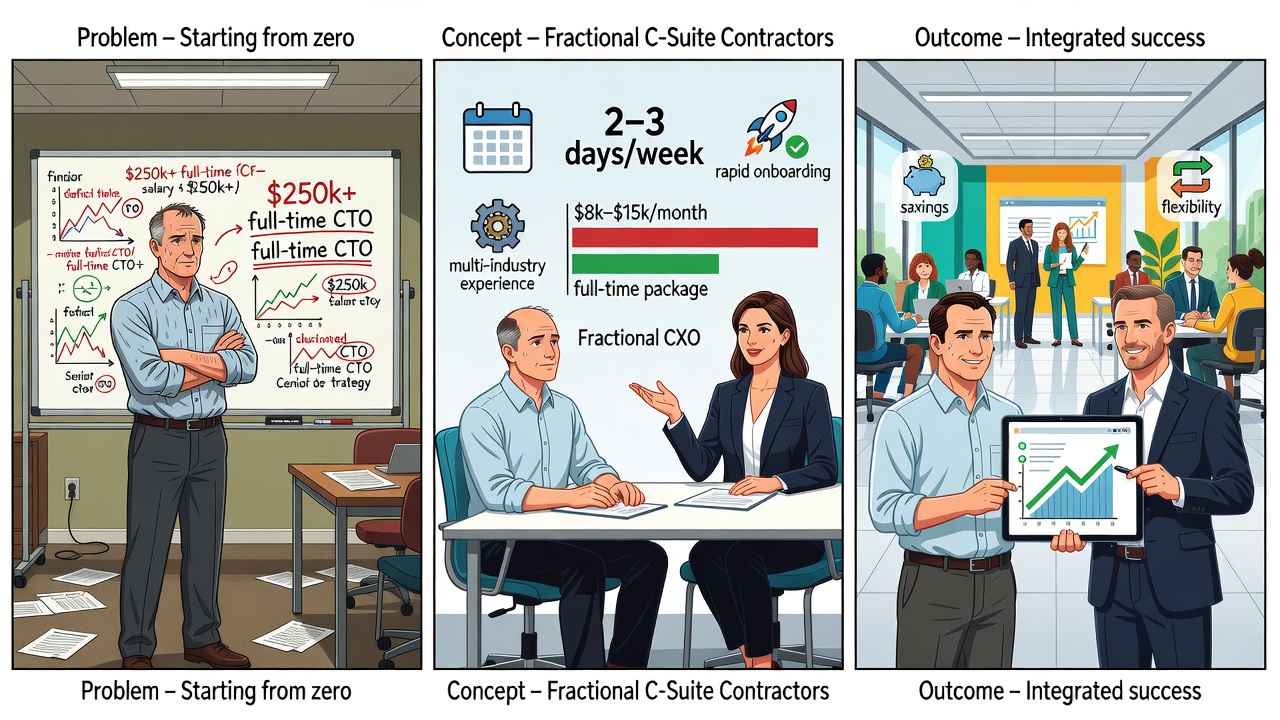
The most immediate benefit for SMB decision-makers is dramatic cost reduction. A traditional full-time CTO or COO package often exceeds $250,000 annually when including salary, benefits, equity, and potential severance. Fractional C-suite contractors typically charge $8,000 to $15,000 per month for engagements of two to three days per week. This represents an 80 to 90 percent savings while still providing embedded strategic leadership.
These economics align spending directly with business needs. Growing companies avoid paying for year-round capacity when senior input is only critical during specific phases, such as product launches or market expansions. Demand for fractional roles surged 68 percent in FY24 as startups and SMBs sought execution support without prohibitive hiring costs.
Consider a $5 million ARR software company that needs to overhaul its tech stack. Hiring a full-time CTO would strain cash flow and dilute equity. Instead, a fractional CTO delivers the roadmap in 90 days for under $45,000 total, freeing capital for engineering hires and marketing. The model also removes risks like long-term employment contracts or unexpected severance packages. SMB owners can test leadership fit on a short-term basis and adjust without financial penalties. Another concrete case involves a $2 million e-commerce retailer that engaged a fractional CFO to renegotiate vendor contracts, yielding $120,000 in annual savings and improving cash flow forecasting accuracy by 40%.
Skeptical owners often question whether fractional rates still represent real savings once hidden coordination costs are factored in. In practice, the model sidesteps the 6-9 month ramp-up period typical for full-time hires and eliminates severance exposure that can reach 6 months of salary. A 40-employee distribution firm compared both paths: a failed full-time COO search cost $95,000 in recruiter fees and lost momentum, while a 4-month fractional engagement delivered process improvements worth $180,000 in recovered margin. Implementation begins with a 30-day diagnostic phase that maps current bottlenecks to the fractional executive’s weekly deliverables, ensuring every billed hour maps directly to a quantified outcome. To address concerns about quality dilution from part-time status, the fractional CFO in the e-commerce case provided a shared KPI dashboard updated in real time, allowing the owner to verify weekly impact without daily oversight. This transparency converted initial skepticism into a 12-month renewal after the first quarter’s results exceeded projections by 25%.
Access to Senior Expertise Without Full-Time Commitment
SMBs that scale fastest access senior expertise on demand rather than building large permanent teams. Fractional executives bring multi-industry experience across 2 to 3 day-per-week engagements, embedding leadership that would otherwise require six to nine months of recruiting for a full-time role.
This is especially valuable when product and capital are in place but execution bandwidth is limited. A fractional Chief Growth Officer, for example, can immediately implement demand-generation systems drawn from prior work at companies three times the size. SMBs gain playbooks refined through real-world application instead of learning through expensive trial and error.
Practical example: A manufacturing SMB with $3 million in revenue struggled to modernize its operations. After engaging a fractional COO for 10 hours weekly, the company reduced production bottlenecks by 35 percent within four months. The executive transferred knowledge to an internal operations manager, ensuring long-term capability without ongoing dependency. This on-demand access accelerates progress while preserving the lean structure that defines successful SMBs. Similarly, a healthcare services SMB with 40 employees hired a fractional CMO who launched a targeted LinkedIn campaign, generating 150 qualified leads in the first quarter at half the cost of previous agencies.
Owners sometimes worry that part-time presence will leave teams without day-to-day guidance. Successful engagements counter this by establishing weekly office hours, shared dashboards, and documented decision frameworks that internal managers reference between visits. The same manufacturing SMB reported that after the first 60 days, internal teams resolved 70 percent of issues using the fractional COO’s templates, reducing ad-hoc questions to under two hours per week. Implementation here involved a structured onboarding: the fractional COO first audited workflows for two weeks, then co-created SOPs with the floor supervisor, and finally ran bi-weekly training sessions that empowered the team to handle 80% of escalations independently by month three.
Flexibility, Scalability, and Strategic Fit for SMBs
Fractional leaders match capacity exactly to the current business stage. When revenue plateaus or teams hit execution ceilings, a fractional Chief Growth Officer or CTO can inject targeted strategy on a part-time basis. Engagement models are fully customizable: founders define specific problems, set clear deliverables, and adjust hours quarterly based on milestones.
This scalability prevents over-hiring while ensuring leadership depth during growth spurts or pivots. Start with two to three days per week and scale up or down as revenue bands change. The approach is ideal for Series A or B transitions where strategic guidance is essential but full-time overhead is premature.
Another example involves a retail SMB facing stalled online sales. By bringing in a fractional Chief Marketing Officer for a 90-day sprint, the company redesigned its customer acquisition funnel, increasing conversion rates by 22 percent. Hours were then reduced to maintenance mode once internal teams absorbed the new processes. Such flexibility keeps leadership spend proportional to impact and supports agile responses to market shifts. A fintech SMB further illustrates this by scaling a fractional CTO engagement from 12 hours to 20 hours weekly during a regulatory compliance overhaul, then dialing back after successful audit completion.
Skeptical owners raise the objection that switching executives mid-stream could disrupt momentum. In reality, the retail SMB mitigated this by requiring the fractional CMO to document all funnel logic and hand off assets via a shared Notion workspace, enabling seamless transition if needed. The engagement ultimately renewed at reduced hours because the documented processes delivered sustained 15% month-over-month lead growth without further senior input.
Adoption Trends and Market Validation
Adoption of fractional C-suite contractors is accelerating rapidly. Fractional CTO usage has roughly tripled since 2021, and more than 40 percent of U.S. SMBs are projected to use fractional leaders in 2026. This reflects a broader shift away from traditional full-time structures toward leaner, outcome-focused arrangements that reduce burn while increasing strategic velocity.
The trend is validated across multiple sectors. Companies no longer view fractional executives as temporary stopgaps but as standard tools for efficient growth. The businesses that scale fastest in 2026 are those accessing senior expertise on demand rather than hiring the most people. This validation gives SMB decision-makers confidence that the model is proven and sustainable. Data from industry reports shows average ROI of 3.2x on fractional engagements within the first year for SMBs under $10 million revenue.
Practical Angles and Actionable Steps for SMB Owners
To maximize results, SMB owners should follow proven practices when engaging fractional CXOs. Begin by using them to bridge gaps during funding transitions or when revenue growth stalls. Define a clear 90-day scope with specific KPIs before signing an agreement to ensure alignment and measurable ROI.
Start engagements at two to three days per week and review hours quarterly based on achieved milestones. Prioritize executives who have operated at your current revenue band, such as $2 million to $10 million ARR, to ensure playbook relevance. Combine fractional leadership with existing team leads to transfer knowledge and reduce long-term reliance.
Track cost-per-impact metrics, such as pipeline generated or technical debt reduced, to justify ongoing spend. These steps turn fractional engagements into high-leverage investments rather than expenses. Implementation tip: Use a simple scorecard tracking weekly deliverables and hold monthly alignment calls with the internal team to maintain momentum.
Conclusion
Fractional C-suite contractors represent a powerful evolution in how SMBs access leadership. They deliver cost efficiency, deep expertise, and unmatched flexibility that full-time hires cannot match. With adoption surging and clear economic advantages, the model is now a mainstream strategy for companies aiming to grow without unnecessary overhead.
SMB decision-makers who embrace this approach position their businesses for faster execution and smarter scaling. By starting with defined scopes, tracking results, and choosing experienced partners, owners can unlock senior guidance precisely when needed. The future belongs to agile organizations that leverage fractional talent to compete at higher levels. Consider evaluating a fractional CXO engagement this quarter to experience the benefits firsthand.
Sources
- https://fractionalcxo.to/guides/the-fractional-model
- https://kompella.io/thinking/why-fractional-cto-2026
- https://founderoperator.com/insights/fractional-c-suite-startup-leadership-savings
- https://www.accelsure.com/post/beyond-the-coo-why-fractional-c-suite-leadership-is-the-2026-growth-hack-for-startups
- https://www.ancorepartners.com/playbooks/what-are-fractional-services-the-complete-guide-for-growing-businesses-in-2026
- https://asrify.com/blog/rise-of-fractional-work
- https://veepwork.com/blogs/fractional-leadership-trend/
- https://gracchuspartners.com/when-to-bring-in-a-fractional-chief-growth-officer-cgo-a-practical-guide-for-smbs-and-smes/
- https://stratgik.com/blogs/how-to-hire-a-fractional-cto-a-2026-founder-guide
- https://blog.mean.ceo/fractional-executive-advisor-adoption-statistics/