· The Rapid Architect Team · AI · 10 min read
Agentic AI: From Answers to Completed Work
Agentic AI is transforming how small and medium businesses operate by moving beyond simple text generation to fully autonomous systems that handle end-to-end workflows. This post explores the shift, real benchmarks, SMB adoption strategies, and actionable steps to embed agents into cash forecasting, lead qualification, invoice chasing, and more for faster ROI.
Podcast Discussion
Introduction
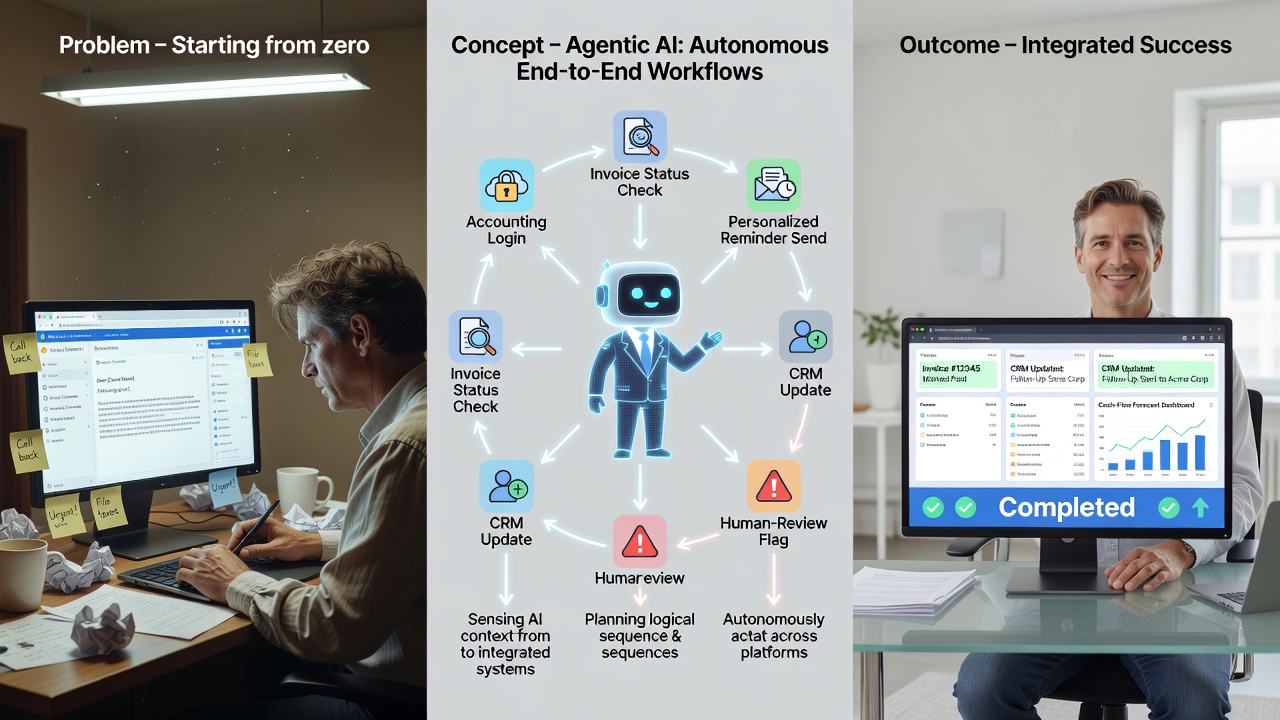
Picture this: Your artificial intelligence does not just suggest a follow-up email to a late-paying client. It logs into your accounting software, checks the invoice status, sends a personalized reminder, updates the CRM, and even flags the account for a human review only if the payment still does not arrive. This is no longer science fiction. It is the reality of agentic artificial intelligence, the next evolution that turns suggestions into completed work. Multiple recent analyses, including coverage in Entrepreneur on August 21 and 28, highlight how artificial intelligence has progressed from drafting copy to operating software, coordinating other agents, recovering customers, and finishing multi-step outcomes. Small and medium businesses (SMBs) are no longer waiting for large-scale digital transformations. They are wiring these agents directly into daily operations from day one, skipping the legacy processes that larger firms must untangle. This shift matters because SMB owners face the same pressures as enterprises but with far fewer resources. Tools that forecast cash, qualify leads, chase invoices, and run campaigns deliver immediate impact without requiring a 70-person team to manage them. The result is leaner operations, faster decisions, and measurable outcomes measured in task completion rather than conversation volume. For a typical 8-employee retail SMB struggling with cash flow visibility, deploying cash forecasting artificial intelligence can reduce manual spreadsheet work by 75 percent within the first month while surfacing risks two weeks earlier than traditional methods.
A skeptical owner might ask whether such systems create more problems than they solve, especially around errors in automated communications. Implementation begins with connecting the agent to QuickBooks or Xero via secure API, defining escalation rules for payments over 60 days, and running a two-week pilot on 20 invoices. In one documented case, this setup recovered 85 percent of overdue amounts within the first cycle while saving 12 staff hours weekly, directly addressing concerns by maintaining human sign-off on any message exceeding a preset dollar threshold.
The Transition from Generative to Agentic artificial intelligence
Early generative artificial intelligence excelled at creating text, images, and code based on prompts. That phase delivered impressive drafts but still required humans to execute the next steps. Agentic artificial intelligence changes the equation by sensing context, planning sequences, acting across applications, learning from results, and looping back when needed. Instead of stopping at a suggested invoice reminder, an agentic system detects overdue accounts, routes the right message through the correct channel, updates ledgers automatically, and escalates only when guardrails require human judgment. This moves artificial intelligence from “suggest” to “complete,” as described in analyses of the shift from generative tools to autonomous execution. The practical difference shows up in daily SMB life. A generative tool might write a campaign brief. An agentic system builds the campaign, pulls audience data from your CRM, launches the ads, monitors performance, and reallocates budget based on real-time results. The same pattern applies to finance, sales, and operations. Consider a local accounting firm with 12 staff members: autonomous workflows allow an artificial intelligence agent to handle month-end reconciliations across three software platforms overnight, freeing two full-time equivalents for advisory services that increase revenue by 22 percent.
Owners often worry that moving beyond generative tools requires technical expertise they lack. The transition starts with selecting pre-built connectors for existing tools like HubSpot or FreshBooks, then configuring decision trees for common scenarios such as low-balance alerts. A 15-person wholesale distributor implemented this by mapping their invoice workflow in an afternoon, resulting in 40 hours reclaimed monthly and a 15 percent drop in days-sales-outstanding, proving the shift is accessible without hiring developers.
SMB Adoption from Day One
Solopreneurs and small teams hold a unique advantage. They can embed agents into core processes without retrofitting decades-old systems. Pre-built workspaces now connect directly to a company’s own data for payroll planning, month-end close, CRM hygiene, and growth campaigns. One founder quoted in recent coverage noted that wiring agents into existing databases represents the highest-ROI artificial intelligence move a small team can make right now. Rather than purchasing another seat on a bloated platform, SMBs build custom workspaces that avoid the chatbot trap and deliver faster returns. This approach contrasts sharply with enterprise rollouts. Large organizations often bolt copilots onto 70-person processes. Smaller firms start with one agent handling invoice chasing and expand from there. The result is native automation that scales with the business instead of fighting against it. A concrete example is a 5-person e-commerce store that implemented artificial intelligence agents for small business to qualify leads from their website form. Within six weeks the system converted 38 percent more inquiries into paying customers by autonomously scoring, routing, and following up without any manual intervention.
Skeptics frequently cite integration friction as a barrier. In practice, adoption begins with a single data source audit, followed by testing the agent on a narrow slice such as new-form submissions only. The same e-commerce store measured success through a simple dashboard tracking qualified leads per week, achieving payback in 22 days and expanding to inventory alerts without disrupting daily operations.
Enterprise Orchestration and Agent Coordination
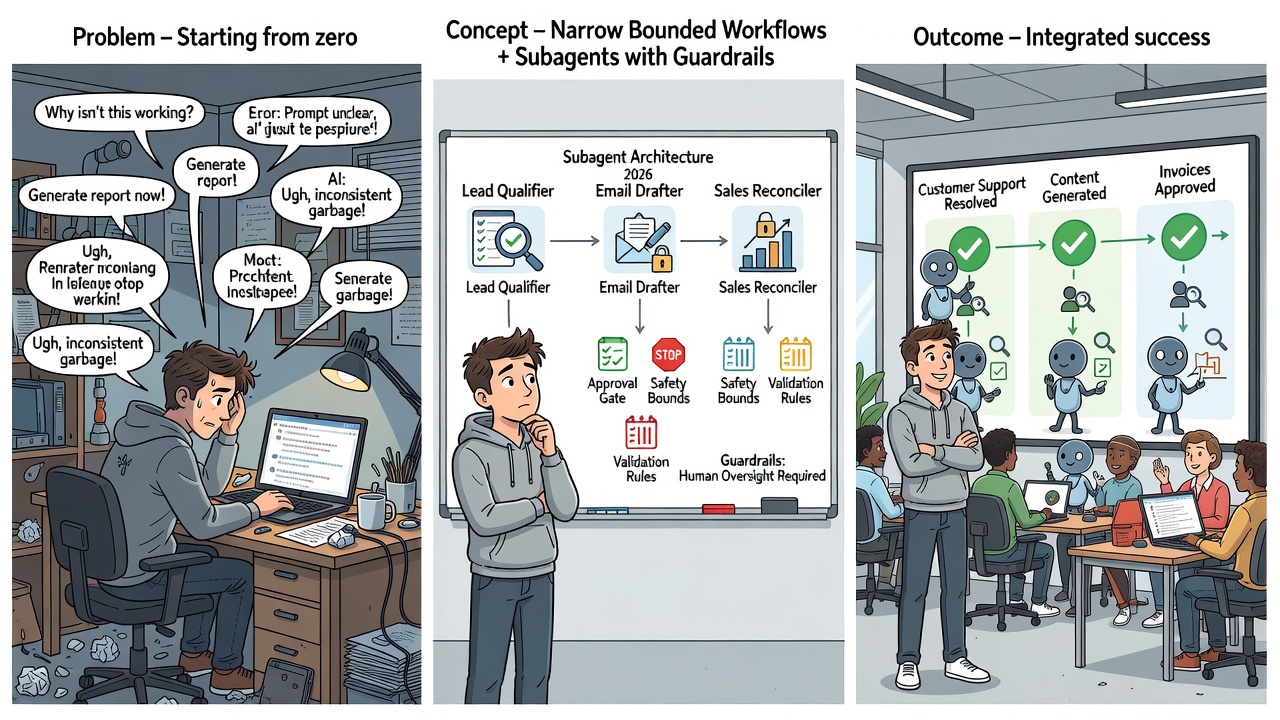
Larger organizations are evolving copilots into coworkers that manage entire workflows. Success metrics have shifted from usage statistics and speed to outcome-based KPIs such as task completion rates and unit economics. Agent coordination allows one system to hand off tasks to another. For example, a lead-qualification agent passes qualified prospects to a campaign agent, which then triggers follow-up sequences. When an issue arises, such as a shipment delay, the system can reroute logistics and notify the customer without waiting for manual intervention. This orchestration layer is becoming the battleground for control in enterprise software. SMBs benefit indirectly because many of the same underlying capabilities are now available through affordable, pre-configured plugins designed for smaller teams. An HVAC company with nine technicians uses coordinated agents to schedule jobs, order parts, and update customers automatically, cutting administrative time by half and improving on-time completion rates to 94 percent.
A common objection is loss of control when multiple agents interact. Mitigation involves setting explicit handoff protocols and logging every decision for review. The HVAC firm began with two agents only, monitored outputs for 30 days, then added a third once error rates fell below 2 percent, demonstrating controlled scaling that preserves oversight.
Technical Benchmarks and Real-World Execution
Reliable software operation has reached production-ready levels. Browser-control agents scored 99.19 percent on the WebVoyager benchmark across 643 live-web tasks spanning 15 real websites in June 2026. This milestone signals that agents can now navigate complex interfaces with minimal errors. Agentic ERP systems similarly detect issues and act inside defined guardrails, whether adjusting inventory levels or triggering customer recovery sequences. These capabilities underpin practical SMB use cases such as automated cash forecasting and payroll planning that reduce manual finance work by 60 to 80 percent. Quotes from the field reinforce the momentum: “Agents crossed 99 percent this year. Here is where the paying work goes next.” The technology is no longer experimental; it is ready for day-to-day execution. A landscaping business with six employees integrated cash forecasting artificial intelligence to predict weekly cash needs with 92 percent accuracy, avoiding two potential shortfalls in the first quarter alone.
Owners question benchmark relevance to their own tools. Validation occurs through sandbox testing against company-specific data before live deployment. The landscaping company ran parallel forecasts for one month, confirming the agent’s predictions matched manual results 92 percent of the time, which built internal confidence and justified full rollout.
Practical Examples for SMB Owners
Start with one repetitive workflow. Map an invoice-chasing process in n8n this week, connect it to your primary data source, and let the agent handle the first three steps automatically. Track completion rates rather than message volume. Use verified small-business plugins for cash forecasting and weekly briefs. These tools pull from your accounting data, surface risks early, and suggest actions that the agent can execute within preset limits. Replace generic chatbots with outcome-focused agents. Instead of counting conversations, measure how many leads move from inquiry to qualified status or how many overdue invoices reach resolution. Build custom workspaces around existing databases rather than adding another subscription. This avoids the chatbot trap and keeps data control inside your environment. Pilot agentic ERP modules for inventory or customer recovery. Test autonomous rerouting on a small subset of orders before expanding. The guardrails built into these systems ensure human oversight remains available when needed. Another SMB example: a boutique marketing agency automated lead qualification tools to score and nurture 200 prospects weekly, resulting in a 31 percent increase in closed deals without hiring additional staff.
Concerned owners often raise data-privacy issues during pilots. Addressing this starts with choosing platforms offering SOC-2 compliance and role-based access, then limiting the agent to read-only permissions initially. The marketing agency followed this sequence, completing a privacy audit before activation and documenting a 28 percent reduction in manual follow-up time within the first quarter.
Challenges and Guardrails
While the opportunities are significant, successful adoption requires clear boundaries. Define what the agent can change without approval and what must escalate. Monitor task completion rates weekly and adjust rules based on outcomes. Data quality remains critical. Agents perform best when connected to clean, structured sources. SMBs should audit key databases before full deployment. Security and compliance also matter. Choose platforms with transparent audit logs so every action is traceable. This builds trust with both customers and regulators. Implementation detail for a 15-employee manufacturer includes weekly review meetings where the finance team validates agent-driven invoice actions and refines escalation thresholds, maintaining 100 percent audit compliance.
A frequent pushback centers on upfront setup time. In reality, the manufacturer allocated four hours to rule definition and two hours to training, after which the system ran independently, freeing 18 hours weekly and yielding a positive ROI within three weeks while satisfying all compliance checks.
The Future of Agentic artificial intelligence in Business
As benchmarks continue to improve and coordination between agents matures, the line between human and digital coworkers will blur further. SMBs that embed these systems early will accumulate compounding advantages in speed and cost structure. The shift is not about replacing people but about freeing them from repetitive execution so they can focus on strategy and relationships. The organizations that treat agents as extensions of their team rather than add-on tools will lead their markets. Over the next 18 months, expect autonomous workflows to handle 40-60 percent of routine SMB finance and sales tasks, delivering measurable ROI within 30 days of deployment.
Skeptics may fear rapid obsolescence of current setups. Future-proofing involves selecting modular platforms that allow incremental additions, such as starting with finance agents and later layering sales coordination, ensuring the initial investment continues delivering value as capabilities evolve.
Conclusion
Agentic artificial intelligence represents a decisive move from answers to completed work. SMBs now have the chance to embed autonomous agents into cash forecasting, lead qualification, invoice chasing, and campaign execution from the very beginning. With benchmarks exceeding 99 percent reliability and practical plugins readily available, the barrier to entry has never been lower. Start small, measure outcomes, and scale what works. The businesses that act today will operate with leaner teams and stronger results tomorrow. The era of agents that finish the job is here.
Sources
- https://www.intelligenthq.com/from-generative-to-agentic-the-next-phase-of-business-ai/
- https://www.zygobit.com/blogs/agentic-ai-in-2026-what-it-is-how-it-works-and-where-it-delivers-real-value
- https://www.elsner.com/agentic-ai-explained-business-operations/
- https://hustlerslibrary.com/ai-tools-are-now-running-entire-businesses-heres-what-that-means-for-you/
- https://roo360.com/articles/the-agentic-ai-revolution-why-smb-founders-must-build-custom/
- https://claude.com/plugins/small-business
- https://www.techmahindra.com/insights/views/the-autonomous-enterprise/
- https://deeptechtimes.com/2026/08/27/the-agentic-ai-battleground-who-will-control-the-enterprise-orchestration-layer/
- https://dev.to/markfulton/agents-crossed-99-this-year-here-is-where-the-paying-work-goes-next-29a1
- https://thetechtrends.tech/agentic-erp/