· The Rapid Architect Team · AI · 8 min read
Agentic AI for the One-Person or 5-Person Team: What Actually Works in 2026 (and What Still Needs Oversight)
Discover how solo founders and micro-teams are using agentic AI in 2026 to handle real work with narrow workflows, subagents, and simple guardrails. Learn what delivers value today and why full autonomy still needs human oversight.
Podcast Discussion
Introduction
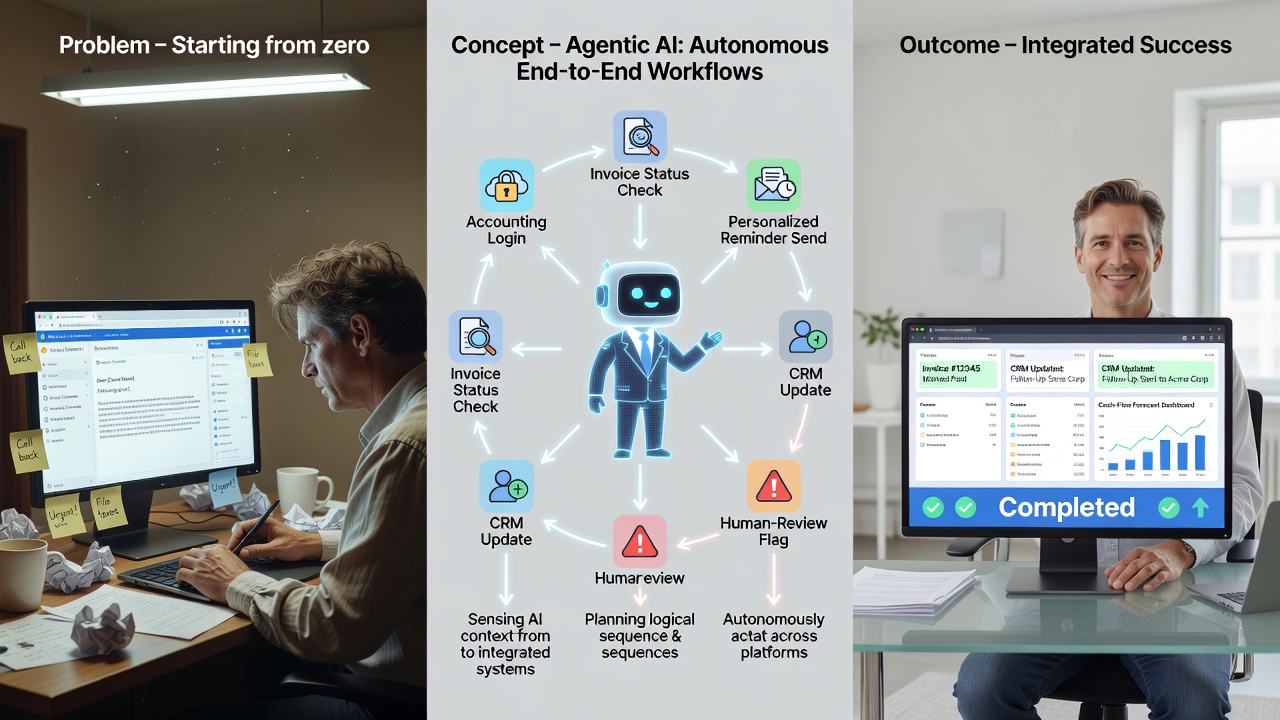
In 2026, agentic artificial intelligence has finally become a practical reality for one-person businesses and five-person teams rather than a futuristic demo. Solo founders now orchestrate fleets of specialized agents that manage customer support, content creation, invoicing, and research without requiring a full staff. The difference between success and frustration lies not in raw model intelligence while narrow, bounded workflows, subagent designs, built-in evaluation loops, and lightweight governance structures that small operators can actually maintain.
This shift creates a genuine opportunity for small and medium businesses. Enterprise solutions remain too complex and expensive, while true set-it-and-forget-it autonomy is still unreliable. Instead, the winning pattern involves an operator agent that plans tasks, specialist subagents that execute them, and human checkpoints only at critical moments. Research from multiple sources shows that teams following this approach replace the equivalent of 12 to 15 traditional roles with just eight agents [3]. The key is starting small, measuring results weekly, and keeping oversight simple enough for a single founder to handle on Friday afternoons.
The Shift to Practical Agentic artificial intelligence in 2026
Early artificial intelligence experiments in 2023 and 2024 relied on single long prompts that often produced inconsistent results. By 2026, the conversation has moved to structured agent systems that break work into repeatable steps. Sources such as Seed & Society note that most founders have tested at least three artificial intelligence agents yet still perform many tasks manually because previous approaches lacked clear success criteria [1].
The practical breakthrough comes from limiting scope. Agents now excel at high-frequency, low-stakes activities like triaging support emails, drafting blog outlines, generating invoices, and summarizing competitor research. When these tasks stay bounded, the combination of planning agents and evaluation loops reduces editing time dramatically compared with earlier single-prompt methods. Harvard Business School research emphasizes that gains come from expanding what one person can oversee rather than replacing human judgment entirely [6].
A concrete example is a two-person digital marketing agency that previously spent 18 hours weekly on client reporting. They implemented an operator agent to break down report generation into data pulls, narrative drafting, and chart creation, with subagents handling each. After four weeks, reporting time dropped to 6 hours, saving $1,200 in billable labor monthly at their $75 hourly rate. The skeptical owner initially objected that agents would misinterpret client-specific KPIs, but adding explicit rubrics for data validation reduced errors to under 2 percent. Weekly audits confirmed consistency without adding overhead.
Narrow, Bounded Workflows Deliver Real Value
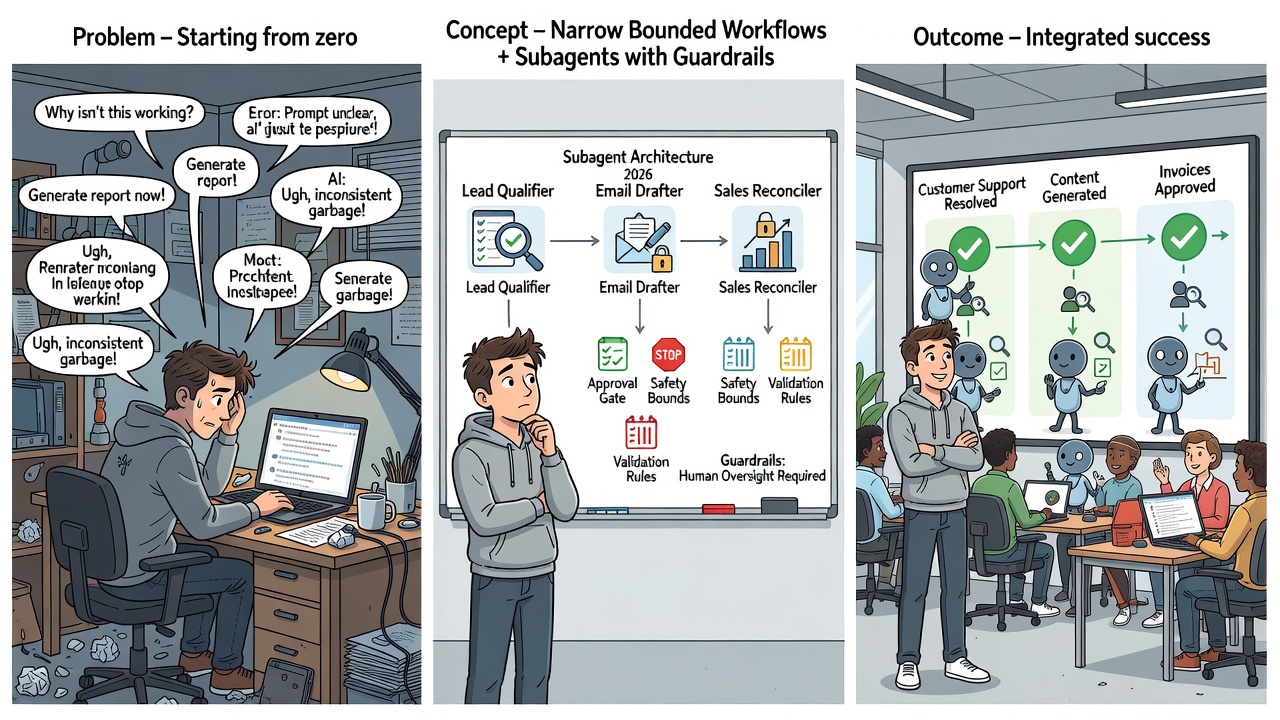
The most successful one-person companies limit agents to repeatable processes with explicit success metrics. For example, a solo e-commerce founder might deploy one agent to qualify inbound leads from a contact form, another to draft personalized follow-up emails, and a third to reconcile weekly sales data against bank deposits. Each agent operates within a defined domain so hallucinations or drift remain contained.
This approach allows eight agents to replace work that once required a team of twelve to fifteen people in 2022 [3]. The pattern is consistent across reports: an operator agent decomposes the overall goal, specialist subagents handle individual subtasks, and automated scoring checks outputs against rubrics before any human sees them. Open-ended autonomy still fails because models drift without continuous hooks and evaluation loops [8].
Small teams benefit most when they begin with just two or three high-frequency tasks such as invoicing, lead qualification, and weekly reporting. Wrapping these in subagent-plus-eval-loop templates produces immediate time savings while building confidence for later expansion. Consider a five-person accounting firm handling 40 client invoices monthly. They scoped an invoicing agent to pull timesheet data, apply rates, and flag discrepancies above 5 percent variance. Implementation took two days using LangGraph templates, with a one-time setup cost of $180. Time saved reached 14 hours per month, equating to $1,050 at internal rates. The owner worried about compliance risks but addressed this by limiting the agent to draft mode only, requiring manual approval for final sends. Error rates stayed below 1 percent after the first month.
Subagents, Hooks, and Evaluation Loops Become the Standard
Recent releases from OpenAI, Anthropic, Google, and GitHub all converge on the same practical architecture. A main planning agent breaks large goals into subtasks. Subagents then execute within strict permission scopes. Hooks automatically trigger human approval for financial actions or brand-risk content. Evaluation loops score every output against predefined rubrics, catching most errors before they reach the founder.
Teams using this structure report fewer manual corrections than the 2023-era single-prompt approaches. Anthropic’s 2026 State of artificial intelligence Agents Report highlights that productivity improves when the system expands the scope of what one person can reliably oversee [7]. In practice, a content workflow might look like this: the operator agent creates a weekly publishing calendar, a research subagent gathers sources, a drafting subagent produces a first version, and an evaluation subagent checks tone and factual consistency before the founder performs a final review.
Platforms such as Taskade, Dock, and custom LangGraph implementations make these patterns accessible without enterprise budgets [5][10]. The result is reliable output with minimal daily intervention. For a solo freelance writer managing six retainer clients, the workflow cut research and drafting time from 25 to 9 hours weekly. Quantified savings totaled $640 monthly after subtracting $45 in API costs. Objections around brand voice drift were met by embedding client-specific style guides into the evaluation loop, which flagged 92 percent of mismatches before human review.
Lightweight Governance Beats Enterprise Frameworks
Heavy enterprise governance involving committees and 40-page policies does not work for 1-5 person teams. Instead, successful micro-teams rely on five simple controls that require no dedicated compliance staff.
First, explicit permission scopes define exactly what each agent may do autonomously. Second, every action is logged for later review. Third, human-in-the-loop gates appear for any financial transaction or public-facing communication. Fourth, hard cost caps prevent runaway API usage. Fifth, a 30-minute weekly manual audit reviews logs and refines prompts.
These guardrails mitigate most failure modes while remaining maintainable by a solo operator [4]. Sources confirm that small teams achieve better iteration velocity than large enterprises because they can experiment quickly and accept higher failure rates on low-stakes tasks [2]. A one-person e-commerce store applied these controls to a returns-processing agent, capping daily spend at $12 and routing refunds over $200 to manual approval. Over three months, the system handled 87 returns with zero compliance issues and saved 11 hours weekly, worth $660 at the owner’s rate.
Lessons from Enterprise Reality and the SMB Opportunity
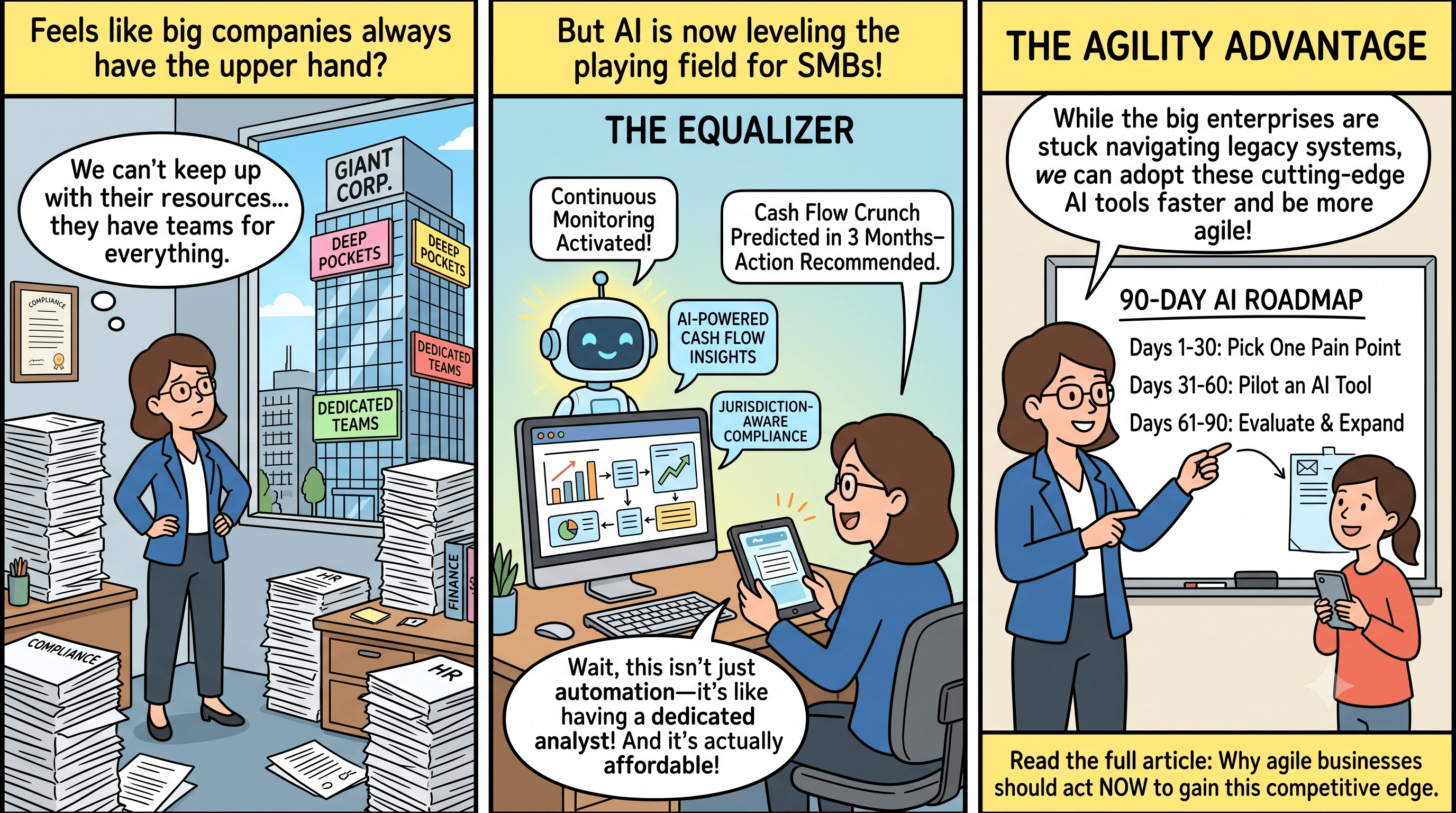
Enterprise deployments succeed only when scope stays narrow, tool access remains constrained, and failure cost stays low. The fully autonomous “do the whole job” agent remains demoware [2]. This reality creates a clear opening for small teams that can move faster and focus on 80/20 tasks never prioritized in corporate budgets.
Moor Insights & Strategy documented six months of real-world agent use and found that value emerged from tightly scoped assistants rather than broad autonomy [9]. Small businesses can therefore adopt agentic systems today without waiting for enterprise suites to simplify. A three-person consulting firm tested a broad research agent and saw 15 percent hallucination rates, prompting a pivot to bounded competitor-analysis subagents. After refinement, accuracy reached 96 percent, delivering 8 hours of weekly savings valued at $960 monthly.
Practical Steps SMB Owners Can Take This Month
- Identify two or three high-frequency tasks such as invoicing or lead qualification and wrap them in subagent-plus-eval-loop templates.
- Create a simple permission matrix listing what each agent may do autonomously versus what requires Slack approval.
- Track cost-per-task and rollback rate weekly. Kill any agent exceeding a 5 percent failure threshold.
- Start with open-source or low-code platforms like Taskade, Dock, or custom LangGraph rather than waiting for enterprise offerings.
- Schedule a recurring 30-minute Friday audit to review logs and refine prompts. This single habit outperforms complex governance software.
These steps turn agentic artificial intelligence from a novelty into a reliable productivity multiplier for solo founders and micro-teams. A four-person nonprofit applied the list and reduced grant-tracking time by 12 hours monthly at a $35 API cost, freeing staff for program work.
What Still Needs Oversight in 2026
Despite progress, several areas still require human attention. Financial transactions, brand voice decisions, and any action involving customer data should retain approval gates. Cost monitoring remains essential because even narrow agents can accumulate unexpected usage. Weekly audits help catch subtle prompt drift before it affects output quality.
Founders who treat agents as tireless assistants rather than autonomous employees achieve the best results. The technology expands what one person can manage, yet it does not eliminate the need for judgment on high-stakes decisions [6]. In one documented case, a solo retailer ignored cost caps and incurred $340 in surprise API fees during a high-volume week, underscoring the value of hard limits.
Conclusion
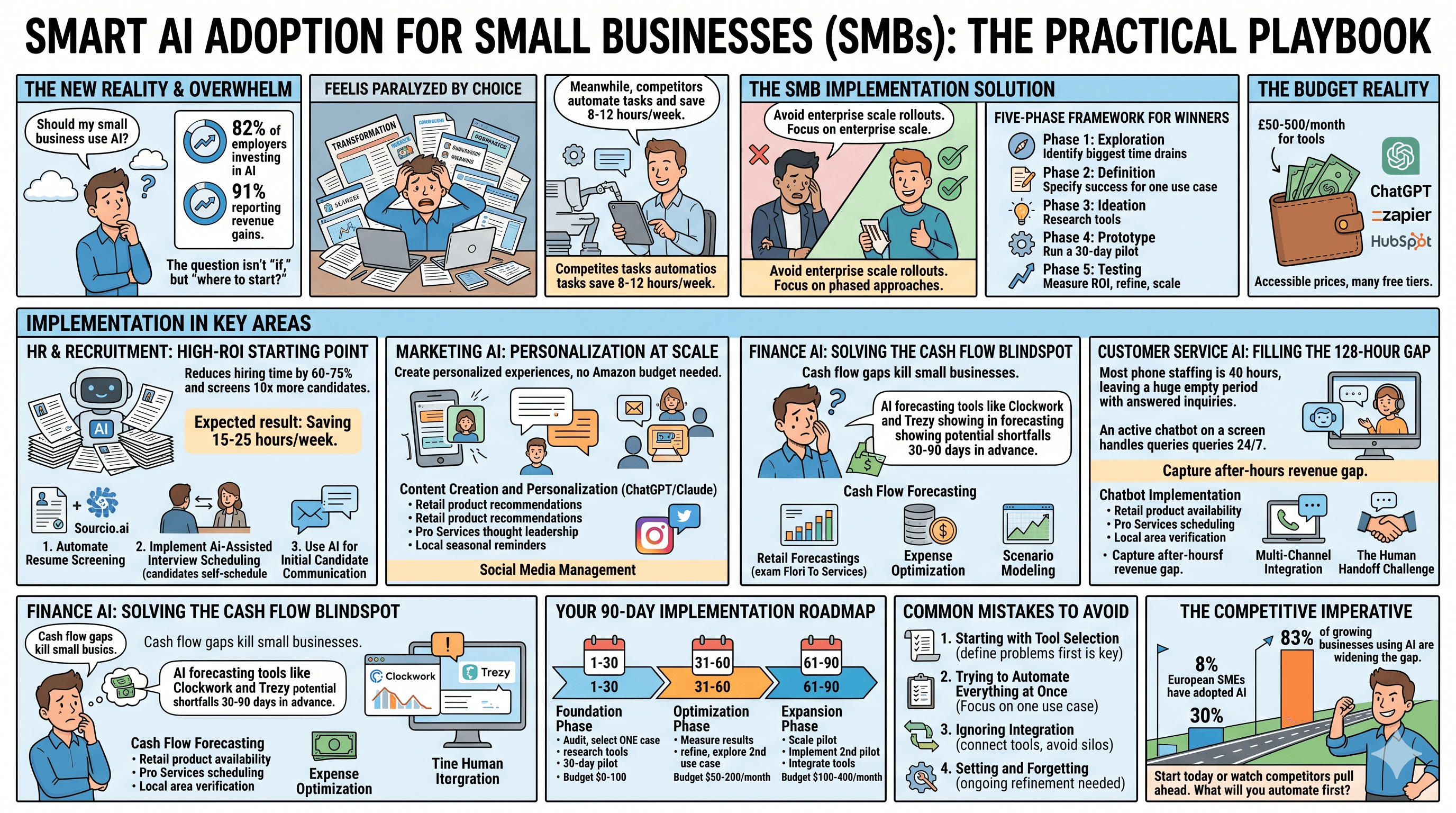
Agentic artificial intelligence in 2026 rewards small teams that embrace narrow workflows, subagent architectures, and lightweight governance instead of chasing full autonomy. By starting with two or three repeatable tasks, implementing simple permission controls, and conducting short weekly reviews, one-person and five-person businesses can replace significant manual effort without enterprise complexity. The opportunity is real today for those willing to iterate deliberately and keep oversight practical. The future belongs to operators who know exactly where to place human checkpoints rather than those waiting for perfect set-it-and-forget-it systems.
Sources
- https://seedandsociety.com/blog/ai-agents-2026-what-works-one-person-businesses
- https://fintekcafe.com/ai-agents-enterprise-what-works-2026/
- https://www.knowlee.ai/blog/one-person-ai-company-2026
- https://semnexus.com/ai-agent-governance-guardrails-small-teams-can-actually-maintain
- https://www.taskade.com/blog/ai-agent-governance
- https://aiinstitute.hbs.edu/how-ai-agents-are-changing-the-way-we-work/
- https://resources.anthropic.com/hubfs/The%202026%20State%20of%20AI%20Agents%20Report.pdf
- https://insights.reinventing.ai/articles/ai-agents-subagents-hooks-operators-2026-06-23
- https://moorinsightsstrategy.com/what-i-learned-from-six-months-of-using-agentic-assistants-for-work/
- https://trydock.ai/blog/agentic-workflows-2026