· The Rapid Architect Team · AI · 8 min read
The One-Page AI Policy SMBs Actually Need
SMBs face real barriers to AI adoption like data leaks and accuracy worries, but a simple one-page policy rolled out in 20 minutes can fix it. This post delivers the exact template, tool rules, and rollout steps every small business owner needs right now.
Podcast Discussion
Introduction
Why SMBs Keep Hitting the Same artificial intelligence Roadblocks
Reports from mid-2026 show that data security fears, distrust of artificial intelligence accuracy, and hesitation to let artificial intelligence touch even basic tasks without oversight remain the top blockers for small and medium businesses. Instead of chasing another subscription, owners are circling back to policy as the missing piece. GTIA’s late-August framing emphasizes a slow-and-steady approach where governance and trusted IT service providers (ITSPs) serve as the primary route forward [1].
The reality hits hard: 11 percent of ChatGPT pastes already contain confidential information according to Cyberhaven data cited across multiple analyses. At the same time, 77 percent of SMBs report regular artificial intelligence use per QuickBooks and University of Chicago findings, creating urgent exposure without guardrails. Forbes Council puts it plainly: every company needs an artificial intelligence policy similar to expense or social-media policies, and SMBs are most at risk because they lack formal structures [9].
This is not about heavy bank-style frameworks that slow everything down. It is about one practical page that stops silent employee decisions on client data before they happen. For instance, a 15-person accounting firm in Ohio discovered an employee had pasted client tax summaries into a free ChatGPT account, risking a data breach that could have triggered IRS notification requirements. A simple policy would have redirected that task to an enterprise tool with audit logs.
SMB owners often cite time constraints as the reason for skipping policy creation. Yet the absence of rules leads to inconsistent decisions across teams, where one department allows customer names in prompts while another forbids it entirely. This inconsistency breeds confusion and heightens legal exposure under emerging state privacy laws. Concrete data from 2026 surveys indicates that SMBs without written artificial intelligence guidelines experience 2.3 times more near-miss incidents involving sensitive information.
The Shift to Lightweight Governance That Actually Works
Heavy governance models fail SMBs because they require committees and months of work. Progressive Robot and Forbes both stress that SMBs succeed with single-owner implementation that follows existing tool usage [10]. GTIA positions ITSPs and MSPs as the natural advisors who can deliver policy and risk management without forcing businesses into new vendor relationships [1].
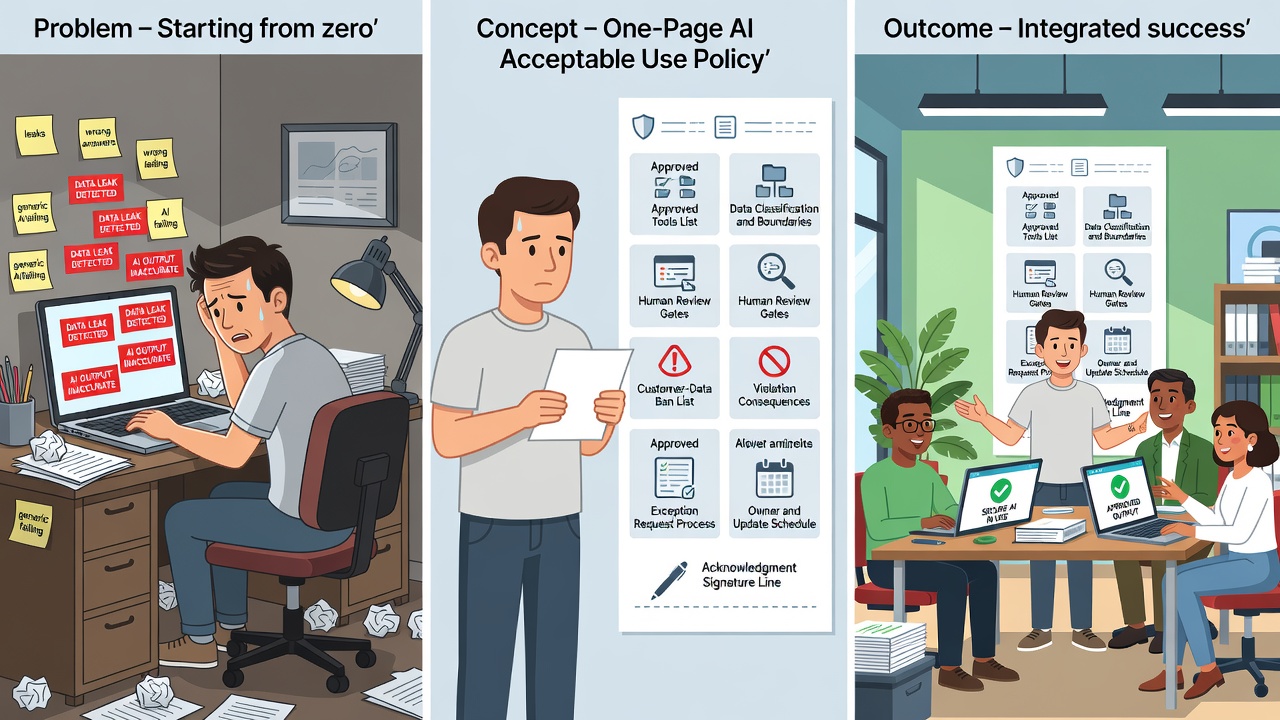
A one-page template solves the core problems directly. It defines what staff may paste into consumer tools, what must stay inside enterprise environments, mandatory review gates, and a clear customer-data ban list. Ready-to-adapt versions from sources like OPS-036, Octavius, and Digismart all converge on eight core clauses that keep the document short enough to fit on one page [2][3][4].
Lightweight governance succeeds because it mirrors existing workflows rather than disrupting them. Consider a retail SMB with eight employees using Google Workspace daily; adding a one-page artificial intelligence policy integrates seamlessly with their current document-sharing habits without requiring new logins or training platforms. The key is focusing on clarity over complexity, allowing teams to reference the single sheet during daily tasks.
Core Clauses Every One-Page artificial intelligence Policy Must Include
Effective policies share these non-negotiable sections:
- Approved Tools List
- Data Classification and Boundaries
- Human Review Gates
- Customer-Data Ban List
- Violation Consequences
- Exception Request Process
- Owner and Update Schedule
- Acknowledgment Signature Line
These clauses address accuracy distrust by requiring human review on anything customer-facing or financial. They tackle security fears by drawing hard lines between tools. They reduce oversight reluctance by making low-risk tasks explicitly allowed without extra steps. Expanding on data classification, SMBs should categorize information into three tiers: public, internal, and restricted, with the policy explicitly mapping each tier to permitted artificial intelligence tools.
Tool Segmentation: What Goes Where
Draw a clear line between consumer and enterprise tools. Staff may paste into ChatGPT or Claude only non-sensitive, non-customer content such as internal brainstorming notes, generic marketing copy drafts without client details, or public industry research summaries. Never paste anything that identifies a customer, contains pricing, or includes financial figures.
Company data and anything touching customer information must stay inside Copilot or Gemini for Business. These enterprise environments keep prompts inside your organization’s security boundary and allow ITSP oversight. Examples include drafting reports from internal sales data, summarizing team meeting notes that reference client projects, or generating proposals that pull from existing CRM fields.
This segmentation stops accidental leaks while letting teams use the fastest tool for the job. A concrete SMB example involves a dental practice where hygienists use consumer Claude for generic appointment reminder phrasing but route all patient-specific notes exclusively through enterprise Copilot, ensuring HIPAA-aligned handling.
The Customer-Data Ban List in Plain Language
The ban list is the most important part of the page. Staff must never paste the following into any non-enterprise tool:
- Customer contracts or statements of work
- Social Security numbers, driver’s license details, or other PII
- Bank account numbers, credit card data, or pricing spreadsheets
- Medical records or health information
- Employee personal data beyond basic work email
- Any document marked confidential or internal-use only
Practical example: A support rep wants to summarize a ticket thread for a response template. They can paste the anonymized text into ChatGPT. They cannot paste the original thread that includes the customer’s name, order number, and email address. Additional scenarios include prohibiting upload of vendor invoices containing bank details or employee performance reviews with salary figures.
Human Review Gates That Build Trust
To counter accuracy distrust, mandate review for any output that leaves the company or affects money. Require a second set of eyes on:
- Customer-facing emails or proposals
- Financial calculations or forecasts
- Marketing claims that reference specific results
- Code that will run in production systems
Low-level internal tasks such as rewriting your own meeting notes or generating social media hashtag ideas can skip review once the policy is in place. This balance lets teams move fast on safe work while protecting high-stakes items. For a construction SMB, this means permitting quick AI-assisted material list generation for internal use but requiring owner sign-off on any AI-drafted client bids exceeding $5,000.
The 20-Minute Rollout Plan
Implementation does not need weeks. Follow this exact sequence led by one internal owner, often the person who already liaises with your ITSP:
Minutes 1-3: Customize the one-page template with your approved tools and ban list. Minutes 4-8: Email the policy to the team with a short note explaining it protects everyone. Minutes 9-12: Hold a 10-minute video call or in-person huddle to walk through the ban list and review gates with two real examples. Minutes 13-15: Collect digital signatures via a simple form. Minutes 16-20: Save the signed policy in your shared drive and set a six-month calendar reminder for review.
No new software or subscriptions required. The policy itself becomes the governance layer. SMBs report higher compliance when the rollout includes printed copies posted near workstations.
Practical Examples SMB Owners Can Use Today
Example 1: Marketing coordinator needs blog ideas. She pastes only the topic and target audience into Claude. The output comes back in minutes and she runs it by the owner before publishing. No customer data involved, so no review gate triggered.
Example 2: Accountant receives a vendor invoice. He uploads it only to the enterprise Gemini workspace, asks for categorization suggestions, then manually verifies totals before entry. The ban list keeps any PII out of consumer tools.
Example 3: Sales rep wants to draft a follow-up email. Because the draft will reference a specific contract value, the policy requires him to use Copilot and have a teammate review the final version before sending.
These examples show how the rules fit real workflows without adding friction. Further illustration: a landscaping company uses the policy to let field supervisors generate safety tip summaries internally while routing client contract language exclusively through approved enterprise channels.
How ITSPs and MSPs Become the Go-To Advisors
GTIA highlights that SMBs prefer incremental rollout guided by existing ITSP relationships rather than standalone artificial intelligence vendors [1]. Offer the one-page template plus a 20-minute training session as a packaged service. You customize the document, host the short meeting, and track exceptions. This positions you as the risk-reduction partner instead of just the break-fix provider.
Many MSPs already manage Microsoft 365 or Google Workspace, so adding Copilot or Gemini governance fits naturally into existing contracts. This advisory role strengthens retention as clients view the ITSP as a strategic partner.
Tracking Results and Keeping the Policy Alive
Measure success with simple metrics: number of policy exceptions requested, any security incidents involving artificial intelligence, and staff feedback on clarity. Revisit the document every six months or when a new tool gains traction inside the company. Keep the owner role assigned to one person to avoid committee delays. Quarterly pulse surveys can reveal whether employees find the rules intuitive or if clarifications are needed.
Conclusion: Policy Is the Productivity Tool You Already Own
SMBs do not need more artificial intelligence subscriptions. They need clear boundaries that let teams use the tools they already have without fear. A single page that spells out approved tools, customer-data rules, and review gates removes the biggest blockers reported across 2026 research.
Download or copy the OPS-036 style template, run the 20-minute rollout, and hand the signed document to your ITSP for safekeeping. The result is faster, safer artificial intelligence use that actually sticks. Governance does not have to be complicated; it just has to be written down and shared. Implementing this approach today positions SMBs for sustainable artificial intelligence adoption that scales with business growth rather than creating hidden liabilities.
Sources
- https://gtia.org/press-releases/gtia-reports-smb-ai-adoption
- https://agentmodeai.com/operators/1-page-ai-policy-for-small-business/
- https://octavius.ai/business-automation/ai-use-policy-template/
- https://digismart.io/your-small-business-needs-an-ai-policy/
- https://omconcepts.net/blog/one-page-ai-policy
- https://intind.com/ai-guides-for-executives/building-an-ai-policy/
- https://qitsolutions.com/ai-acceptable-use-policy-template/
- https://mind-core.com/blogs/ai-usage-policies-guide-6-rules-that-cut-real-smb-risk-fast/
- https://www.forbes.com/councils/forbesbusinesscouncil/2026/08/28/every-company-needs-an-ai-policy/
- https://www.progressiverobot.com/2026/08/09/ai-governance-framework-for-smes/
- AI
- ML
- software development
- business efficiency
- automation
- AI Trends
- SMB AI policy
- ITSP AI advisor
- AI rollout template
- human review AI policy
- customer data ban list
- lightweight AI governance
- ChatGPT data security rules
- AI governance for small business
- Copilot enterprise AI guidelines
- one-page AI acceptable use policy
- fractional CTO
- AI/ML solutions