· The Rapid Architect Team · AI · 9 min read
Don’t Hire Yet: The 90-Day AI-Before-Headcount Playbook
FreshBooks data shows 86 percent of solopreneurs try AI before hiring when tasks exceed solo capacity. This 90-day playbook shows SMB owners exactly which roles to automate, how to measure review time, and when a human hire actually becomes the cheaper option.
Podcast Discussion
Introduction
Don’t Hire Yet: The 90-Day AI-Before-Headcount Playbook
Small business owners are staring down a familiar fork in the road: tasks pile up, revenue inches past solo capacity, and the instinct to post a job ad kicks in. But a fresh survey from FreshBooks shows that 86 percent of solopreneurs and microbusiness owners are choosing a different path first. They are testing artificial intelligence tools before adding payroll. This number is both exciting and a little controversial. Owners love the idea of scaling without new salaries, while operators worry about quality slips, hidden review hours, and eventual burnout. The good news is that a structured 90-day experiment can give you clear data before you commit to a hire. This playbook walks through exactly which roles artificial intelligence can delay, when a human is still the cheaper option, and how to run the test without risking your client experience. The shift represents a fundamental change in how SMBs approach growth, allowing owners to test capacity increases with minimal financial risk while preserving cash flow for other priorities like marketing or product development.
Why the 86 Percent Figure Changes the Conversation
The FreshBooks data captures a real mindset shift among solopreneurs facing the classic growth ceiling. At roughly five thousand dollars in monthly recurring revenue, many founders hit the wall where repetitive work starts eating into growth activities. Instead of immediately hiring, they reach for artificial intelligence to absorb bookkeeping cleanup, first-line support, content drafts, and invoice chasing. The result is capacity without headcount costs, which appeals strongly to owners who have bootstrapped their businesses and want to maintain lean operations. Yet 70 percent of owners admit they lack formal artificial intelligence training and rely on free YouTube videos. That training gap creates the controversy: artificial intelligence output can look polished while hiding errors that require extra oversight, potentially leading to client dissatisfaction if not caught early. The 46 percent who now prefer artificial intelligence over a new hire for equal capability signals the trend is accelerating. Businesses that automate first are also four times more likely to hire later, but they hire for judgment roles rather than repetitive ones. This data point underscores why the 86 percent figure matters—it is not just a statistic but evidence that SMBs are prioritizing efficiency and strategic timing in their hiring decisions, especially in uncertain economic conditions where payroll commitments feel risky.
The 90-Day AI-Before-Headcount Framework
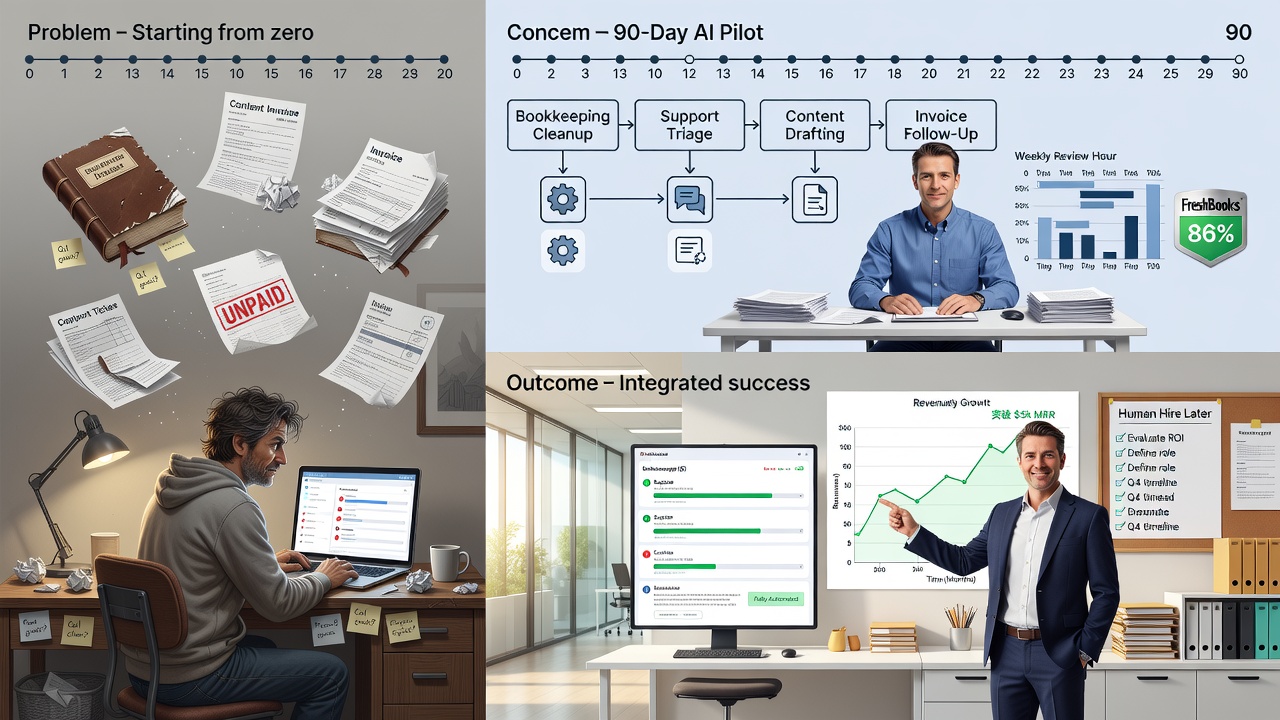
A successful test needs structure, not just random tool trials. Set a strict 90-day window with weekly review-hour tracking to maintain accountability. Choose four repeatable processes that already consume your time: bookkeeping cleanup, first-line support triage, content drafting, and invoice follow-up. Assign an artificial intelligence tool to each, document the time you spend reviewing output, and compare that cost against what a part-time hire would require in salary plus training. Break the 90 days into phases—weeks one through four for setup and initial testing, weeks five through eight for refinement and prompt optimization, and weeks nine through twelve for final measurement and decision-making. The goal is not to eliminate humans forever but to prove whether artificial intelligence can buy you 90 days of runway while revenue grows. If review time stays under 25 percent of total output, you have strong evidence to delay the hire. If it climbs higher, the data points you toward bringing in human help sooner. Track metrics such as hours saved, error rates, and customer response times in a simple spreadsheet to ensure the experiment yields actionable insights rather than anecdotal impressions.
Roles artificial intelligence Can Safely Delay Right Now
Certain tasks follow clear rules and produce measurable output, making them ideal for automation in SMB environments. Bookkeeping cleanup fits this category perfectly because tools can categorize transactions, flag duplicates, and generate basic reports in minutes, freeing owners to focus on revenue-generating activities. First-line support triage works well too: artificial intelligence can answer common questions about shipping times, password resets, or product specs while routing complex issues to you, improving response speed without constant availability. Content drafts save hours on blog outlines, social posts, and email sequences by generating initial versions that require only light editing. Invoice chasing benefits from automated reminders and polite follow-up sequences that feel personal but require zero daily effort. In each case the rules are consistent, the data is structured, and the downside of a minor error is low. Many owners report these four areas alone free up eight to twelve hours per week within the first month, allowing reinvestment into business development or personal time off to prevent burnout. Implementation involves starting with free tiers of tools like Zapier for workflows or ChatGPT for drafts, then scaling to paid versions only after proving value.
When Human Judgment Remains Cheaper Than Review Time
Not every task improves with artificial intelligence, particularly in areas where nuance and context drive outcomes. High-context decisions still cost more in oversight than they save in speed. HR conversations around performance or culture fit require nuance that current tools cannot replicate reliably, risking legal or morale issues. Strategic planning sessions that weigh market signals, cash-flow forecasts, and team dynamics benefit from lived experience and intuition developed over years. Complex client negotiations often hinge on reading tone and adjusting in real time, where missteps can lose deals. When review time exceeds 20 to 30 percent of artificial intelligence output, the math flips. You end up editing, fact-checking, and reworking so much that a trained human would have finished faster. The five-question test helps here: Is the task repetitive? Does it require real-time judgment? What is the fully loaded cost of artificial intelligence review versus a part-time hire? How quickly can quality reach acceptable levels? Would a mistake damage client trust? Answer these honestly each week and the decision becomes data-driven rather than emotional, protecting both your bottom line and reputation.
Quality, Training Gaps, and Burnout Risks
The biggest objection to the AI-first approach is quality drift that can erode customer loyalty over time. Owners who skip training often accept mediocre output because fixing it feels faster than learning a better prompt. That habit creates downstream problems and personal burnout from constant firefighting. Budget five to ten hours in month one for deliberate tool training rather than scattered YouTube sessions, focusing on prompt engineering techniques specific to your industry. Set a hard threshold: if you are spending more than two hours reviewing a single AI-generated deliverable, pause and reassess the tool or process. Many founders also schedule a weekly “human audit” where they sample 10 percent of artificial intelligence work and score it against client standards. This prevents small errors from compounding while still keeping overall review time low. The pattern among successful users is clear: treat artificial intelligence as a junior team member whose work needs light supervision, not a set-it-and-forget-it replacement, ensuring sustainable operations.
Practical SMB Examples That Show the Numbers
Consider a solo e-commerce store owner at six thousand dollars monthly revenue who automated first-line support with an artificial intelligence chatbot and invoice reminders with a simple workflow tool. After 90 days she logged 47 hours of review time against an estimated 120 hours a part-time hire would have required. Net savings exceeded three thousand dollars while response times improved from 24 hours to under four. Another example is a marketing consultant who used artificial intelligence for first-draft blog posts and social content. Review time started at 35 percent but dropped to 18 percent after two weeks of prompt refinement and template creation. She delayed her first hire by five months and used the extra runway to raise rates instead of scaling headcount. A third case involves a bookkeeping service provider who implemented artificial intelligence for transaction categorization across ten client accounts, saving nine hours weekly after initial setup and using the time to onboard two new clients. These cases illustrate that the 90-day test works best when owners track hours weekly and adjust prompts quickly rather than abandoning tools at the first imperfection, demonstrating repeatable results across different SMB niches.
Making the Decision With Your Own Data
At the end of 90 days, run the numbers one final time to inform your strategy. Calculate total artificial intelligence subscription costs plus your review hours valued at your effective hourly rate. Compare that figure to the fully loaded cost of a part-time hire including payroll taxes, benefits, and onboarding time. If artificial intelligence still wins on cost and quality, extend the experiment another 90 days while monitoring for diminishing returns. If the gap narrows or review time creeps above 25 percent, begin a targeted hiring process with a clear job description informed by the exact tasks artificial intelligence could not handle well. The outcome is rarely all-or-nothing. Most owners end up with a hybrid model: artificial intelligence handles volume, and the first human hire focuses on judgment and relationship work, creating a scalable foundation that supports future growth without unnecessary overhead.
Building Long-Term Capacity Without Sacrificing Quality
The 86 percent figure does not signal the end of hiring. It signals smarter hiring that aligns with business maturity stages. Companies that automate repetitive work first grow leaner, higher-value teams once revenue justifies payroll. They also report higher employee satisfaction because new hires step into roles that require creativity and client connection rather than data entry. The key is positioning artificial intelligence as a capacity bridge, not a permanent replacement. Communicate the experiment to clients so they understand response standards will remain high and any changes are improvements. Track both quantitative metrics like review hours and qualitative signals like customer satisfaction scores. When both stay strong, you have proof that the AI-before-headcount approach works for your specific business, fostering resilience and adaptability in competitive markets.
Conclusion
The FreshBooks survey gives every SMB owner permission to pause before posting a job ad. A disciplined 90-day test on bookkeeping, support, content, and invoicing delivers the data needed to decide with confidence. Roles that follow clear rules can be delayed safely while maintaining service levels. Tasks requiring real-time judgment or high-stakes nuance still favor humans once review time exceeds roughly one quarter of output. Owners who invest in training and track hours weekly avoid the quality and burnout traps that fuel controversy around the 86 percent trend. The result is not fewer jobs overall but better-timed hires that accelerate growth instead of simply keeping pace. Run your own 90-day experiment this quarter and let the numbers, not the headlines, guide your next move toward sustainable expansion.
Sources
- https://www.benzinga.com/pressreleases/26/09/g61787450/they-hire-86-solopreneurs-try-ai-first-freshbooks-survey-finds
- https://www.globenewswire.com/news-release/2026/09/15/3362093/0/en/before-they-hire-86-of-solopreneurs-try-ai-first-freshbooks-survey-finds.html
- https://www.selfemployed.com/news/freshbooks-solopreneur-ai-before-hiring-2026/
- https://aishortcutlab.com/articles/solo-founders/ai-strategy-and-planning/ai-tools-delay-first-hire-solo-founders-cost-comparison
- https://runframe.ai/blog/should-i-hire-or-automate-for-business-a-2026-strategy-guide/
- https://vikasmalpani.com/when-to-hire-vs-automate-solo-founders/
- https://smbscaler.com/posts/when-to-hire-a-human-vs-deploy-an-ai-system-in-a-growing-smb
- https://nohireneeded.com/ai-tool-statistics/
- https://aieranews.com/ai-for-small-business-hiring-training-gap-2026/
- https://quickbooks.intuit.com/r/manage-employees/ai-small-business-hiring/
- https://www.gnapartners.com/resources/articles/small-business-hiring-trends-2026