· The Rapid Architect Team · AI · 10 min read
Build Your Own or Buy Off-the-Shelf? How AI-Powered Custom Software Is Revolutionizing the SMB Tech Landscape in 2026
AI-powered coding tools have revolutionized custom software development, making it accessible and affordable for SMBs. Learn when to build custom solutions versus buying off-the-shelf SaaS, and how to leverage this shift for competitive advantage.

Podcast Discussion
Introduction
Introduction: The Software Dilemma Every SMB Owner Faces
You’ve been there before. You sign up for a promising SaaS platform, excited about streamlining your operations. Three months later, you’re wrestling with workarounds, paying for features you’ll never use, and forcing your team to adapt their workflows to fit the software—instead of the other way around.
For decades, small and medium businesses faced an uncomfortable choice: pay enterprise prices for custom software development or conform their unique processes to generic off-the-shelf solutions. The economics simply didn’t favor building custom tools when your competitor down the street could subscribe to the same SaaS for $99 per month.
But 2026 has fundamentally changed this equation. AI-powered coding tools have democratized custom software development, making it accessible and affordable for businesses of all sizes. According to Retool’s 2026 Build vs. Buy Report, 35% of enterprises have already replaced SaaS solutions with custom software, and 78% expect to build more custom internal tools this year [2]. This isn’t just an enterprise trend—it’s a seismic shift that’s empowering SMBs to compete on a level playing field.
The question is no longer whether you can build custom software. It’s whether you should—and increasingly, the answer is yes.
The Hidden Costs of Conforming to Off-the-Shelf Solutions
Before we explore the AI-powered alternative, let’s examine what you’re really paying when you subscribe to generic SaaS platforms.
The Subscription Trap
Those affordable monthly fees have a way of ballooning over time. As your business grows, so do your licensing costs. What started as a manageable expense can quickly become a significant line item—especially when you’re paying per user, per feature, or per transaction [7].
But the financial cost is just the beginning. The real expense lies in what economists call “opportunity cost”—the value of what you sacrifice by conforming your business to someone else’s vision of how work should be done.
Process Distortion
Every off-the-shelf solution embeds assumptions about how businesses operate. When those assumptions don’t match your reality, you face a choice: change your processes or create elaborate workarounds. Neither option is ideal.
As one industry analysis notes, generic AI tools often “can’t access your proprietary data, don’t understand your industry terminology, and can’t integrate with your legacy systems” [1]. You’re left with software that handles 80% of your needs adequately while the remaining 20%—often the processes that differentiate you from competitors—remain unsupported or poorly served.
Data Sovereignty Concerns
When your business data lives in someone else’s cloud, you’re dependent on their security practices, their uptime, and their business continuity. You’re also limited in how you can leverage that data for competitive advantage. Custom solutions keep your proprietary information under your control, enabling deeper analysis and more strategic decision-making.
How AI Has Flipped the Build vs. Buy Equation
The traditional argument against custom development centered on three factors: cost, time, and expertise. Building software required hiring expensive developers, waiting months or years for delivery, and maintaining technical staff to support the finished product.
AI-powered development tools have disrupted all three barriers.
Dramatic Cost Reduction
AI coding assistants can now generate functional code from natural language descriptions, reducing development time by 50% or more in many cases. This translates directly to lower costs. What once required a team of developers working for months can now be accomplished by a smaller team—or even a single technically-inclined employee—in weeks [7].
The numbers are striking. Uber reported saving 21,000 developer hours using AI-powered coding agents [5]. While SMBs operate at smaller scales, the proportional savings are equally significant. A project that might have cost $100,000 in traditional development could now be completed for $30,000 to $50,000—bringing custom software within reach of businesses that previously couldn’t justify the investment.
Accelerated Development Timelines
Speed matters in business. The faster you can deploy a solution, the sooner you realize its benefits. AI-assisted development compresses timelines dramatically, allowing SMBs to iterate quickly and respond to market changes in near real-time.
Low-code and no-code platforms powered by AI have made it possible for business owners to build functional applications without traditional programming knowledge [8]. These tools translate your requirements into working software, handling the technical complexity behind the scenes.
Reduced Expertise Requirements
Perhaps the most transformative change is the democratization of development itself. You no longer need a computer science degree to create custom software. AI tools can guide non-technical users through the development process, explaining options, suggesting improvements, and catching errors before they become problems [6].
This doesn’t eliminate the value of professional developers—far from it. But it does mean that SMBs can accomplish more with smaller teams, and that business owners can participate more directly in the development process, ensuring the final product truly meets their needs.
When Custom Development Makes Strategic Sense
Not every software need justifies custom development. The key is identifying where custom solutions create genuine competitive advantage versus where off-the-shelf tools are “good enough.”
Differentiating Processes Deserve Custom Solutions
As one analysis puts it, the question isn’t whether to build or buy—it’s where differentiating software still matters [4]. If a process is core to your competitive advantage, generic software may actually handicap you by forcing you into the same workflows as your competitors.
Consider a specialty manufacturer with a unique quality control process that sets them apart in their market. Off-the-shelf quality management software might handle basic inspections, but it can’t capture the nuanced checks that make their products superior. Custom software, built around their specific methodology, preserves and enhances that competitive edge.
Integration Requirements
Many SMBs operate with a patchwork of systems accumulated over years of growth. Getting these systems to communicate effectively is often impossible with off-the-shelf solutions that weren’t designed with your specific technology stack in mind.
Custom software can serve as the connective tissue between disparate systems, creating unified workflows and eliminating the manual data transfer that wastes employee time and introduces errors.
Unique Industry Requirements
Some industries have specialized needs that mainstream SaaS providers don’t address. Whether it’s unusual compliance requirements, specialized calculations, or industry-specific workflows, custom development ensures your software fits your reality rather than forcing your reality to fit the software.
Practical Approaches to AI-Powered Custom Development
If you’re considering custom development for your SMB, several approaches can help you succeed.
Start with High-Impact, Low-Complexity Projects
Don’t attempt to replace your entire technology stack at once. Identify a specific pain point where off-the-shelf solutions fall short, and build a targeted solution to address it. Success with smaller projects builds confidence and capability for larger initiatives.
Good candidates for initial projects include:
- Custom dashboards that consolidate data from multiple sources
- Workflow automation tools tailored to your specific processes
- Customer-facing portals that reflect your brand and service model
- Internal tools that eliminate repetitive manual tasks
Leverage No-Code and Low-Code Platforms
For many SMB needs, full custom development isn’t necessary. No-code and low-code platforms powered by AI can create sophisticated applications without traditional programming [6]. These platforms offer a middle ground: more flexibility than off-the-shelf SaaS, but less complexity than ground-up development.
The key is matching the platform to your needs. Simple workflow automation might be perfectly served by a no-code tool, while more complex applications with unique logic may require low-code platforms or traditional development augmented by AI coding assistants.
Consider Hybrid Approaches
The build vs. buy decision isn’t binary. Many successful SMBs use off-the-shelf solutions for commodity functions—email, basic accounting, standard HR processes—while building custom solutions for differentiating capabilities.
This hybrid approach optimizes both cost and competitive advantage. You’re not reinventing wheels that work perfectly well, but you’re also not sacrificing your unique value proposition to software limitations.
Plan for Ownership, Not Just Building
One crucial consideration often overlooked in the excitement of AI-powered development: building software is only the beginning. As one expert cautions, “Building is easy. Owning is hard” [9].
Custom software requires ongoing maintenance, updates, and support. Before embarking on a custom development project, ensure you have a realistic plan for long-term ownership. This might mean:
- Training internal staff to maintain and update the software
- Budgeting for ongoing development support
- Documenting systems thoroughly so knowledge isn’t lost when employees leave
- Planning for eventual upgrades and modernization
Real-World Success Patterns
Across industries, SMBs are finding creative ways to leverage AI-powered custom development.
Replacing Bloated SaaS Subscriptions
Many businesses discover they’re paying for comprehensive platforms when they only need a fraction of the functionality. Custom solutions can deliver exactly what’s needed—nothing more, nothing less—often at lower total cost of ownership than ongoing SaaS subscriptions [7].
Creating Competitive Moats
When your software is custom-built around your unique processes and insights, competitors can’t simply subscribe to the same solution. Your operational advantages become embedded in systems that are genuinely proprietary.
Enabling New Business Models
Custom software can enable business models that off-the-shelf solutions simply can’t support. Whether it’s a unique pricing structure, a novel service delivery method, or an innovative customer experience, custom development removes the constraints that generic software imposes.
The Emerging Role of Agentic AI
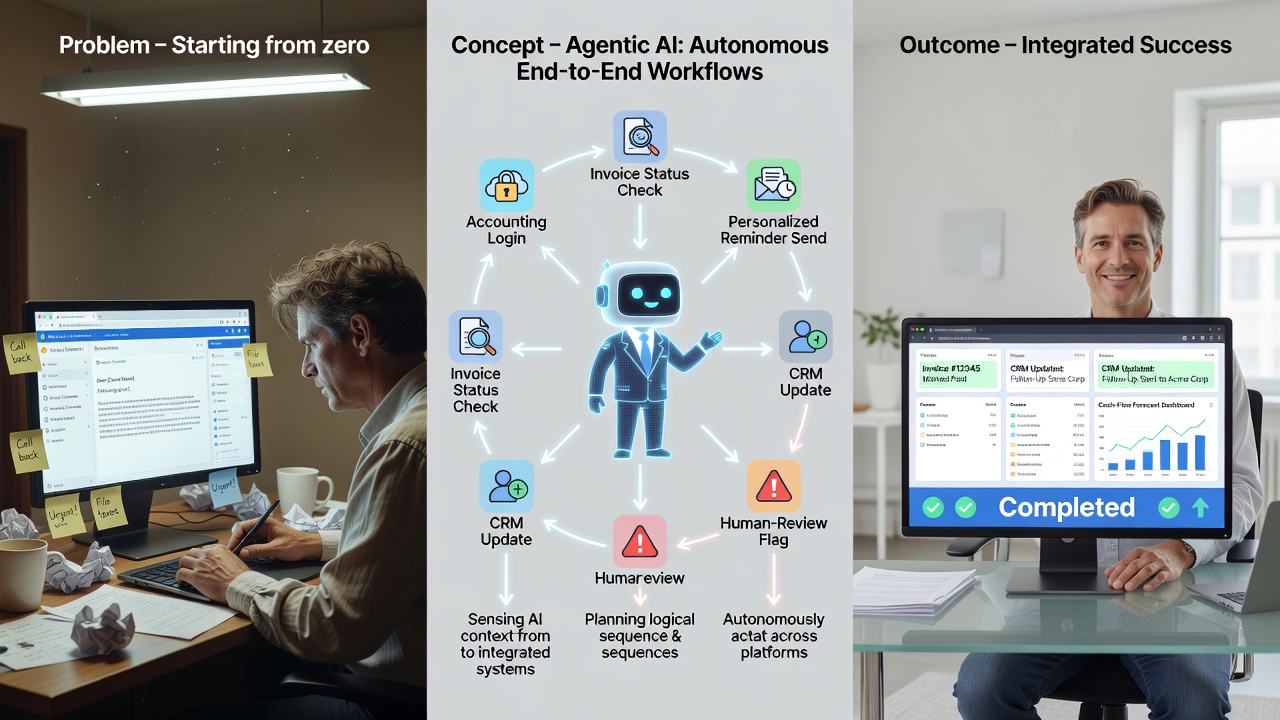
Looking ahead, agentic AI represents the next frontier in custom development for SMBs. These AI systems can handle complex, multi-step tasks with minimal human intervention, effectively serving as tireless digital employees [10].
For SMBs, agentic AI opens possibilities that were previously available only to enterprises with large technical teams. Imagine AI agents that can:
- Monitor your systems and proactively address issues
- Handle routine customer inquiries with genuine understanding of your business
- Process and analyze data to surface actionable insights
- Coordinate between different software systems automatically
Companies like Hexaware are already targeting the low-code SaaS market with agentic AI solutions, recognizing that SMBs represent a massive underserved market for intelligent automation [10].
Making the Decision: A Framework for SMB Leaders
As you evaluate whether to build custom software or continue with off-the-shelf solutions, consider these questions:
Strategic Importance: Does this function differentiate your business, or is it a commodity operation? Build custom for differentiation; buy off-the-shelf for commodities.
Fit Quality: How well do available SaaS solutions match your actual needs? If you’re using less than 50% of features or constantly working around limitations, custom development deserves consideration.
Total Cost of Ownership: Compare not just subscription fees vs. development costs, but also the hidden costs of workarounds, training, and process distortion. Often, custom solutions prove more economical over a three to five year horizon.
Integration Needs: How critical is integration with existing systems? Custom solutions can be designed for seamless integration from the start.
Change Velocity: How frequently do your needs evolve? Custom solutions can be modified as your business changes, while SaaS platforms update on their own schedules.
Conclusion: The New Era of SMB Technology
The democratization of software development through AI represents one of the most significant shifts in the technology landscape for small and medium businesses. For the first time, custom software—once the exclusive domain of enterprises with deep pockets—is accessible to businesses of all sizes.
This doesn’t mean every SMB should rush to build custom solutions for every need. Off-the-shelf SaaS still makes sense for many functions, particularly those that aren’t central to your competitive advantage. The key is making intentional choices rather than defaulting to generic solutions because custom development seems out of reach.
The businesses that thrive in this new era will be those that strategically blend off-the-shelf efficiency with custom differentiation. They’ll use AI-powered tools to build exactly what they need, when they need it, without conforming their unique processes to someone else’s vision of how business should work.
The technology playing field has been leveled. The question now is: what will you build?
Sources
- [1] https://symilars.com/cs/blog/custom-ai-software-development-when-to-build-vs-buy-ai-solutions-2026 - Analysis of when generic AI tools fall short for business needs
- [2] https://www.businesswire.com/news/home/20260217548274/en/Retools-2026-Build-vs.-Buy-Report-Reveals-35-of-Enterprises-Have-Already-Replaced-SaaS-With-Custom-Software - Retool’s 2026 report on enterprise shift toward custom software
- [4] https://spr.com/build-vs-buy-in-the-ai-era-where-differentiating-software-still-matters/ - Strategic analysis of where custom software creates competitive advantage
- [5] https://rywalker.com/research/in-house-coding-agents - Research on AI coding agents and productivity gains including Uber’s 21,000 developer hours saved
- [6] https://building.theatlantic.com/low-code-automation-vs-custom-ai-development-what-to-choose-83d490fd2ef1 - Comparison of low-code automation versus custom AI development approaches
- [7] https://fruition.net/blog/ai-changes-buy-vs-build-equation - Analysis of how AI has changed the economics of custom software development
- [8] https://medium.com/@pez_5622/build-the-digital-tools-your-small-business-has-always-needed-with-ai-cad9906b4c56 - Guide to no-code AI development for small businesses
- [9] https://josephfung.ca/building-is-easy-owning-is-hard-b096b970233a - Perspective on long-term ownership considerations for custom software
- [10] http://business.outlookindia.com/corporate/hexaware-bets-on-agentic-ai-to-take-a-bite-of-low-code-saas-market - Coverage of agentic AI developments targeting the low-code SaaS market
- AI
- ML
- software development
- business efficiency
- automation
- AI Trends
- custom internal tools
- custom software vs SaaS
- no-code development SMB
- SMB technology solutions
- build vs buy software SMB
- agentic AI small business
- SMB digital transformation
- AI-powered development 2026
- AI development cost savings
- business process automation
- fractional CTO
- AI/ML solutions