· The Rapid Architect Team · AI · 9 min read
From Shadow AI to Controlled Advantage: A Practical Governance Checklist for SMBs Building Their Own Tools
Shadow AI is surging in small and medium businesses as teams build custom agents faster than policies can keep up. This post delivers a founder-friendly governance checklist that converts hidden risks into repeatable competitive edges, complete with real-world examples and a lightweight 12-control framework any SMB can implement in under a week.
Podcast Discussion
Introduction
From Shadow artificial intelligence to Controlled Advantage: A Practical Governance Checklist for SMBs Building Their Own Tools
The Rise of Shadow artificial intelligence in SMBs
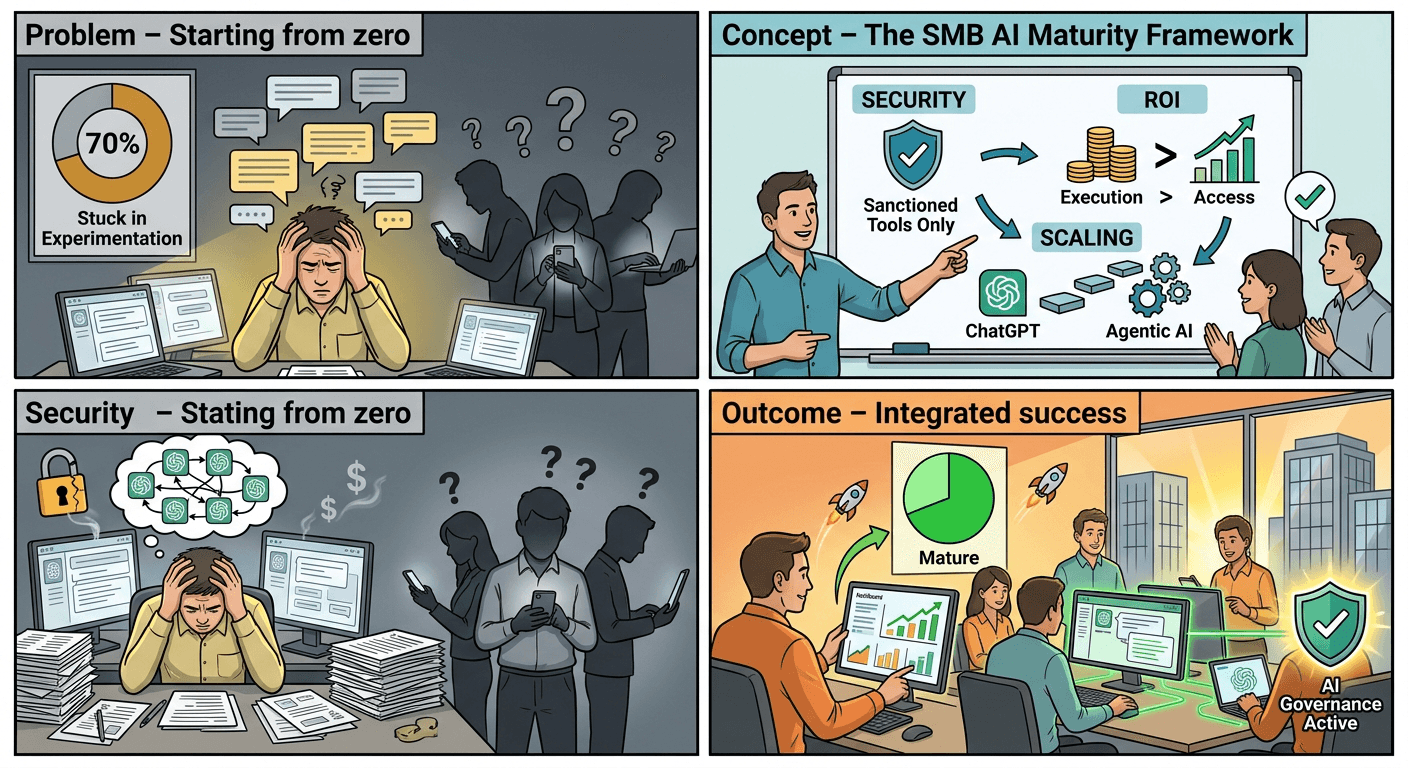
Small and medium businesses are no longer just using artificial intelligence. They are building it. A recent global survey of 1,150 small-business leaders revealed that 67 percent of AI-engaged SMBs have already created at least one custom artificial intelligence tool or agent. Two-thirds of these firms now rely on self-built solutions for daily operations. Yet 35 percent of the same companies later discover unapproved tools running in production without any documentation or oversight.
This gap between rapid creation and missing oversight is what experts call shadow artificial intelligence. It starts innocently enough. A marketing coordinator signs up for a free ChatGPT account to draft social posts. A sales rep connects a no-code automation tool to the CRM to score leads. An operations manager builds a simple agent that pulls inventory data and summarizes it each morning. Each experiment feels like a quick win. Collectively they create invisible workflows that touch customer data, financial records, and proprietary processes.
The Pax8 research underscores how fast this trend is accelerating. SMBs are developing artificial intelligence solutions faster than they can govern them. Unlike large enterprises with dedicated compliance teams, most SMBs operate with lean staff and founder-led decision making. The result is a patchwork of tools that deliver short-term productivity but expose the business to long-term risk.
Consider a 15-employee retail chain that built a custom inventory forecasting agent using free tiers of multiple platforms. The tool saved the owner eight hours per week on manual stock checks and reduced over-ordering by 22 percent in the first quarter. However, the agent pulled supplier pricing data and customer purchase histories without any logging. When a vendor audit flagged inconsistencies, the business spent $4,200 in consultant fees and two full days of staff time to trace the data paths. This example shows how shadow artificial intelligence can deliver measurable gains like time savings while creating hidden compliance costs that quickly outweigh the benefits if left unchecked. Skeptical owners often object that governance will slow innovation, yet mapping usage upfront prevents exactly these expensive interruptions and lets teams focus on scaling what works.
Why Governance Gaps Matter More Than You Think
Data leakage is the most immediate concern. Research from Resultsense shows that 68 percent of organizations have already experienced AI-related data leakage, while only 23 percent maintain dedicated security policies for artificial intelligence use. The problem is not usually malicious intent. It is the absence of visibility.
Consider a 12-person accounting firm that built a custom agent to reconcile bank statements. The agent was connected to both the accounting software and a large language model. No one documented which client records were being sent to the model. When a team member later used the same account to generate marketing copy, sensitive financial details from multiple clients were inadvertently included in prompts. The firm only discovered the exposure during a routine client audit. The incident required notifying three clients, revising contracts, and implementing new encryption steps at a total cost of $7,500 plus lost billable hours. A similar manufacturing SMB with 22 employees faced parallel issues when an artificial intelligence quality-control agent shared proprietary specs with an external model, leading to a three-week production delay and $12,000 in rework.
UK SME-focused analysis highlights that the real governance challenge lies in workflows rather than isolated tools. Who owns the outcome when an autonomous agent updates a customer record? What data is accessed during each step? How do you audit decisions made by code that no one fully understands? These questions cannot be answered by simply approving or banning software. They require mapping processes. Owners often push back that their teams are too small for formal oversight, yet the quantified examples prove that skipping governance multiplies costs through audits, rework, and lost trust far beyond the 30 minutes needed for basic documentation.
From Risk to Strategic Advantage
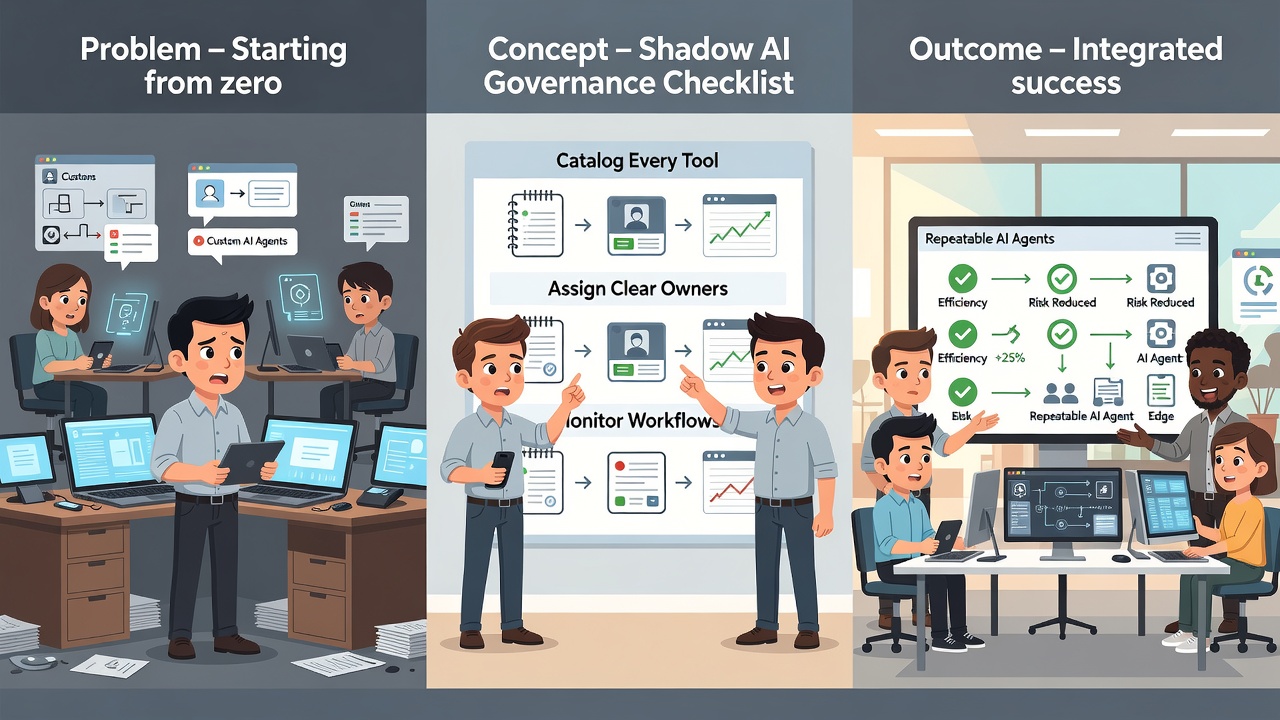
Governance is often portrayed as a brake on innovation. For SMBs the opposite is true. When teams catalog every tool, assign clear owners, and monitor workflows, shadow artificial intelligence transforms into documented, repeatable competitive edges. Companies that take this step report faster onboarding of new employees, easier compliance audits, and fewer costly surprises.
The narrative across multiple 2026 studies is consistent. SMBs that treat governance as an enabler rather than a burden gain an advantage over competitors still operating in the dark. A 10-person team that spends one focused afternoon mapping its artificial intelligence usage can move from uncontrolled experiments to controlled advantage in less than a week. One landscaping company with nine staff implemented basic ownership logs and cut new-hire training time from three weeks to nine days because documented prompts and workflows replaced tribal knowledge. Another eight-person e-commerce firm quantified a 15 percent reduction in customer support tickets after standardizing an artificial intelligence agent with review steps, directly boosting revenue by $18,000 annually.
Skeptics claim governance adds bureaucracy that SMBs cannot afford, yet these cases demonstrate clear ROI through reduced training time, higher consistency, and new business wins from demonstrated controls. The key is keeping the process lightweight and founder-led so it accelerates rather than hinders daily operations.
The Four-Pillar Blueprint for SMBs
Practical governance for small businesses rests on four pillars that fit on a single page and require minimal bureaucracy.
First, identify every artificial intelligence touchpoint. This includes free accounts, browser extensions, no-code automations, and custom agents. Many founders are surprised to learn how many tools exist when they ask each team member to list what they use in a typical week. A 14-person logistics SMB discovered 19 separate artificial intelligence instances during its first audit, including three overlapping inventory tools that duplicated effort.
Second, assign ownership. Every tool or workflow needs a named person responsible for its performance and data handling. Ownership prevents the common problem of tools that continue running long after the original creator has moved on. In practice, this means updating a shared spreadsheet with names and escalation paths so knowledge does not walk out the door.
Third, map data exposure. For each workflow, record what information leaves the company and where it goes. Start with non-sensitive data sets and expand only after logging and review processes are in place. One dental practice with 11 employees began by flagging only appointment reminders, then gradually added billing data once encryption was verified, avoiding the $5,000 breach response costs seen in peer firms.
Fourth, schedule lightweight reviews. Treat governance as a 30-minute quarterly exercise rather than an annual project. This keeps the living document current without draining resources. Owners worried about ongoing time commitment find that quarterly sessions actually prevent the multi-day fire drills that arise from undocumented tools.
The 12-Control Minimum Viable Governance Checklist
SMB-tailored resources such as those from Pattrn Data and Nex-Flow emphasize that effective controls can be captured in just three pages. Here is a condensed version of the 12-control minimum.
- List all artificial intelligence tools and extensions currently in use.
- Identify whether accounts are personal or shared.
- Record the business owner for each tool.
- Document the primary use case.
- Note which data sets are accessed or transmitted.
- Verify client or customer data exposure.
- Implement version control for prompts used in production workflows.
- Require human review before any customer-facing output is sent.
- Maintain a simple log of agent decisions that affect revenue or compliance.
- Restrict initial artificial intelligence access to non-sensitive data only.
- Establish a quick off-boarding process when an employee leaves.
- Schedule the next 30-minute governance review on the calendar.
These controls turn messy experiments into secure, auditable processes. They do not require enterprise software or legal teams. They simply demand consistent attention from the founder or a designated operations lead. A 19-person construction firm applied the checklist and saved an estimated $9,800 in potential compliance penalties during its first external review.
Practical Example: A 10-Person Marketing Agency
Take a 10-person digital marketing agency that serves local retailers. The team built three custom agents: one for keyword research, one for social caption generation, and one for performance report summarization. Initially each agent ran on separate free accounts with no central record.
After a one-hour audit the agency listed every tool, tagged each with an owner, and noted that the report summarization agent was pulling client campaign data. They moved the agent to a shared, logged account, added a human review step for all client reports, and created a simple shared document that listed prompts and their versions.
Within two weeks the agency reduced accidental data exposure, improved report consistency, and won a new client partly because they could demonstrate clear artificial intelligence governance during the pitch. What began as shadow artificial intelligence became a documented workflow that supported business growth. The agency later quantified 12 hours saved per month on report revisions and avoided a potential $3,200 data-incident response after implementing version control.
Getting Started This Week
Begin with a one-hour audit. Ask every team member to list the artificial intelligence tools they use, including free accounts. Tag each entry with an owner and the type of data involved. Use a free template from resources such as Pattrn Data or Nex-Flow to structure the output.
Next, adopt a workflow-first lens. Instead of banning tools, map which business processes now depend on artificial intelligence. This perspective reveals both risks and opportunities for standardization. A skeptical owner might worry this diverts focus from revenue work, yet the mapping exercise itself often uncovers duplicated effort worth several hours weekly.
Finally, implement the 12-control minimum and schedule the first quarterly review. Treat the exercise as a quick win rather than a burden. SMBs that follow this path consistently report higher confidence in their artificial intelligence usage and lower anxiety about compliance. One 13-person professional services firm completed the full cycle in four days and immediately used the resulting documentation to reassure a key client during contract renewal.
Conclusion
Shadow artificial intelligence is not going away. SMBs will continue to build custom agents because the productivity gains are real. The question is whether those gains remain hidden liabilities or become controlled, strategic advantages. By adopting a lightweight, founder-led governance checklist, small teams can document ownership, reduce data leakage, and turn ad-hoc experiments into repeatable processes that support growth. The window to act is open now. Start with a one-hour audit this week and convert your shadow artificial intelligence into a documented competitive edge before the risks catch up with the rewards.
Sources
- https://www.pax8.com/en-us/news-post/pax8-research-finds-small-businesses-are-building-ai-faster-than-they-can-govern-it/
- https://sacg.co.uk/insights/uk-sme-ai-governance-2026-workflow-records-aime-controls/
- https://skylineos.ai/insights/shadow-ai-small-business
- https://www.pattrndata.io/resources/shadow-ai-checklist-founder-led-smes
- https://thenextweb.com/news/shadow-ai-small-businesses-pax8-survey
- https://www.channeldive.com/news/smbs-lack-ai-governance-report/832804/
- https://www.resultsense.com/insights/2025-10-14-shadow-ai-strategic-governance-sme-blueprint/
- https://www.nex-flow.io/blog/ai-governance-smb-checklist-2026.html
- https://www.arthur.ai/column/ai-governance-framework-guide
- https://tech.co/news/small-businesses-are-developing-ai-faster-than-they-can-control