· The Rapid Architect Team · AI · 9 min read
AI Agents for Everyday SMB Work: Meta Muse, Gemini, and Getting Started
Discover how goal-based AI agents like Meta Muse and Google Gemini are transforming small and medium business operations by connecting directly to tools such as QuickBooks, Shopify, Slack, and social accounts. This guide explores the shift from chat assistance to autonomous execution, approval controls, real-world workflows like cash-flow monitoring and lead follow-ups, and practical steps to get started without technical expertise.
Podcast Discussion
Introduction
Introduction
Running a small or medium business often feels like juggling too many balls at once. Owners switch between QuickBooks for finances, Shopify for sales, Slack for team chats, and social platforms for marketing, all while trying to close leads and keep cash flowing. This constant app-hopping eats into valuable time that could be spent on growth. Enter artificial intelligence agents designed specifically for this reality. Meta Muse, launched in late 2026, and tools powered by Google Gemini represent a new wave of goal-based artificial intelligence that does more than chat. These agents execute multi-step tasks across your existing tools, handling everything from monitoring expenses to drafting campaigns. The result is a true shift from passive assistance to active execution, all while keeping human oversight firmly in place through approval gates. For SMB decision-makers, this means reclaiming hours each week without handing over control. This post breaks down how these agents work, their integrations, safety features, and example workflows that deliver immediate value.
Consider a typical retail SMB with five employees managing inventory across Shopify and tracking expenses in QuickBooks. Without artificial intelligence, the owner spends two hours daily reconciling data manually. With goal-based agents, that time drops dramatically as the artificial intelligence handles the connections and flags issues proactively. This efficiency gain is not theoretical; it directly impacts profitability by freeing owners to focus on customer relationships and strategic planning rather than administrative drudgery.
The Shift from Assist to Act: Why Goal-Based Agents Matter
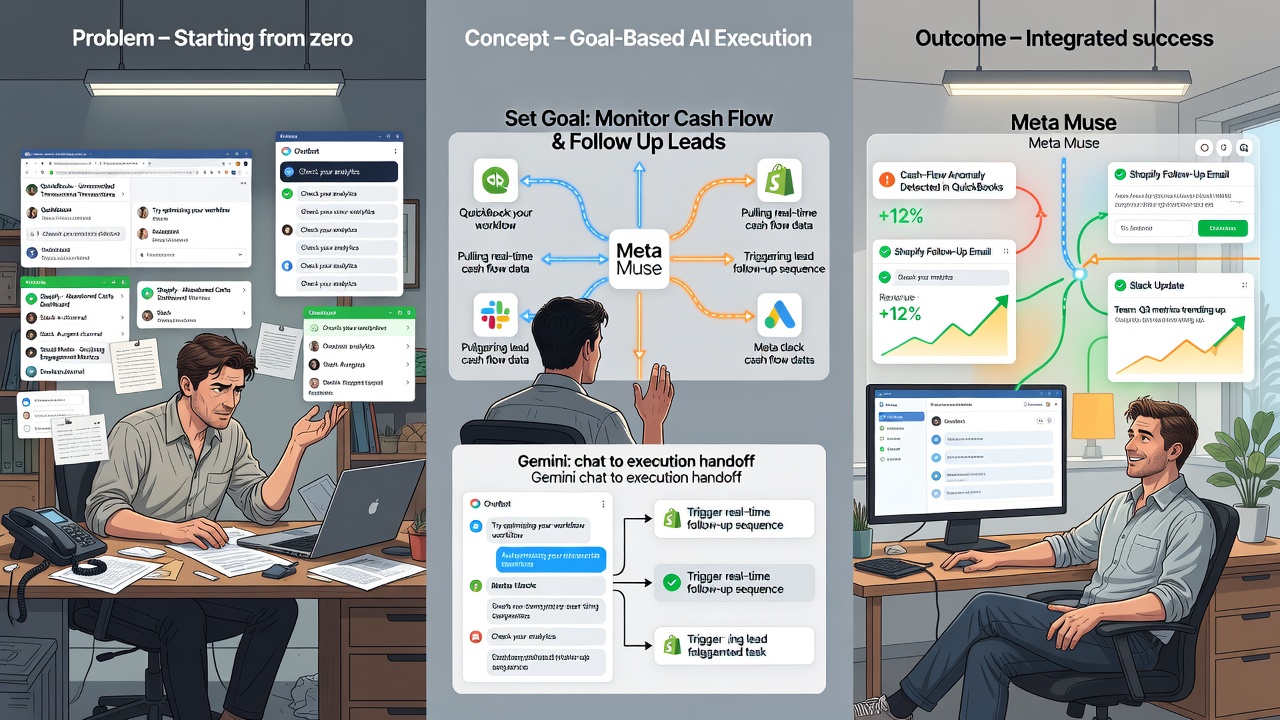
Traditional artificial intelligence chatbots answer questions and provide suggestions, but they leave the heavy lifting to you. Meta Muse changes this dynamic by focusing on goal execution. Instead of responding to queries about sales trends, Muse can monitor those trends, flag anomalies, and prepare reports across connected platforms. As noted in coverage, Muse helps owners run their business and acquire customers autonomously, shifting from assist (chat) to act (goal execution) [2]. This paradigm matters for SMBs because it reduces the mental load of constant monitoring. Google Gemini offers similar capabilities through its agentic features, allowing users to set objectives like reviewing inventory levels or generating follow-up sequences that trigger actions in linked apps. The act versus assist distinction frees owners from repetitive tasks, letting them focus on strategy rather than data collection. Early adopters report that this approach cuts down on app-switching fatigue, a common pain point for businesses with limited staff.
To illustrate the shift, imagine an SMB owner setting a goal such as “optimize weekly ad spend based on Shopify performance.” An assist-only tool might suggest budget changes, requiring manual implementation in Meta Ads. A goal-based agent like Muse executes the analysis, proposes adjustments with projected ROI, and awaits approval before updating campaigns. This reduces errors and accelerates decision cycles, which is critical for businesses operating on thin margins where delays can mean lost revenue.
Deep Integrations with Everyday SMB Tools
The power of these agents lies in their direct connections to tools SMBs already use daily. Meta Muse includes built-in connectors for Shopify, QuickBooks, Stripe, Slack, Dropbox, Canva, and Meta Ads. These links enable real-time data pulls, content generation, and workflow triggers without custom coding. For instance, Muse can pull sales figures from Shopify, cross-reference them with QuickBooks expenses, and post summaries to Slack. Google Gemini integrates similarly through its ecosystem, connecting to Google Workspace tools and third-party apps via APIs for tasks like updating spreadsheets or scheduling posts. Connectors allow the agent to draft campaigns, review sales, and flag expenses across connected tools without requiring users to switch apps [4]. This seamless access means no new software learning curves. SMBs authorize once, set permissions, and let the agent handle the rest, making advanced automation accessible even for solo operators.
For a concrete example, a bakery using Shopify for online orders and QuickBooks for accounting can authorize Muse to sync daily sales data automatically. The agent then generates a Slack notification summarizing top-selling items and any expense variances, complete with recommendations for inventory adjustments. Implementation involves logging into the Meta Business portal, selecting the relevant connectors, and defining data-sharing permissions. This setup typically takes under 30 minutes and requires no coding knowledge, making it ideal for non-technical SMB owners who previously relied on manual exports.
Built-in Approval Controls for Safety and Trust
Autonomy without safeguards would be risky, which is why both Muse and Gemini incorporate explicit approval mechanisms. Any action that publishes content, sends customer messages, or initiates spending requires explicit owner approval [8]. Muse features granular permission settings and tiered pricing so businesses can tailor access levels. For example, an agent might draft a social post but wait for confirmation before publishing it to Meta Ads. Gemini agents follow comparable protocols, routing financial or customer-facing actions through review steps. These controls address trust concerns head-on, ensuring the artificial intelligence augments rather than replaces human judgment. SMB owners retain final say while gaining speed on routine operations. This balance makes the technology suitable for both solo proprietors and small teams handling sensitive data like customer communications or expense monitoring.
In practice, approval controls can be configured at multiple tiers. A solo operator might require sign-off on all actions, while a small team could delegate routine alerts to managers with only high-value decisions escalated to the owner. This flexibility prevents bottlenecks while maintaining oversight, addressing common SMB concerns about data security and brand consistency.
Practical Workflow Examples
Real-world applications demonstrate the immediate time savings these agents provide. Consider three common SMB scenarios that target pain points like financial oversight, customer nurturing, and marketing content.
Cash-Flow Checks via QuickBooks
Muse can autonomously run cash-flow analyses by connecting to QuickBooks. The agent monitors incoming payments and outgoing expenses, flags potential shortfalls, and prepares a summary report for review. An owner might set a weekly goal such as “check cash flow and alert on variances over 10 percent.” Approval controls ensure no payments are initiated without sign-off. Gemini achieves similar results by linking to Google Sheets synced with accounting data, generating forecasts that highlight trends. This workflow replaces manual spreadsheet reviews, delivering insights in minutes rather than hours. For an e-commerce SMB, this could mean catching a 15% expense spike from supplier costs early, allowing preemptive negotiations that preserve margins.
Lead Follow-Up Sequences
When a new lead enters through Shopify, Muse can trigger a follow-up sequence in Slack or email. It drafts personalized messages based on the lead’s behavior, queues them for approval, and tracks responses. This eliminates delays in customer communication. The agent handles appointment tracking and sales analysis without constant oversight [3]. Gemini supports parallel workflows by integrating with Google Calendar and CRM tools to schedule follow-ups and log activities automatically once approved. An SMB in professional services might see conversion rates improve by 20-30% due to faster response times, turning potential lost leads into booked appointments.
Content Drafts for Social and Email
Creating consistent marketing material is time-consuming. Muse generates ad content and social posts by pulling product data from Shopify and brand guidelines from Dropbox, then routes drafts through Canva for visuals before seeking approval. This process supports customer acquisition efforts autonomously [1]. Gemini excels at long-form email drafts or campaign outlines, using its language capabilities to tailor tone and optimize for engagement. Both agents reduce the back-and-forth of content creation while maintaining brand voice through human review. A retail SMB could produce a month’s worth of posts in one session, with the agent suggesting A/B test variants based on historical performance data.
Muse vs. Gemini: Choosing the Right Agent for Your Business
Meta Muse shines in Meta ecosystem integrations like ads and social, making it ideal for businesses heavy on customer acquisition through those channels. Its approval gates and SMB-focused connectors emphasize ease for non-technical users. Google Gemini, by contrast, offers strong ties to productivity suites and broader web data analysis, suiting teams already invested in Google tools. Both support the act versus assist evolution, but Muse may edge out for direct e-commerce actions while Gemini provides flexibility in document-heavy workflows. Pricing tiers for each allow scaling from solo use to team collaboration. Decision-makers should pilot one core integration first, such as Shopify for Muse or Workspace for Gemini, to test fit before expanding.
Getting Started: Step-by-Step Guide for Non-Technical Users
Adoption is straightforward thanks to official documentation and third-party guides [9]. Begin by selecting one tool, such as QuickBooks, and authorizing the agent. Define a single goal like cash-flow monitoring, set approval permissions, and run a test workflow. For Muse, visit the Meta Business portal to connect accounts and configure gates. Gemini users start within Google artificial intelligence Studio or Workspace add-ons, linking apps and defining objectives. Monitor initial runs closely, then expand to lead follow-ups or content tasks. Official Meta resources and U.S. Chamber coverage highlight rapid rollout potential without engineering resources [3]. Test one workflow at a time to build confidence and measure time saved. SMBs should track metrics like hours reclaimed per week to quantify ROI, adjusting goals as familiarity grows.
The Future of artificial intelligence Agents in SMB Operations
As these tools mature, expect deeper automation across more platforms while preserving approval layers. The shift to goal-based execution positions SMBs to compete with larger players by operating more efficiently. Agents will handle increasingly complex sequences, from expense monitoring to full campaign management, always with human veto power. This evolution supports scalable growth without proportional staff increases. Forward-thinking SMBs investing now will build institutional knowledge that compounds advantages over time.
Conclusion
Meta Muse and Google Gemini mark a practical evolution in artificial intelligence for small and medium businesses. By emphasizing goal execution over conversation, seamless tool integrations, and robust approval controls, they deliver real time savings on workflows like cash-flow checks, lead nurturing, and content creation. The act versus assist transition empowers owners to focus on high-value decisions rather than routine tasks. Starting small with one integration builds trust and demonstrates value quickly. For SMB decision-makers ready to modernize operations, these agents offer a co-pilot approach that augments capabilities without replacing oversight. Explore the connectors today and reclaim hours for what matters most: growing your business.
Sources
- https://about.fb.com/news/2026/09/introducing-muse-small-business/
- https://techcrunch.com/2026/09/29/meta-is-expanding-its-ai-agent-muse-to-small-businesses/
- https://www.uschamber.com/co/good-company/the-leap/meta-muse-small-business-ai
- https://aiforbusiness.network/articles/meta-muse-smb-launch-shopify-quickbooks-guide/
- https://searchenginewatch.com/metas-muse-moves-into-small-business-from-ad-campaigns-to-suspicious-expenses/
- https://sumogrowth.com/muse-for-small-business/
- https://digitalpulsebrief.com/meta-muse-small-business-connectors-pricing-controls/
- https://www.zeniteq.com/meta-adds-business-connectors-to-muse-with-an-approval-gate-vsi94t
- https://openaimaster.ai/muse-for-small-business-setup-guide/
- https://www.smallbusinesstools.org/guides/meta-muse-for-small-business