· The Rapid Architect Team · AI · 11 min read
How to Turn Your Team into AI Literate in Weeks – A Practical Guide for Small Businesses
Transform your small business team from AI-curious to AI-capable in weeks with this practical guide covering assessment, training, tool selection, and implementation strategies that actually work.
Podcast Discussion
Introduction
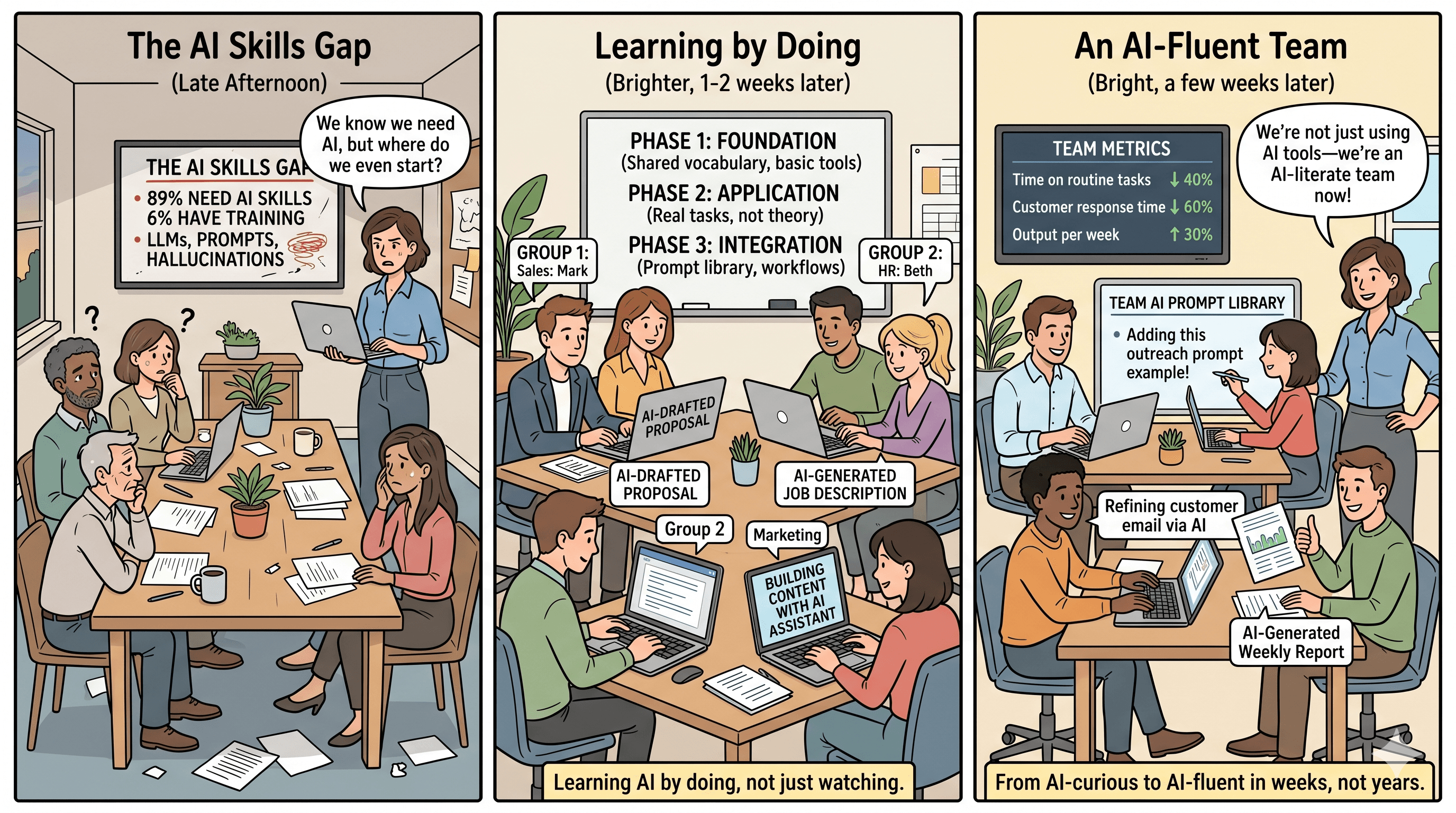
The gap between knowing you need artificial intelligence and actually using it effectively is where most small businesses get stuck. Here’s a number that should concern every business owner: 89 percent of companies acknowledge their workforce needs artificial intelligence skills, but only 6 percent have implemented training programs to get there [3]. That’s not a skills gap—it’s a chasm.
If you’re a small business owner who has dabbled with ChatGPT, experimented with artificial intelligence writing tools, or watched competitors talk about “leveraging artificial intelligence” while feeling increasingly left behind, you’re not alone. The good news? Building artificial intelligence literacy across your team doesn’t require a massive budget, a dedicated tech department, or months of formal training. With the right approach, you can transform your team from artificial intelligence-curious to artificial intelligence-capable in a matter of weeks.
This guide provides a practical, actionable roadmap for small business owners ready to close that gap—without the chaos, confusion, or consultant fees that typically accompany technology transformations.
Why artificial intelligence Literacy Matters More Than artificial intelligence Tools
Before diving into the how, let’s address the why. Many business owners make the mistake of focusing on tools first and training second. They purchase subscriptions, install software, and then wonder why adoption stalls.
The reality is that artificial intelligence tools deliver value only when employees can use them effectively [4]. A sophisticated artificial intelligence platform in the hands of an untrained team is like giving someone a professional camera without teaching them photography—you’ll get results, but nowhere near the potential.
According to a Salesforce study, 71 percent of small business owners believe artificial intelligence has significant potential for their operations [2]. Yet belief doesn’t translate to implementation without the foundational literacy to support it. artificial intelligence literacy isn’t about turning your accountant into a machine learning engineer. It’s about helping every team member understand what artificial intelligence can do, when to use it, and how to work alongside it effectively.
The 90-Day Framework: From Curious to Fluent
While this guide promises results in weeks, the most sustainable approach follows a structured 90-day plan that moves your team from artificial intelligence-curious to artificial intelligence-fluent [1]. Think of it in three phases: Foundation (weeks 1-4), Application (weeks 5-8), and Integration (weeks 9-12). Even if you compress this timeline, maintaining these three distinct phases ensures lasting adoption rather than fleeting enthusiasm.
Phase One: Building the Foundation (Weeks 1-4)
The first month focuses on demystifying artificial intelligence and establishing a common vocabulary across your organization. This isn’t about technical deep-dives—it’s about creating shared understanding.
Start with an artificial intelligence readiness audit. Before training begins, assess where your team currently stands. Some employees may already be using artificial intelligence tools independently, while others might harbor skepticism or fear about the technology. Understanding these starting points helps you tailor your approach [1].
Create a simple survey asking questions like:
- Have you used any artificial intelligence tools in the past six months?
- What tasks do you find most repetitive in your daily work?
- What concerns, if any, do you have about artificial intelligence in the workplace?
Establish your artificial intelligence vocabulary. One of the biggest barriers to artificial intelligence adoption is jargon. Terms like “prompts,” “large language models,” “hallucinations,” and “tokens” can feel alienating to non-technical team members. Spend time in early training sessions defining these terms in plain language.
For example, explain that a “prompt” is simply the instruction or question you give an artificial intelligence tool—like asking a very capable assistant to complete a task. A “hallucination” is when artificial intelligence confidently presents incorrect information as fact, which is why human oversight remains essential.
Focus on the ‘why’ before the ‘how.’ Most companies get artificial intelligence training wrong because they treat it like a one-off course people “finish” and forget [9]. Instead, help your team understand why artificial intelligence literacy matters for their specific roles. A customer service representative needs to see how artificial intelligence can help them respond faster and more consistently. A marketing coordinator needs to understand how artificial intelligence can accelerate content creation without replacing their creative judgment.
Choosing the Right Tools for Your Team
With foundation established, you need to select which artificial intelligence tools your team will actually learn. This is where many small businesses stumble—they either choose too many tools or pick solutions that don’t match their actual workflows.
Start with one core tool. Rather than overwhelming your team with a dozen artificial intelligence applications, select one versatile tool that addresses multiple use cases [6]. For most small businesses, this means a general-purpose artificial intelligence assistant like ChatGPT, Claude, or Microsoft Copilot. These tools can handle writing, analysis, brainstorming, and research—covering the majority of knowledge work tasks.
Match tools to existing workflows. The most successful artificial intelligence implementations integrate with tools your team already uses [8]. If your team lives in Google Workspace, explore Gemini integration. If you’re a Microsoft shop, Copilot offers seamless integration with familiar applications. This reduces friction and accelerates adoption.
Consider your technical capacity honestly. One of the most common concerns from small business owners is: “I don’t have anyone technical on my team” [7]. The good news is that modern artificial intelligence tools are designed for non-technical users. You don’t need coding skills to use artificial intelligence effectively—you need clear thinking and good communication skills to craft effective prompts.
The Hands-On Training Approach That Actually Works
Here’s where traditional corporate training fails: it separates learning from doing. Singapore’s Senior Minister of State for Manpower recently highlighted the shift away from the old model of “study first, work later” towards integrating work and study so people learn artificial intelligence in the context of real tasks [9]. This principle should guide your training approach.
Use real work, not hypothetical exercises. Instead of having employees practice with made-up scenarios, have them bring actual tasks from their workload to training sessions. A salesperson should practice using artificial intelligence to draft a real proposal. An HR manager should use artificial intelligence to create an actual job description they need.
Implement the “shadow and solve” method. Pair employees and have them work through artificial intelligence-assisted tasks together. One person operates the tool while the other observes and asks questions. Then switch roles. This peer learning approach often proves more effective than top-down instruction [4].
Create a prompt library specific to your business. As your team experiments with artificial intelligence, document the prompts that work well for your specific context. A prompt that generates great marketing copy for a B2B software company will differ from one that works for a local restaurant. Build this library collaboratively, encouraging team members to contribute their discoveries.
Overcoming Resistance and Building Champions
Not everyone will embrace artificial intelligence with enthusiasm. Some team members may feel threatened, skeptical, or simply overwhelmed. Addressing these concerns directly is essential for organization-wide adoption.
Acknowledge legitimate concerns. Fear about job displacement is real and shouldn’t be dismissed. Be transparent about how you see artificial intelligence fitting into your business. In most small business contexts, artificial intelligence augments human work rather than replacing it—handling routine tasks so employees can focus on higher-value activities that require human judgment, creativity, and relationship-building.
Identify and empower artificial intelligence champions. Every team has early adopters who naturally gravitate toward new technology. Identify these individuals and give them additional training and responsibility for helping colleagues [10]. These peer champions often prove more effective than external trainers because they understand your specific business context and speak the same language as their coworkers.
Celebrate early wins publicly. When someone uses artificial intelligence to solve a problem or complete a task more efficiently, share that success with the entire team. Concrete examples from colleagues are far more compelling than abstract promises about productivity gains.
Measuring Progress and Maintaining Momentum
Without measurement, it’s impossible to know whether your artificial intelligence literacy initiative is succeeding. But traditional training metrics—like completion rates for courses—don’t capture what matters.
Track adoption, not just training completion. The goal isn’t for employees to finish a training module; it’s for them to actually use artificial intelligence in their daily work. Monitor tool usage, ask about artificial intelligence application in regular check-ins, and survey employees about their comfort level over time [8].
Establish baseline metrics before training begins. If you want to demonstrate ROI, you need to know where you started. Track metrics relevant to your business: time spent on routine tasks, customer response times, content production volume, or whatever measures matter for your operations.
Build artificial intelligence into regular workflows and meetings. artificial intelligence literacy isn’t a one-time achievement—it’s an ongoing practice. Incorporate artificial intelligence discussion into regular team meetings. Ask questions like: “Did anyone discover a new way to use artificial intelligence this week?” or “What task did artificial intelligence help you complete faster?” This keeps artificial intelligence top-of-mind and normalizes its use [9].
A Practical Week-by-Week Implementation Plan
Let’s translate these principles into a concrete timeline you can implement starting Monday.
Week 1: Assessment and Setup
- Conduct your artificial intelligence readiness survey
- Select your primary artificial intelligence tool
- Ensure all team members have access and accounts
- Schedule training sessions for the coming weeks
Week 2: Foundation Training
- Hold a 90-minute session covering artificial intelligence basics and vocabulary
- Demonstrate the selected tool with live examples
- Assign homework: each team member uses artificial intelligence for one real task
Week 3: Role-Specific Application
- Break into smaller groups by function (sales, operations, admin)
- Work through role-specific use cases with real tasks
- Begin building your company’s prompt library
Week 4: Peer Learning and Problem-Solving
- Implement shadow-and-solve sessions
- Address questions and challenges that have emerged
- Identify artificial intelligence champions for ongoing support
Weeks 5-8: Deepening Practice
- Hold weekly 30-minute check-ins to share wins and challenges
- Introduce additional use cases as comfort grows
- Expand prompt library based on team discoveries
Weeks 9-12: Integration and Optimization
- Measure progress against baseline metrics
- Formalize artificial intelligence into standard operating procedures
- Plan for ongoing learning and tool updates
Common Pitfalls to Avoid
Learning from others’ mistakes can save you significant time and frustration. Here are the most common pitfalls in small business artificial intelligence training:
Trying to do too much too fast. The excitement of artificial intelligence’s potential can lead to overreach. Start with a narrow focus and expand gradually rather than attempting to transform every process simultaneously [6].
Neglecting governance and guidelines. artificial intelligence literacy includes understanding when not to use artificial intelligence and how to use it responsibly. Establish clear guidelines about data privacy, fact-checking artificial intelligence outputs, and appropriate use cases for your business context.
Treating training as a one-time event. artificial intelligence tools evolve rapidly. What works today may change in six months. Build ongoing learning into your culture rather than treating artificial intelligence training as a box to check [3].
Ignoring the human element. Technology adoption is fundamentally about people, not tools. The businesses that succeed with artificial intelligence are those that prioritize change management, communication, and employee support alongside technical training.
The Competitive Advantage of artificial intelligence-Literate Teams
Small businesses that build artificial intelligence literacy now position themselves for significant competitive advantage. While larger competitors may have bigger budgets, small businesses have agility. You can implement changes faster, adapt more quickly, and empower every team member to contribute to artificial intelligence-driven improvements.
An artificial intelligence-literate team doesn’t just use tools more effectively—they identify new opportunities, solve problems creatively, and drive innovation from every level of the organization. They become partners in your artificial intelligence journey rather than passive recipients of technology decisions.
Taking the First Step
The gap between artificial intelligence-curious and artificial intelligence-fluent isn’t as wide as it might seem. With structured training, hands-on practice, and organizational commitment, your team can develop meaningful artificial intelligence capabilities in weeks rather than months or years.
Start this week with your readiness assessment. Choose your primary tool. Schedule your first training session. The businesses that thrive in the artificial intelligence era won’t be those with the biggest budgets or the most sophisticated technology—they’ll be those that empower their people to work effectively alongside artificial intelligence.
Your team is ready to learn. The question is: are you ready to teach them?
Sources
- [1] https://resources.rework.com/guides/ai-team-readiness/90-day-ai-fluency-plan - 90-Day Plan: From AI-Curious to AI-Fluent implementation guide
- [2] https://www.salesforce.com/blog/small-business/ai-literacy-for-startups/ - Salesforce study on AI literacy for startups and small businesses
- [3] https://www.graygroupintl.com/blog/ai-upskilling-for-business - LinkedIn 2026 Workforce Learning Report on AI skills gap
- [4] https://www.smaartcompany.com/blog/ai-team-training-small-business - Practical AI enablement playbook for small business
- [6] https://aiscending.com/small-business-ai/ - Guide to AI tools that actually work for small business
- [7] https://www.tilakraj.info/blog/the-complete-guide-to-implementing-ai-in-a-small-business-without-a-tech-team - AI implementation without a tech team
- [8] https://www.ayautomate.com/blog/how-to-make-team-ai-native - Step-by-step guide to making teams AI-native
- [9] https://www.3l3c.ai/sg/blog/ai-business-tools-singapore/ai-literacy-work-playbook - AI literacy playbook emphasizing integrated learning
- [10] https://ienable.ai/blog/how-to-give-every-employee-ai.html - 6-step playbook for rolling out AI to employees