· The Rapid Architect Team · AI · 11 min read
Building AI Literacy in Your Small Team: Quick Wins for Owners and Staff in 2026
Discover practical strategies for building AI literacy across your small team in 2026, from establishing shared vocabulary to creating role-specific playbooks—no technical background or massive training budget required.

Podcast Discussion
Teaser Video
Introduction
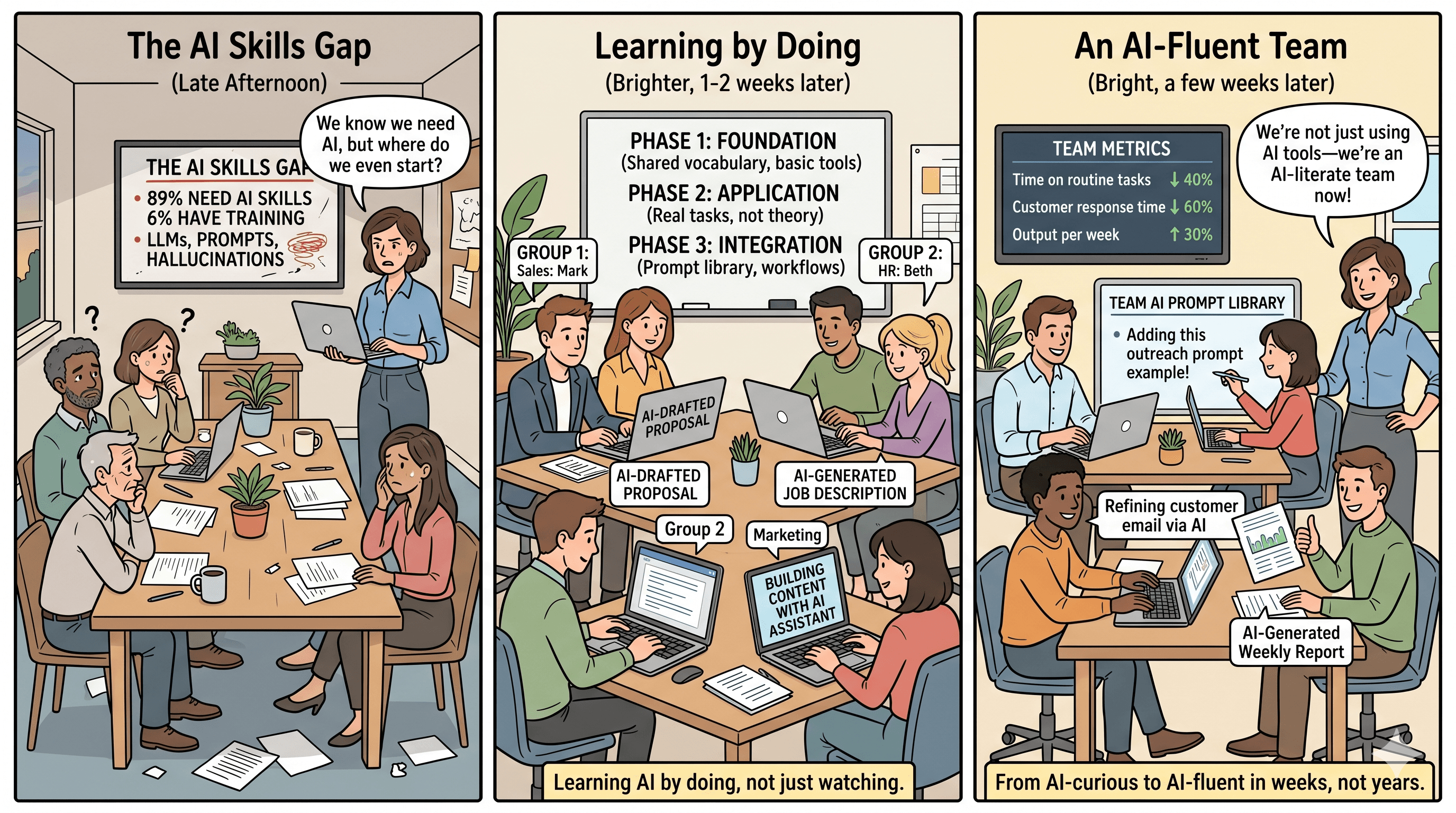
The numbers are stark and impossible to ignore: 89 percent of companies acknowledge their workforce needs AI skills, but only 6 percent have implemented training programs to bridge that gap [4]. For small business owners, this statistic represents both a challenge and an extraordinary opportunity. While larger competitors struggle with bureaucratic inertia and complex approval processes, your lean team can pivot quickly, experiment freely, and build AI competency that transforms your operations.
The AI revolution isn’t coming—it’s already here. In 2026, 68 percent of US small businesses use AI regularly, saving between $500 and $2,000 per month while reclaiming more than 20 hours of work weekly [8]. But these benefits don’t materialize automatically. They require something that money can’t buy: a team that understands how to work alongside artificial intelligence effectively.
This guide will walk you through practical, achievable steps to build AI literacy across your small team—whether you have three employees or thirty. No technical background required. No massive training budgets necessary. Just strategic thinking and a commitment to learning together.
Why AI Literacy Matters More Than AI Tools
It’s tempting to think that building AI capability means simply subscribing to the right software. Buy ChatGPT Plus, sign up for an AI scheduling tool, implement an automated customer service bot—and you’re done, right?
Not quite. The real competitive advantage comes not from the tools themselves, but from your team’s ability to use them effectively. As one analysis puts it, “AI literacy isn’t just a ‘nice-to-have’ skill—it’s essential for staying competitive in today’s fast-paced business world” [2].
Think about it this way: giving someone a professional camera doesn’t make them a photographer. The same principle applies to AI. Your customer service representative needs to understand when to let an AI chatbot handle inquiries and when human intervention creates better outcomes. Your marketing coordinator needs to know how to prompt AI writing tools to produce content that actually sounds like your brand. Your operations manager needs to recognize which processes benefit from automation and which require human judgment.
This literacy gap explains why so many small businesses invest in AI tools only to abandon them within months. Without proper understanding, these powerful technologies become expensive digital paperweights.
The Small Team Advantage: Why Agility Beats Budget
Here’s something that might surprise you: being small is actually an advantage when it comes to AI adoption. Crystal Ricevuto, VP of Marketing at Levitate, highlights how agility gives small teams a genuine edge in adopting AI technologies [1]. While enterprise organizations navigate complex approval hierarchies and change management protocols, you can experiment with a new tool tomorrow morning.
This agility manifests in several ways. First, communication flows faster in small teams. When you discover an effective AI workflow, sharing it with your entire staff might take a single team meeting rather than months of corporate training rollouts. Second, you can iterate quickly. If a particular AI approach isn’t working, pivoting doesn’t require executive approval or budget reallocation—you simply try something different.
A coffee shop in Portland exemplifies this advantage, using AI to predict rush hours and optimize staffing accordingly [9]. This isn’t a massive enterprise deployment—it’s a small business owner recognizing a specific problem and applying an AI solution with minimal friction. That kind of nimble implementation becomes your competitive moat.
Starting Point: Assess Your Team’s Current AI Understanding
Before launching any training initiative, you need to understand where your team currently stands. This doesn’t require formal assessments or expensive consultants. Instead, have honest conversations around these questions:
What AI tools are team members already using? You might be surprised. Many employees experiment with ChatGPT, Grammarly, or AI-powered features in familiar software without formally reporting it. Understanding existing usage reveals both opportunities and potential risks.
What fears or misconceptions exist? Some team members worry AI will replace their jobs. Others assume AI is too complex for non-technical people. These concerns need addressing before productive learning can happen.
Where do current workflows create frustration? The best AI implementations solve real problems. Identifying pain points—repetitive tasks, communication bottlenecks, time-consuming research—points toward high-impact applications.
This assessment phase shouldn’t feel like an interrogation. Frame it as curiosity about how the team works and where technology might help. The goal is building a foundation for collaborative learning, not evaluating individual competency.
Quick Win #1: Establish a Shared AI Vocabulary
One of the fastest ways to build team-wide AI literacy is developing common language. When everyone understands basic terminology, conversations about AI become productive rather than confusing.
You don’t need a comprehensive glossary—just enough shared vocabulary to communicate effectively. Key terms worth ensuring everyone understands include:
Prompt: The instruction or question you give an AI system. Better prompts yield better results.
Large Language Model (LLM): The technology behind tools like ChatGPT that processes and generates human-like text.
Hallucination: When AI generates information that sounds plausible but is factually incorrect. Understanding this limitation is crucial for responsible use.
Automation vs. Augmentation: Automation replaces human tasks entirely; augmentation enhances human capabilities. Most successful small business AI applications fall into the augmentation category.
Consider creating a simple one-page reference document with these definitions. Better yet, have team members contribute definitions in their own words—the act of explaining concepts reinforces understanding [2].
Quick Win #2: Implement “AI Experiment Hours”
Structured experimentation accelerates learning faster than any formal training program. The concept is simple: dedicate regular time for team members to explore AI tools relevant to their roles.
This might look like one hour weekly where your marketing person experiments with AI content generation, your bookkeeper explores automated categorization features, and your customer service lead tests AI response suggestions. The key is making experimentation expected rather than something people squeeze in when they have spare time.
During these sessions, encourage documentation of discoveries—both successes and failures. What prompts worked well? What tasks proved unsuitable for AI assistance? What unexpected capabilities emerged? This documentation becomes institutional knowledge that benefits the entire team.
The approach aligns with research showing that hands-on experience with AI tools dramatically accelerates literacy development [5]. Reading about AI capabilities pales in comparison to actually using them.
Quick Win #3: Create Role-Specific AI Playbooks
Generic AI training often fails because it doesn’t connect to actual job responsibilities. A more effective approach: develop brief playbooks showing how AI applies to specific roles within your organization.
For a customer service role, this might include:
- Using AI to draft initial responses to common inquiries
- Prompts for summarizing lengthy customer complaint histories
- Guidelines for when AI assistance is appropriate versus when human judgment is essential
For a marketing role, the playbook might cover:
- AI tools for brainstorming content ideas
- Prompts for adapting content across different platforms
- Quality control processes for AI-generated copy
These playbooks don’t need to be lengthy documents. Even a single page per role provides valuable guidance. The process of creating them—ideally with input from the team members who hold those roles—builds literacy through practical application [6].
Quick Win #4: Establish AI Ethics Guidelines
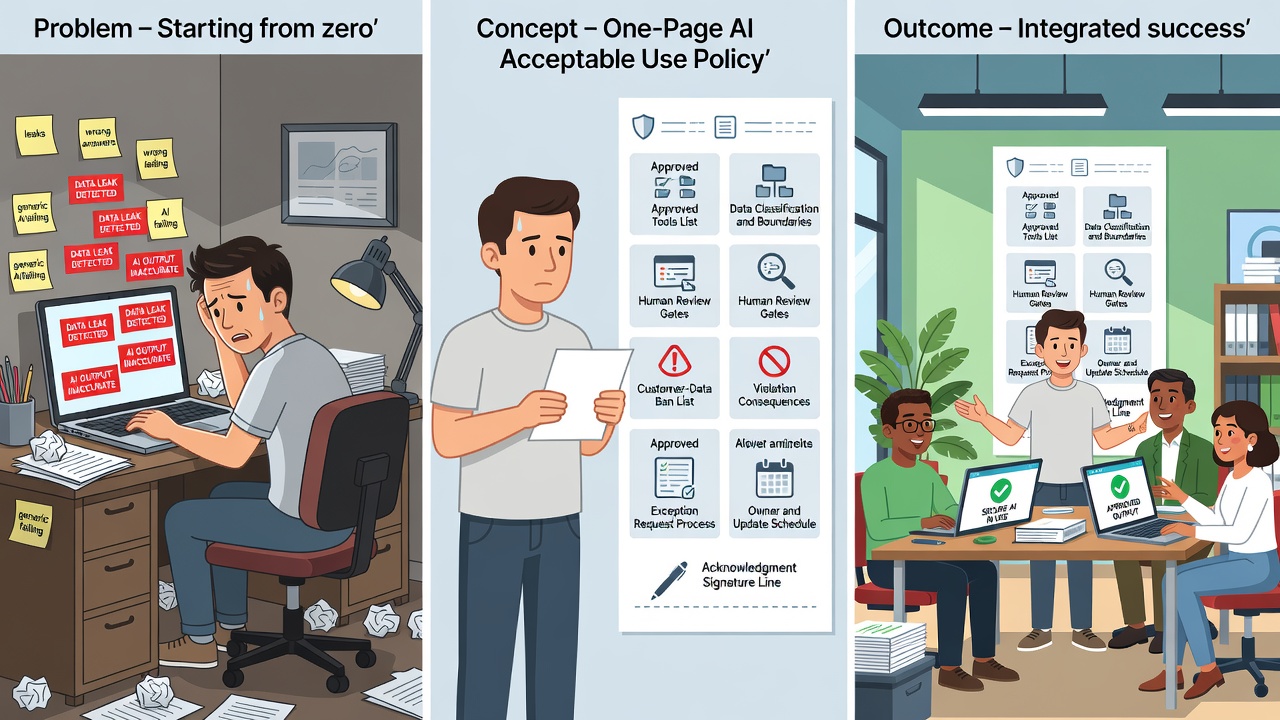
As your team becomes more comfortable with AI, establishing clear ethical guidelines becomes essential. This isn’t about creating bureaucratic obstacles—it’s about building trust and ensuring responsible use.
Key areas to address include:
Data privacy: What customer or business information should never be entered into AI tools? Many AI platforms use inputs for training purposes, making this consideration critical.
Transparency: When should customers or clients know that AI assisted in creating communications or making recommendations? Different industries and relationships may require different approaches.
Verification: What fact-checking processes should accompany AI-generated content? Given AI’s tendency toward hallucination, verification protocols protect your business reputation.
Human oversight: Which decisions require human approval even when AI provides recommendations? Maintaining appropriate human involvement ensures accountability.
Having these conversations proactively prevents problems and demonstrates to your team that AI adoption is being handled thoughtfully rather than recklessly [9].
Quick Win #5: Leverage Free and Low-Cost Learning Resources
Building AI literacy doesn’t require expensive training programs. The ecosystem of free and affordable learning resources has exploded, making quality education accessible to any small business.
Salesforce offers AI literacy resources specifically designed for small businesses and startups, covering practical applications rather than theoretical concepts [3]. Similarly, platforms like Enterprise Nation provide guidance tailored to small business contexts rather than enterprise environments [2].
For more structured learning, many AI tool providers offer free training on their specific platforms. These vendor-provided resources often prove more practical than generic AI courses because they focus on actual tool usage rather than abstract concepts.
Encourage team members to share resources they discover. A simple shared document or Slack channel where people post helpful tutorials, articles, or videos creates a collaborative learning environment that costs nothing but generates significant value [5].
Measuring Progress: How to Know Your Literacy Efforts Are Working
Building AI literacy is an ongoing process, not a one-time achievement. But how do you know if your efforts are actually working? Look for these indicators:
Increased AI tool adoption: Are team members voluntarily incorporating AI into their workflows? Genuine adoption—not mandated compliance—signals growing comfort and competency.
Quality of AI outputs: Are the results team members generate with AI assistance improving over time? Better prompting skills and tool selection indicate developing literacy.
Confident problem-solving: When new challenges arise, does your team consider AI-assisted approaches? This mindset shift suggests AI has become part of how they think about work.
Peer teaching: Are team members sharing tips and techniques with each other? When knowledge flows horizontally rather than just from leadership, literacy has become embedded in your culture.
Appropriate skepticism: Do team members verify AI outputs and recognize limitations? Healthy skepticism indicates sophisticated understanding rather than blind trust.
Track these indicators informally through regular conversations rather than formal assessments. The goal is understanding progress, not creating additional administrative burden.
Building Long-Term AI Culture
Quick wins provide momentum, but sustainable AI literacy requires embedding learning into your organizational culture. This means making AI competency part of how your business operates rather than a separate initiative.
Consider incorporating AI literacy into hiring criteria and onboarding processes. New team members should understand from day one that AI proficiency is valued and expected. Include AI tool training alongside other onboarding activities [9].
Celebrate AI wins publicly. When someone discovers an effective AI application or develops a particularly useful prompt, share it with the entire team. Recognition reinforces that AI experimentation is valued and encourages others to share their discoveries.
Stay current with AI developments. The technology evolves rapidly, and literacy requires ongoing learning. Designate someone—perhaps rotating responsibility—to monitor AI developments relevant to your industry and share updates with the team [4].
Most importantly, model the behavior you want to see. When leadership actively uses AI tools, discusses their learning process openly, and admits when they’re still figuring things out, it creates psychological safety for everyone else to do the same.
Common Pitfalls to Avoid
As you build AI literacy in your team, watch out for these common mistakes:
Moving too fast: Enthusiasm for AI can lead to overwhelming your team with too many tools and expectations simultaneously. Start with one or two applications and expand gradually.
Ignoring resistance: Some team members will be skeptical or fearful. Dismissing these concerns rather than addressing them creates underground resistance that undermines adoption.
Focusing only on efficiency: While time savings matter, framing AI purely as an efficiency tool misses opportunities for quality improvement, creativity enhancement, and competitive differentiation.
Neglecting human skills: AI literacy should complement, not replace, development of human capabilities like critical thinking, emotional intelligence, and creative problem-solving [9].
Conclusion: Your Competitive Advantage Awaits
The gap between AI-literate small businesses and those still hesitating grows wider every month. But here’s the encouraging news: building AI literacy doesn’t require massive investments or technical expertise. It requires intentionality, experimentation, and a commitment to learning together.
Start with the quick wins outlined here. Establish common vocabulary. Create space for experimentation. Develop role-specific guidance. Address ethics proactively. Leverage free resources. Then build on that foundation with ongoing learning and cultural reinforcement.
Your small team’s agility is a genuine advantage in this moment. While larger competitors navigate bureaucratic complexity, you can move quickly, learn rapidly, and build AI capabilities that transform your operations. The tools are accessible. The resources are available. The only question is whether you’ll seize the opportunity.
The businesses that thrive in the coming years won’t necessarily be those with the biggest AI budgets. They’ll be those whose teams understand how to work effectively alongside artificial intelligence—combining human judgment with machine capability in ways that create genuine value. That future is available to you, starting today.
Sources
- [1] https://insidesmallbusiness.com.au/latest-news/how-small-teams-can-actually-win-with-ai-in-2026 - Crystal Ricevuto on small team agility advantages in AI adoption
- [2] https://www.enterprisenation.com/learn-something/how-to-improve-ai-literacy-in-your-small-business/ - Enterprise Nation guide on improving AI literacy in small businesses
- [3] https://www.salesforce.com/blog/ai-literacy-for-small-business/ - Salesforce AI literacy resources for startups and small businesses
- [4] https://www.graygroupintl.com/blog/ai-upskilling-for-business - LinkedIn 2026 Workforce Learning Report statistics on AI skills gap
- [5] https://business.sparklight.com/the-wire/tech-talk/productivity/how-foster-ai-adoption-and-literacy-within-your-team - Guide on fostering AI adoption and literacy within teams
- [6] https://sureprompts.com/blog/ai-for-small-business-guide - Complete guide to using AI without a tech team
- [8] https://adratechsystems.com/en/resources/ai-for-small-business-guide-2026 - Statistics on small business AI adoption and ROI
- [9] https://smallbusinesscurrents.com/2026/03/11/balancing-innovation-and-people-how-small-businesses-can-build-a-thriving-ai-culture/ - Building thriving AI culture in small businesses