· The Rapid Architect Team · AI · 9 min read
AI Agents in 2026: Your Smartest Tool, Not Your Employee's Replacement
AI agents in 2026 are transforming business operations, but the smartest companies are using them to enhance employee capabilities rather than replace workers—here's how SMBs can implement this winning strategy.
Podcast Discussion
Introduction
Remember the panic of early 2023? Headlines screamed that AI agents would make human workers obsolete. AutoGPT burst onto the scene, promising to break down tasks, write code, and debug itself—all without human intervention. Tech Twitter went wild. Business owners everywhere wondered if they should start handing out pink slips [1].
Fast forward to 2026, and the reality looks remarkably different. AI agents have indeed transformed how we work, but not in the apocalyptic way many predicted. Instead of replacing your team, these intelligent systems have become something far more valuable: powerful tools that amplify what your employees can accomplish.
For small and medium business owners navigating this rapidly evolving landscape, understanding this distinction isn’t just academic—it’s essential for making smart investments and building a sustainable competitive advantage.
The Great Expectations Reset
Let’s be honest about what happened. The early AI agent hype created unrealistic expectations that simply couldn’t be met. Those autonomous systems that were supposed to run entire departments? They struggled with anything beyond narrowly defined tasks. The “set it and forget it” promise of fully autonomous AI workflows? It turned out that forgetting about your AI agents was a recipe for expensive mistakes [1].
Deloitte’s recent research reveals a sobering truth: many agentic AI implementations are failing. But here’s the crucial insight—they’re failing not because the technology isn’t powerful, but because organizations tried to use AI as a wholesale replacement for human-designed processes rather than as an enhancement to them [5].
The businesses finding success with AI agents in 2026 are those that “reimagine operations and manage agents as workers”—not as replacements for workers, but as a new category of contributor that requires its own form of oversight and integration [5].
Understanding the Tool vs. Replacement Distinction
Think about how you use a power drill. It doesn’t replace your carpenter—it makes your carpenter dramatically more effective. They still need to know where to drill, what size bit to use, and how to handle unexpected situations like hitting a pipe. The drill amplifies their expertise; it doesn’t substitute for it.
AI agents work the same way. As one industry analysis puts it, AI is “beginning to act as a collaborator that helps people think, decide, and execute” [3]. Notice the key word: helps. The human remains central to the process.
Consider what’s happening at Snowflake, the cloud-based data platform. A year ago, their engineers spent significant portions of their day on routine tasks like scanning dashboards and monitoring systems. Today, AI agents handle much of that routine work [7]. But here’s what didn’t happen: Snowflake didn’t fire those engineers. Instead, those engineers now focus on higher-value work—solving complex problems, innovating new solutions, and doing the creative thinking that AI simply cannot replicate.
The Collaboration Model That Actually Works
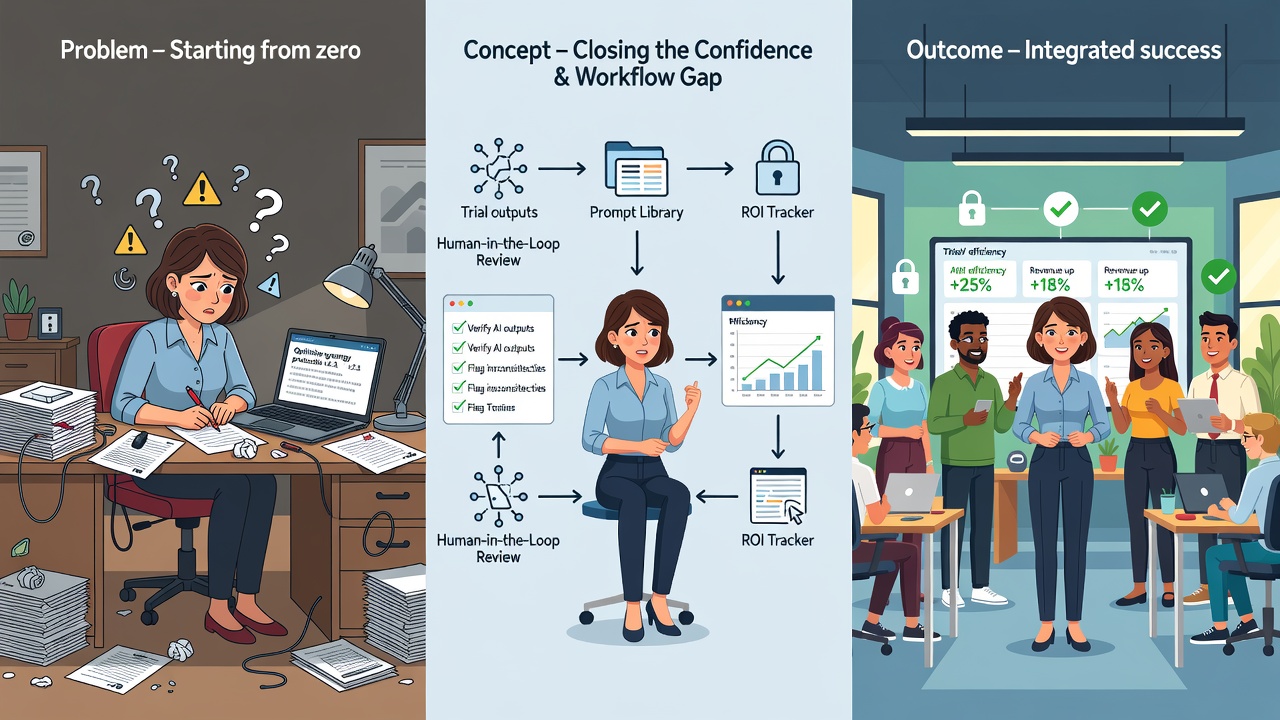
The most successful AI implementations in 2026 follow what experts call the “human-in-the-loop” model. Rather than attempting full autonomy, these systems keep humans involved at critical decision points while automating the routine work that consumes so much time [2].
Here’s what this looks like in practice for an SMB:
Customer Service: An AI agent handles initial customer inquiries, gathering information and resolving straightforward issues. When situations become complex or emotionally charged, the agent seamlessly hands off to a human team member—along with a complete summary of the conversation and suggested solutions. Your customer service rep doesn’t waste time asking “Can you spell your name again?” They jump straight into problem-solving.
Sales Operations: AI agents can research prospects, draft initial outreach emails, and even schedule meetings. But the actual relationship-building, negotiation, and closing? That remains firmly in human hands. The AI handles the tedious data gathering; your salespeople focus on what they do best—connecting with other humans.
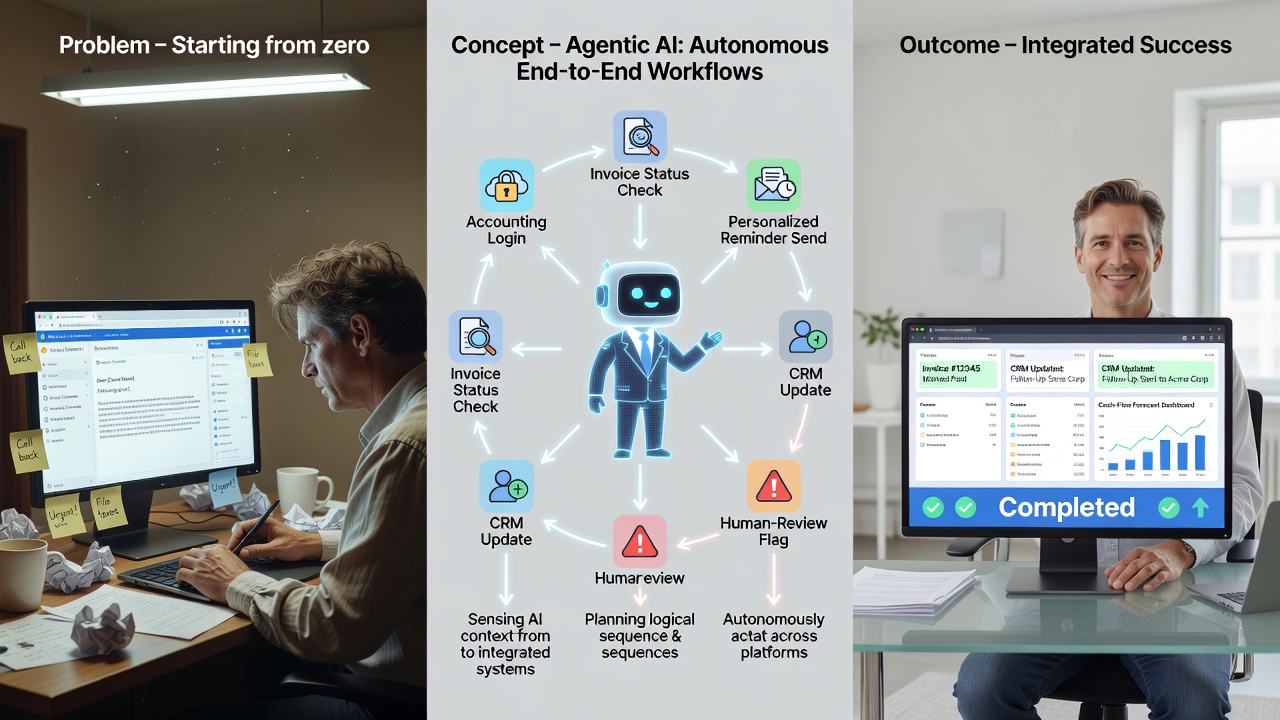
Financial Analysis: AI can process invoices, flag anomalies, and generate preliminary reports faster than any human. But interpreting those reports, making strategic decisions, and understanding the business context behind the numbers requires human judgment and experience.
Why Full Automation Fails (And Will Continue To)
There’s a fundamental reason why the “AI replaces employees” narrative keeps falling short: AI systems, no matter how sophisticated, lack what researchers call “contextual judgment.”
AI agents excel at pattern recognition and processing information at scale. They can analyze thousands of data points in seconds and identify trends that would take humans weeks to spot. But they struggle mightily with:
- Novel situations that don’t match their training data
- Ethical nuances that require weighing competing values
- Creative problem-solving that demands thinking outside established patterns
- Emotional intelligence and reading the unspoken dynamics in human interactions
- Accountability for decisions with significant consequences
As Harvard Business Review notes in their analysis of 2026 workplace trends, CEO expectations for AI-driven growth remain high, but the path to that growth runs through human-AI collaboration, not human replacement [9].
The Real Threat: Task Erosion, Not Job Elimination
Here’s where SMB owners need to pay close attention. While AI isn’t replacing employees wholesale, it is changing what those employees do. One analyst describes it as AI “quietly stealing your job one task at a time” [4].
This isn’t necessarily a bad thing—in fact, it can be tremendously positive. The tasks being automated are often the ones employees like least: data entry, routine correspondence, basic research, and repetitive analysis. When AI handles these tasks, employees can focus on work that’s more engaging, more creative, and often more valuable to the business.
But this shift requires intentional management. If you implement AI tools without rethinking roles and responsibilities, you’ll end up with confused employees, underutilized AI, and wasted investment. The businesses winning with AI in 2026 are those that proactively redesign jobs to take advantage of human-AI collaboration.
Practical Steps for SMB Owners
So how do you actually implement AI as a tool rather than a replacement? Here’s a framework that’s working for forward-thinking SMBs:
Step 1: Audit Your Workflows
Before investing in any AI solution, map out your key business processes. Identify tasks that are:
- Repetitive and rule-based (good AI candidates)
- Creative and judgment-intensive (keep human)
- High-stakes decisions (keep human with AI support)
- Customer-facing and emotionally sensitive (human-led, AI-assisted)
Step 2: Start Small and Specific
The failed AI implementations Deloitte identified share a common trait: they tried to automate too much, too fast [5]. Instead, pick one well-defined process where AI can add clear value. Prove the concept, learn from the experience, then expand.
Step 3: Involve Your Team
Your employees know their jobs better than any consultant or vendor. Involve them in identifying automation opportunities and designing new workflows. This accomplishes two things: you get better solutions, and you build buy-in rather than resistance.
Step 4: Invest in Training
AI tools are only as effective as the people using them. Budget for training—not just on the technical aspects of the tools, but on the new ways of working they enable. Your customer service rep needs to learn not just how to use the AI system, but how to add value in a world where AI handles routine inquiries.
Step 5: Measure What Matters
Don’t just track whether AI is completing tasks. Measure outcomes that matter to your business: customer satisfaction, employee productivity, error rates, and revenue impact. If your AI implementation isn’t moving these needles, something needs to change.
The Competitive Advantage of Getting This Right
Here’s the exciting part for SMB owners: the businesses that figure out human-AI collaboration gain a significant competitive advantage. They can operate with the efficiency of much larger organizations while maintaining the personal touch and agility that make small businesses special.
Consider a local accounting firm that implements AI for data processing and preliminary analysis. Their accountants can now serve more clients without sacrificing quality. But unlike a fully automated solution, they still provide the personal relationships, nuanced advice, and human judgment that clients value. They’re not competing on price with AI-only solutions; they’re competing on value with a human-AI hybrid approach that delivers the best of both worlds.
KPMG’s research indicates that 2025 set the stage for “agent-driven enterprise reinvention” in 2026 [10]. The key word is reinvention—not replacement. The enterprises seeing success are those reinventing how work gets done, not simply swapping humans for machines.
The Human Skills Premium
As AI handles more routine tasks, the value of distinctly human skills increases. Emotional intelligence, creative thinking, ethical judgment, and complex problem-solving become more valuable, not less, in an AI-augmented workplace.
For SMB owners, this means:
- Hire for human skills: Technical skills can be augmented by AI; human skills cannot.
- Develop your team: Invest in training that builds judgment, creativity, and emotional intelligence.
- Reward what matters: Recognize and compensate employees for the uniquely human contributions that AI can’t replicate.
Looking Ahead: The Evolution Continues
AI technology will continue advancing. The agents of 2028 will be more capable than those of 2026, just as today’s tools far exceed what was possible in 2023. But the fundamental dynamic—AI as tool, humans as decision-makers—is likely to persist for the foreseeable future.
The organizations building sustainable success are those treating AI agents as “trusted work partners” rather than autonomous replacements [3]. They’re creating what some call a “silicon-based workforce” that works alongside the carbon-based one, each contributing their unique strengths [5].
Conclusion: Your Toolbox Just Got More Powerful
The narrative has shifted, and SMB owners who recognize this shift position themselves for success. AI agents aren’t coming for your employees’ jobs—they’re coming to make your employees more effective, more productive, and more valuable.
The businesses that thrive in 2026 and beyond will be those that view AI as the most powerful addition to their toolbox in a generation. Like any tool, AI requires skill to use effectively. It needs maintenance, oversight, and a human hand guiding it toward valuable outcomes.
Your employees remain your most important asset. AI agents are there to amplify their capabilities, handle their tedious tasks, and free them to do the creative, judgment-intensive, relationship-building work that only humans can do.
The question isn’t whether to adopt AI—that ship has sailed. The question is whether you’ll adopt it thoughtfully, as a tool that enhances your team, or carelessly, as a replacement that never quite delivers on its promise.
Choose the toolbox approach. Your employees—and your bottom line—will thank you.
Sources
- [1] http://oreateai.com/blog/beyond-the-buzzwords-how-ai-agents-are-reshaping-not-replacing-our-workflows/ - Analysis of how AI agents reshape rather than replace workflows
- [2] https://building.theatlantic.com/why-ai-is-becoming-a-coworker-not-a-tool-acda3d20644d - ODSC article on AI as coworker collaboration model
- [3] https://talent500.com/blog/ai-agents-2026-digital-partners/ - Overview of AI agents as trusted work partners in 2026
- [4] https://newsletter.workitdaily.com/p/ai-is-quietly-stealing-your-job-one-task-at-a-time - Analysis of task-level AI automation impact
- [5] https://www.deloitte.com/us/en/insights/topics/technology-management/tech-trends/2026/agentic-ai-strategy.html - Deloitte research on agentic AI implementation challenges and successes
- [7] https://www.aljazeera.com/economy/2026/3/8/the-new-boss-at-work-may-not-be - Al Jazeera report on AI reshaping workplace hierarchies including Snowflake example
- [9] https://hbr.org/2026/02/9-trends-shaping-work-in-2026-and-beyond - Harvard Business Review analysis of 2026 workplace trends
- [10] https://kpmg.com/us/en/media/news/q4-ai-pulse.html - KPMG research on agent-driven enterprise reinvention