· The Rapid Architect Team · AI · 10 min read
Beyond Chatbots: How Agentic AI Is Becoming Your Business's 24/7 Digital Workforce
Discover how agentic AI is transforming from simple chatbots into autonomous digital workers that handle complete business workflows like invoice processing, lead follow-up, and social media management—operating as your 24/7 staff without constant human supervision.

Teaser Video
Podcast Discussion
Introduction
Remember when chatbots felt revolutionary? You’d type a question, get an answer, and marvel at how far technology had come. Fast forward to 2026, and those chatbots now seem quaint—like comparing a calculator to a smartphone. The artificial intelligence landscape has undergone a seismic shift, and if you’re running a small or medium business, understanding this change could be the difference between thriving and merely surviving.
We’re witnessing what industry experts call the transition from “artificial intelligence that talks” to “artificial intelligence that acts.” In fewer than 18 months, Gartner predicts that 40% of enterprise applications will include some form of artificial intelligence agent—up from less than 5% in 2025 [4]. This isn’t gradual adoption; it’s a structural transformation in how businesses operate. And the good news? SMBs are perfectly positioned to benefit.
The Evolution: From Copilots to Autonomous Agents
To understand where we’re headed, let’s briefly examine where we’ve been. The artificial intelligence journey for most businesses followed a predictable path: first came basic chatbots that answered FAQs, then “copilots” that helped draft emails and summarize meetings. These tools were genuinely useful, but they shared a fundamental limitation—they required constant human prompting and supervision [9].
As one industry analysis bluntly puts it: “Most agentic artificial intelligence is just chatbots with extra steps… a natural language interface, a few tool calls, maybe a multi-turn conversation. That is not an agent. That is a chatbot with an API wrapper” [2].
True agentic artificial intelligence represents something fundamentally different. These systems don’t just respond to prompts—they pursue goals independently, planning actions, using tools, and adapting based on results [10]. Think of the difference between asking an assistant to “help me write an invoice” versus telling them to “make sure all our invoices get paid on time.” The first requires your constant involvement; the second delegates an entire outcome.
What Makes Agentic artificial intelligence Different?
The technical distinction matters because it directly impacts what these systems can do for your business. Traditional artificial intelligence assistants operate in a request-response loop: you ask, they answer, you act. Agentic artificial intelligence operates in a goal-execution loop: you define an objective, and the system plans, executes, monitors, and adjusts until that objective is achieved [1].
This shift positions agentic artificial intelligence “at the heart of operational execution, moving beyond assistance into autonomous action” [1]. The implications are profound. Instead of artificial intelligence that helps you do your work faster, you now have artificial intelligence that does certain work entirely on your behalf.
Consider the core capabilities that define true agentic systems:
Autonomous Planning: The agent breaks down complex goals into actionable steps without requiring human guidance for each decision.
Tool Usage: Rather than just generating text, agents can access databases, trigger actions in other software, send communications, and interact with multiple business systems.
Adaptive Execution: When something unexpected happens—a payment fails, a lead responds unusually, a document is missing information—the agent adjusts its approach rather than simply stopping and waiting for instructions.
Persistent Memory: Unlike chatbots that forget everything between sessions, agentic systems maintain context over time, learning from past interactions and outcomes [7].
Real-World Workflows: Where Agentic artificial intelligence Shines
Let’s move from theory to practice. Here are the workflows where SMBs are seeing the most immediate value from agentic artificial intelligence deployment:
Invoice-to-Paid Automation
The traditional accounts receivable process involves creating invoices, sending them, tracking responses, sending reminders, following up on late payments, reconciling when payments arrive, and handling exceptions. Each step typically requires human attention.
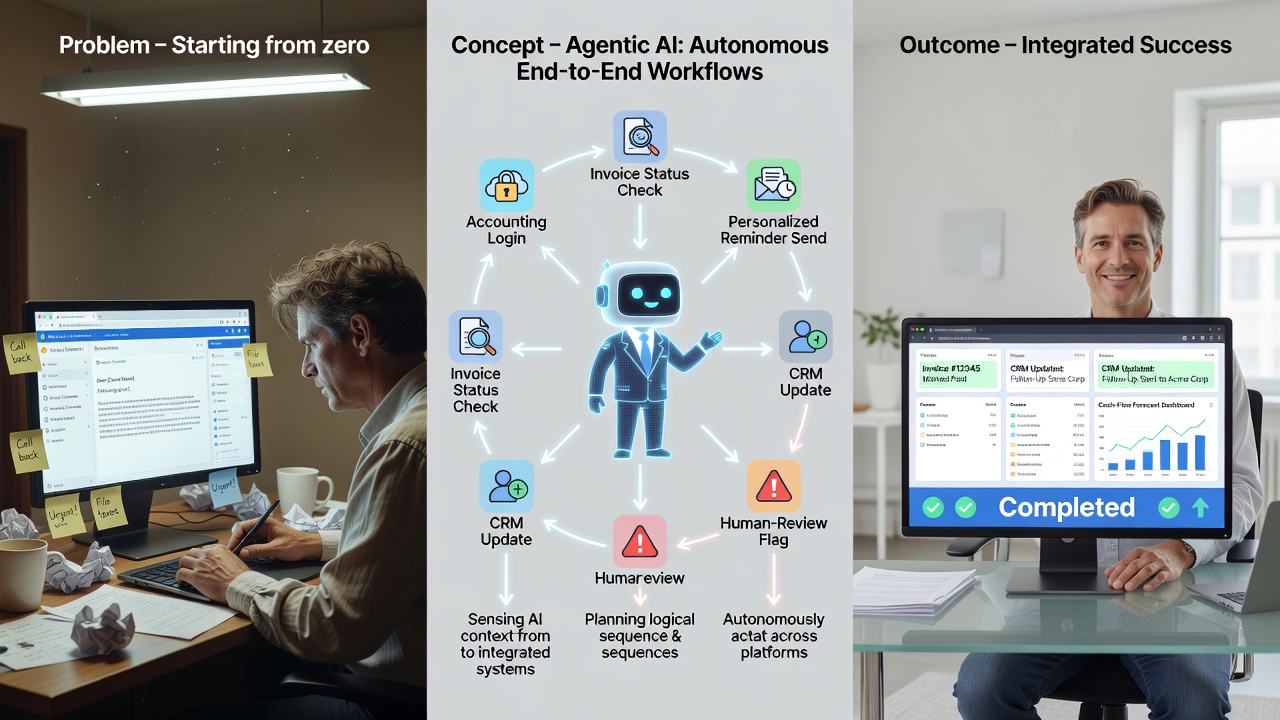
An agentic artificial intelligence system handles this entire workflow autonomously. It monitors for completed work or delivered products, generates appropriate invoices, sends them through preferred channels, tracks payment status, escalates follow-ups based on customer history and payment patterns, processes incoming payments, reconciles accounts, and flags genuine problems for human review [3].
The key insight here is that the agent isn’t just automating individual tasks—it’s managing an entire business process with the judgment to handle variations and exceptions.
Comprehensive Social Media Management
Social media management traditionally requires constant attention: monitoring trends, creating content, scheduling posts, responding to comments, analyzing performance, and adjusting strategy. For SMBs without dedicated marketing staff, this often falls through the cracks.
Agentic artificial intelligence systems now handle the complete social media lifecycle. They analyze your brand voice and audience engagement patterns, generate content aligned with your strategy, schedule posts for optimal timing, monitor and respond to comments and messages, track performance metrics, and adjust future content based on what’s working [8].
This isn’t the same as scheduling tools or artificial intelligence writing assistants you might have used before. The agent maintains strategic coherence across all activities, learning and adapting over time rather than executing isolated tasks.
Lead Follow-Up and Qualification
Perhaps nowhere is the “24/7 staff” metaphor more apt than in lead management. Traditional lead follow-up suffers from a fundamental timing problem: leads come in at all hours, but your sales team works limited hours. Studies consistently show that response time dramatically impacts conversion rates.
Agentic artificial intelligence transforms this dynamic. When a lead comes in—whether at 2 PM or 2 AM—the agent immediately engages, qualifying the prospect through natural conversation, gathering relevant information, answering initial questions, and scheduling meetings with human salespeople when appropriate [3].
But the sophistication goes deeper. These systems research prospects using available data sources, personalize outreach based on company information and likely pain points, and maintain persistent follow-up sequences that adapt based on prospect responses [3]. One practical guide notes that effective lead qualification agents “gather context from CRM, enrich data, and route leads with a confidence score—reducing manual qualification time by 70%” [3].
Support Ticket Triage and Resolution
Customer support represents another high-impact application. Traditional support requires human agents to read each ticket, categorize it, determine urgency, route it appropriately, and often handle resolution. This creates bottlenecks and delays.
Agentic artificial intelligence systems now handle the complete triage process: analyzing incoming tickets, categorizing issues, determining urgency based on customer history and issue type, routing to appropriate resources, and—increasingly—resolving straightforward issues entirely without human involvement [3]. Complex issues still reach human agents, but those agents receive pre-researched context and suggested solutions, dramatically reducing resolution time.
The Business Case: Why This Matters for SMBs
Large enterprises have always been able to throw bodies at operational challenges. Need 24/7 coverage? Hire three shifts. Need faster invoice processing? Add more accounting staff. SMBs rarely have this luxury.
Agentic artificial intelligence fundamentally changes this equation. As one analysis frames it, these systems act as “24/7 staff” that never sleep, never take vacations, and scale instantly with demand [6]. For an SMB, this means competing on operational capability with much larger organizations.
The productivity gains are substantial but often misunderstood. The value isn’t primarily in doing existing tasks faster—it’s in doing tasks that simply weren’t getting done. That lead that came in Friday evening and wasn’t followed up until Monday? Now it’s engaged within minutes. Those invoice reminders that fell through the cracks during busy periods? Now they’re sent consistently and persistently.
Implementation Reality: Starting Points for SMBs
If you’re convinced of the potential but uncertain where to start, here’s practical guidance based on what’s working for SMBs in 2026:
Start with high-volume, rule-based workflows: The best initial candidates for agentic artificial intelligence are processes that happen frequently, follow relatively predictable patterns, but still require judgment that traditional automation couldn’t handle [5]. Invoice processing, lead qualification, and support triage fit this profile well.
Define clear success metrics before deployment: What does success look like? Faster response times? Higher conversion rates? Reduced manual processing time? Define these upfront so you can evaluate performance objectively [5].
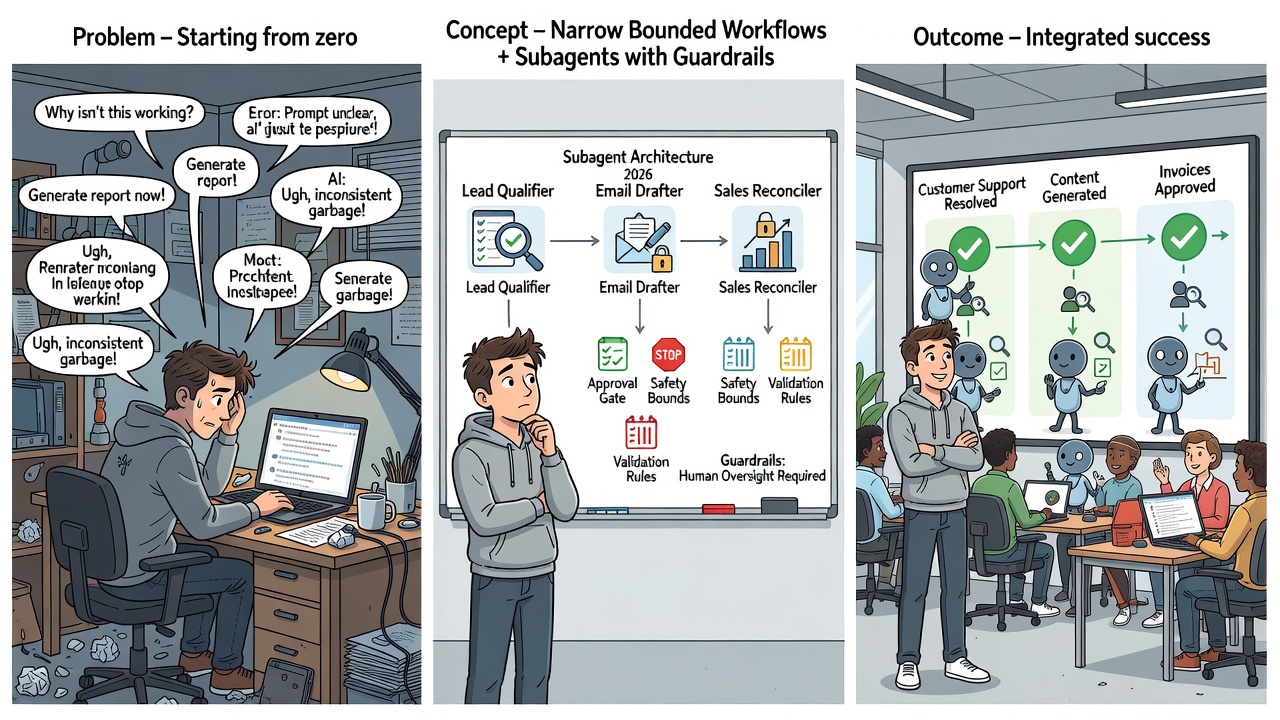
Plan for human oversight, especially initially: The most successful implementations maintain what experts call “human-in-the-loop” checkpoints for high-stakes decisions [6]. As you build confidence in the system’s judgment, you can gradually expand its autonomous authority.
Ensure proper integration with existing systems: Agentic artificial intelligence derives much of its power from accessing and acting within your existing business systems—CRM, accounting software, communication platforms. Poor integration dramatically limits effectiveness [5].
Governance and Risk Management
With greater autonomy comes greater responsibility—for both the artificial intelligence and the humans deploying it. SMBs implementing agentic artificial intelligence need to consider several governance dimensions:
Access controls: What systems can the agent access? What actions can it take? Proper scoping prevents both errors and security vulnerabilities [6].
Audit trails: When an agent takes action, you need clear records of what it did and why. This matters for compliance, debugging, and continuous improvement [5].
Escalation protocols: Define clear triggers for when agents should stop and involve humans. Financial thresholds, unusual situations, and customer complaints often warrant human judgment [6].
Regular review cycles: Agentic systems should be reviewed regularly to ensure they’re still aligned with business objectives and operating as intended [5].
The Competitive Landscape: Act Now or Catch Up Later
The adoption curve for agentic artificial intelligence is steep. Organizations implementing these systems now are building operational advantages that compound over time—their agents learn and improve, their processes become more efficient, and their human staff focuses increasingly on high-value activities that genuinely require human judgment [9].
Waiting carries real costs. As one analysis notes, businesses relying solely on copilot-style artificial intelligence are “noticing a new pattern: productivity gains plateau and humans remain the bottleneck” [9]. The firms pulling ahead are those embracing artificial intelligence that acts, not just artificial intelligence that assists.
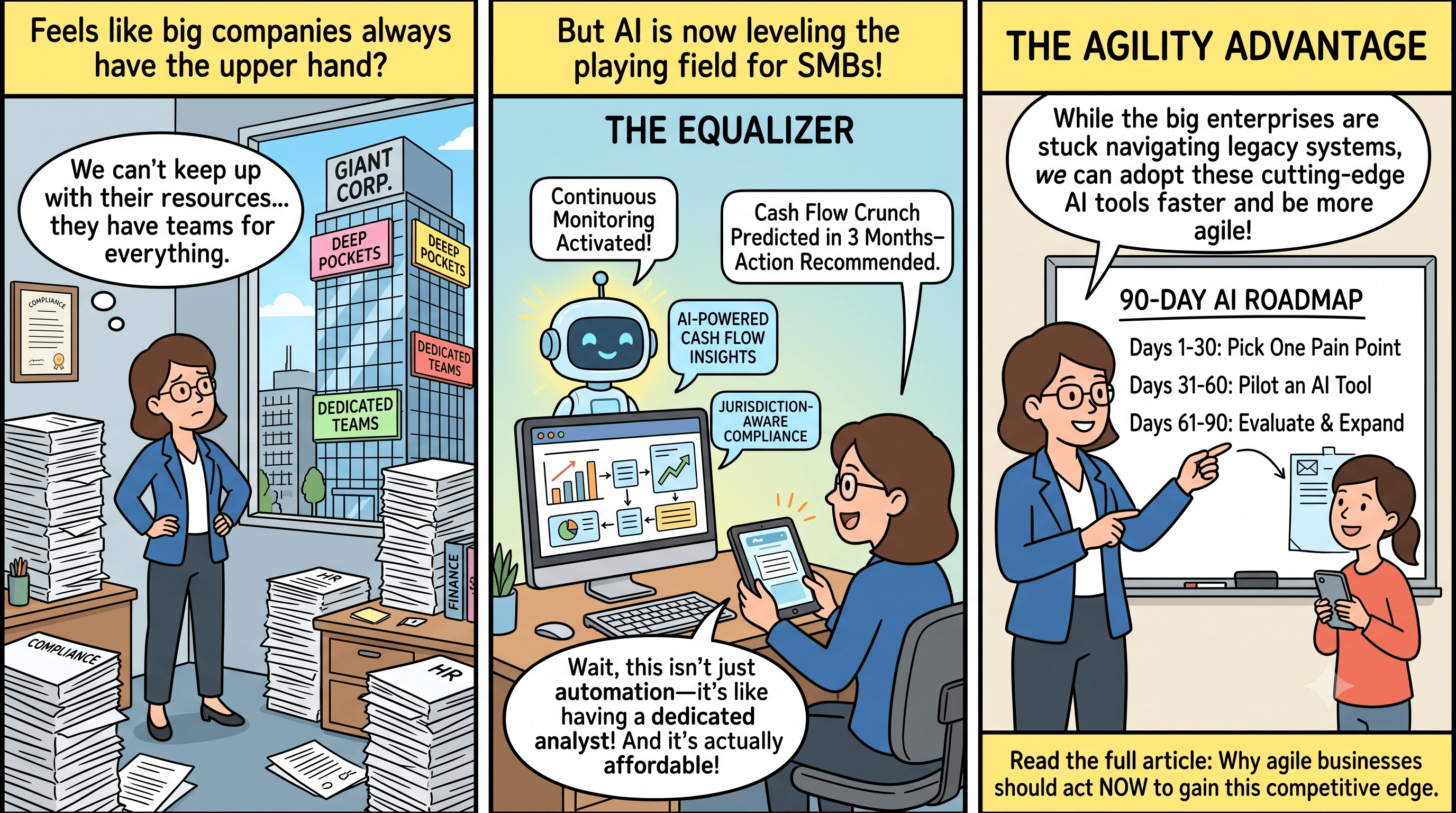
For SMBs specifically, the window of opportunity is significant. Enterprise adoption of agentic artificial intelligence is accelerating, but complexity and legacy systems slow large organizations. SMBs can often implement more quickly and adapt more readily, potentially leapfrogging larger competitors in operational capability.
Looking Ahead: The Multi-Agent Future
The current wave of agentic artificial intelligence typically involves single agents handling specific workflows. The next evolution—already emerging—involves multi-agent systems where specialized agents collaborate on complex objectives [7].
Imagine a sales agent that qualifies leads, hands off to an onboarding agent that sets up new customers, coordinates with a support agent that handles initial questions, and reports to an analytics agent that identifies patterns and opportunities. This orchestrated approach multiplies the impact of individual agents.
For SMBs, this future means even more sophisticated automation becomes accessible without proportional increases in complexity or cost.
Conclusion: Your 24/7 Digital Workforce Awaits
The shift from chatbots and copilots to agentic artificial intelligence represents more than an incremental improvement—it’s a fundamental change in what artificial intelligence can do for your business. We’re moving from artificial intelligence that helps you work to artificial intelligence that works for you.
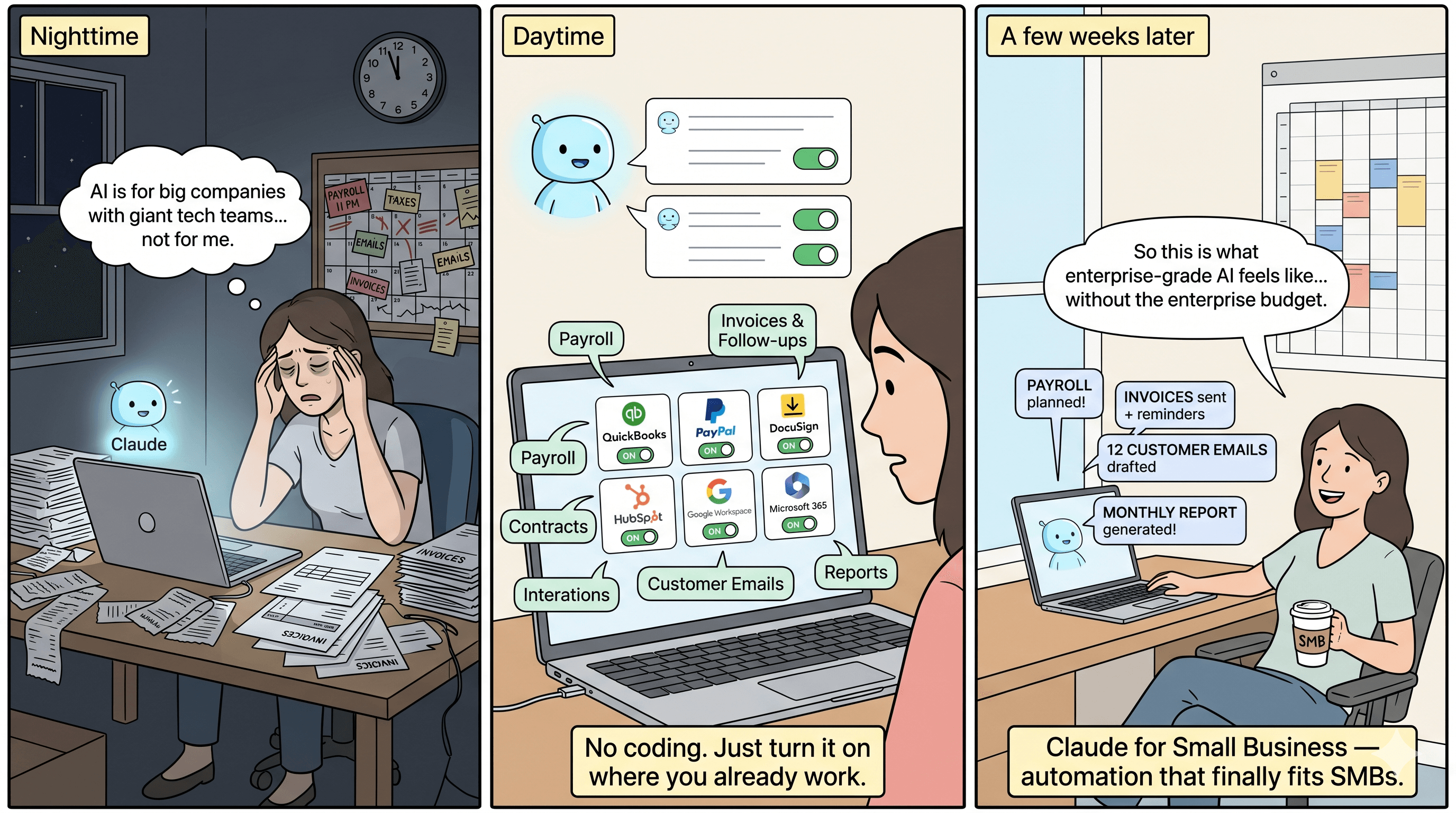
For small and medium businesses, this transition offers unprecedented opportunity. The operational capabilities that once required large teams and significant budgets are becoming accessible through intelligent automation that plans, executes, and adapts autonomously.
The practical path forward starts with identifying high-impact workflows in your business—lead follow-up, invoice management, customer support, social media—and exploring how agentic artificial intelligence might transform them. Begin with clear objectives, maintain appropriate oversight, and scale as you build confidence.
The businesses that thrive in this new landscape won’t be those with the most employees or the biggest budgets. They’ll be those that most effectively leverage artificial intelligence agents as genuine members of their operational teams—digital staff that work around the clock, learn continuously, and free human talent for the creative, strategic, and relationship-building work that truly requires a human touch.
The future of business automation isn’t about replacing humans—it’s about augmenting human capability with tireless, intelligent agents that handle the operational heavy lifting. That future is here, and it’s accessible to businesses of every size.
Sources
- [1] https://blog.novatalk.ai/2026/02/24/agentic-ai-2026-enterprise-productivity-autonomous-systems/ - Overview of agentic AI positioning in enterprise operational execution
- [2] https://casys.ai/blog/agentic-ai-guide - Critical analysis distinguishing true agentic AI from chatbots with API wrappers
- [3] https://www.novakit.ai/blog/ai-agents-business-automation-practical-guide - Practical guide to AI agent workflows including lead qualification and invoice processing
- [4] https://neurosignal.tech/from-chatbots-to-agents-the-rise-of-autonomous-goal-oriented-ai-in-enterprise-workflows/ - Gartner statistics on AI agent adoption trajectory
- [5] https://jishulabs.com/blog/building-ai-agents-enterprise-2026 - Enterprise implementation guide covering architecture and governance
- [6] https://layerlogix.com/blog/agentic-ai-2026-autonomous-ai-business-operations - Business operations guide with governance and safety considerations
- [7] https://lucaberton.com/blog/agentic-ai-multiagent-systems-2026/ - Analysis of multi-agent systems and autonomous workflow execution
- [8] https://passhulk.com/blog/agentic-ai-workflow-automation-guide/ - Enterprise guide to agentic AI for workflow automation
- [9] https://360degreecloud.com/blog/beyond-the-copilot-why-2026-is-the-year-of-the-agentic-ai-enterprise/ - Analysis of productivity plateau with copilots and shift to agentic AI
- [10] https://www.vybe.build/blog/what-is-agentic-ai - Complete guide to agentic AI capabilities and goal-independent operation