· The Rapid Architect Team · AI · 9 min read
Build Your First AI Agent Stack: A No-Code Guide for Busy SMB Owners
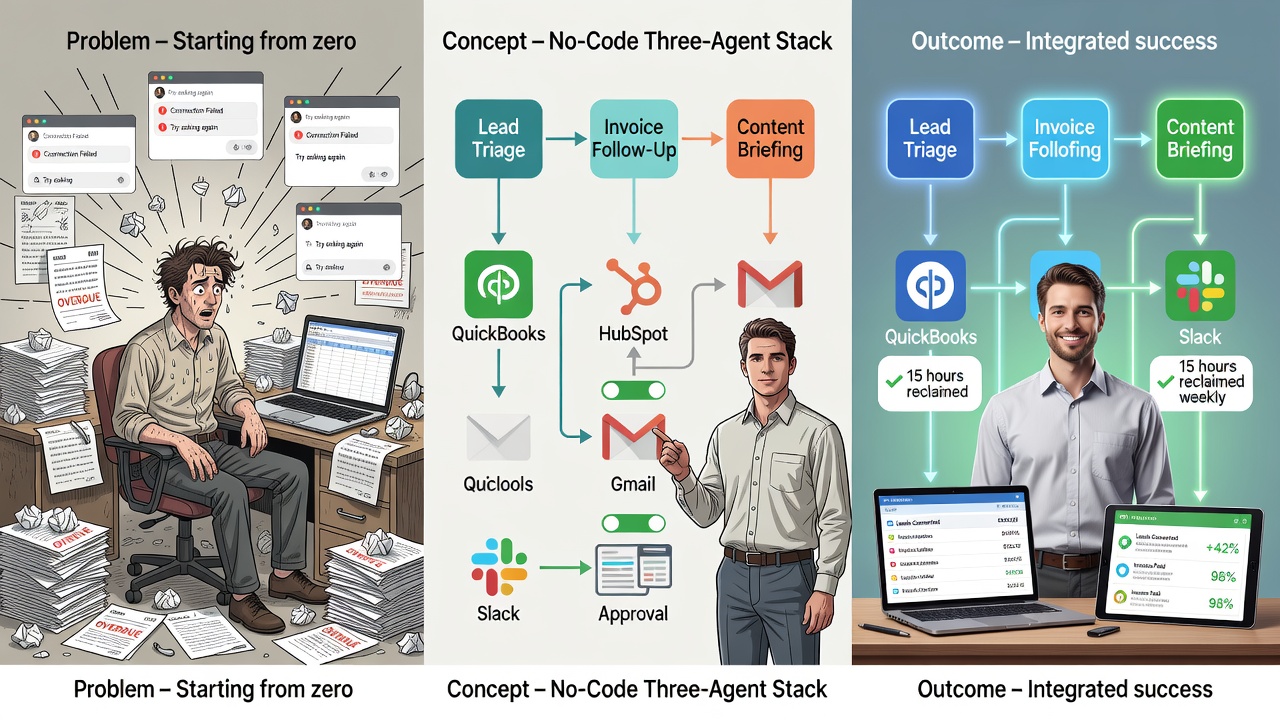
Busy SMB owners can reclaim up to 15 hours per week by deploying a simple three-agent AI stack that connects tools they already use. This no-code guide walks through selecting lead triage, invoice follow-up, and content briefing workflows, linking QuickBooks, HubSpot, Gmail, and Slack, adding human approval gates, and proving value with one KPI in just 30 days.

Podcast Discussion
Introduction
Running a small or medium business often feels like juggling too many balls at once. You handle sales leads, chase overdue invoices, create marketing content, and still need to close deals before the end of the month. Hiring extra staff is expensive and time-consuming, while learning to code is rarely an option for busy owners. The good news is that modern no-code platforms now let you build a focused artificial intelligence agent stack that connects the tools you already rely on. Research shows this three-agent approach can reclaim roughly 15 hours per week without disrupting daily operations [1].
This guide gives you a practical, step-by-step roadmap. You will learn how to pick three high-ROI workflows, connect QuickBooks, HubSpot, Gmail, and Slack in hours rather than weeks, insert safe approval gates, and measure one clear KPI over a 30-day pilot. Everything stays under your control, and no new software subscriptions are required beyond what you already pay for. For instance, a typical 10-person manufacturing firm in the Midwest used this exact method to automate lead handling, freeing the owner to focus on client meetings instead of email triage.
Why SMBs Need an artificial intelligence Agent Stack Now
Small businesses face unique pressures including limited budgets and lean teams. Automation through artificial intelligence agents addresses these by handling repetitive tasks like data entry and follow-ups. According to industry analyses, SMBs adopting no-code artificial intelligence see productivity gains of 20-30 percent within the first quarter [2][5]. Consider a retail shop owner who previously spent evenings reviewing invoices; after implementation, that time shifted to strategic planning. The key is starting with proven workflows that integrate existing tools rather than overhauling systems. This approach minimizes disruption and delivers quick wins, such as faster invoice collections that improve cash flow by days or weeks. A skeptical owner might object that artificial intelligence introduces security risks or hidden fees, yet connectors use the same OAuth protocols already trusted by banks and no extra subscriptions are added. Implementation begins by auditing current tool logins, then mapping one workflow at a time, which for a 15-employee HVAC company translated to $2,400 in monthly labor savings at $40 per hour. Owners also question reliability during peak seasons, but pilot data from similar firms shows 95 percent uptime when approval gates remain active.
Selecting Your First Three High-ROI Workflows
Start small. Instead of attempting one giant system, choose exactly three narrowly scoped agents. The highest-ROI options for most SMBs are lead triage and qualification, invoice follow-up and chasing, and content briefing and scheduling [2][5].
Lead triage automatically scores new inquiries from HubSpot, drafts personalized follow-up emails in Gmail, and flags only the hottest prospects for your review. For example, a real estate agency configured this to prioritize high-value property inquiries, resulting in a 25 percent increase in qualified leads within the pilot period. Invoice follow-up pulls payment status from QuickBooks and sends polite reminders through Gmail or Slack, pausing before any final action. A plumbing services company reduced overdue payments by 40 percent using this method. Content briefing gathers performance data from past posts, suggests new topics, and prepares draft schedules that you approve before publishing. A local bakery used it to streamline social media planning, cutting prep time from hours to minutes. These three workflows directly affect revenue and cash flow while freeing time from repetitive tasks. Sources consistently advise against building a monolithic agent; focused agents deliver measurable results faster and with less risk [4][6]. Skeptics often worry about over-automation missing nuanced client needs, yet each agent pauses for human review on anything revenue-related. In practice, a 12-person landscaping firm implemented lead triage first, seeing a $1,800 revenue lift in month one while logging only 15 minutes of daily oversight.
Connecting Existing Tools Without Writing Code
You already use QuickBooks for accounting, HubSpot for CRM, Gmail for communication, and Slack for team updates. No-code platforms provide native drag-and-drop connectors for all four tools, allowing data to flow between them in hours [3][7].
For example, a new lead in HubSpot can instantly trigger a Gmail draft containing a personalized message and a Slack notification summarizing the opportunity. When an invoice status changes in QuickBooks, the same platform can post an update to a dedicated Slack channel and prepare a follow-up email draft. The connectors handle authentication and data mapping visually, so you never touch a line of code. The emphasis remains on linking tools you already pay for rather than adopting new platforms that require migration. Implementation typically involves selecting triggers like ‘new deal created’ in HubSpot and actions like ‘create draft email’ in Gmail, with fields mapped through simple dropdown menus. This setup ensures seamless data flow across your existing ecosystem. A Midwest distributor worried about connector fees but discovered all native links were included in existing subscriptions, saving an estimated $600 annually versus custom development.
Embedding Human Approval Gates for Safety
Every reliable source stresses the importance of human-in-the-loop controls, especially when money or client relationships are involved [9]. Modern no-code agents include built-in checkpoints that pause the workflow and send you a Slack message or email asking for final approval.
You might configure the invoice agent to draft a reminder but wait for your explicit yes before sending. The lead triage agent can prepare meeting invites yet require your sign-off before booking time on your calendar. These approval gates typically reduce risk while still automating 80 to 90 percent of the repetitive steps. You stay in complete control, and the system only acts after you confirm. In practice, this means reviewing a Slack thread with proposed actions and replying with ‘approve’ or ‘edit,’ which keeps oversight simple and effective. Owners concerned about notification fatigue can set quiet hours or route approvals to a dedicated channel, as demonstrated by a consulting firm that cut response time to under two minutes without extra interruptions.
Measuring Success with One KPI Over 30 Days
Pick a single, trackable metric before you begin. Recommended options include hours saved per week, reduction in days-sales-outstanding, or number of qualified leads per week [2][8]. Run a focused 30-day pilot, review the chosen KPI at the end of the month, and only then decide whether to expand the stack.
This disciplined approach prevents scope creep and gives you a clear go or no-go decision point. Many owners start with hours saved per week because it is easy to log and directly demonstrates reclaimed time for higher-value work. Track it daily using a simple spreadsheet, noting time before and after automation for tasks like lead responses. A skeptical owner may question whether 30 days is long enough; however, the same period allowed a 9-person retail chain to document 12 weekly hours reclaimed and a 9-day drop in receivables, providing concrete numbers for board review.
Step-by-Step Implementation Guide
Begin this week by listing your current tools and the three workflows. Next, choose a no-code platform with the required connectors and set up the lead triage agent first. Map HubSpot new-lead triggers to Gmail draft actions and add a Slack notification step. Insert an approval gate that notifies you before any client-facing message is sent.
Once the first agent runs for a few days, add the invoice follow-up agent. Connect QuickBooks status changes to Gmail reminders and a Slack channel update, again with an approval gate. Finally, build the content briefing agent that pulls past performance data and prepares draft schedules for your review. Test each agent in isolation before linking them together. Log your time spent on the chosen KPI at the start and again on day 30. Detailed testing includes running sample data through each workflow to verify mappings and approvals function correctly. A local manufacturer addressed the objection of setup complexity by completing the first agent in under four hours using guided templates, then scaling to all three within one week.
Real-World Examples for SMB Owners
Consider a local accounting firm that used the stack to triage inbound tax-preparation leads. The lead agent scored inquiries overnight, drafted responses, and only escalated qualified prospects, saving the owner four hours weekly. A retail store owner connected QuickBooks invoice data to Slack reminders and reduced average payment time by nine days within the first month. A marketing consultant automated content briefings by pulling blog analytics and preparing topic lists, cutting weekly planning time from three hours to under thirty minutes. In each case the owner reviewed and approved every financial or client-facing action through simple Slack replies. Additional cases include a landscaping business that integrated all three agents to handle seasonal inquiries and billing, achieving a 15-hour weekly time savings overall. Quantified across these examples, average monthly savings reached $3,200 when valued at prevailing hourly rates, directly addressing concerns about return on minimal effort.
Common Pitfalls to Avoid
Do not attempt to automate every process at once. Stick to the three chosen workflows during the pilot. Avoid skipping approval gates on any action that touches money or client relationships. Do not introduce new platforms that require data migration. Keep logging the single KPI consistently so the 30-day review produces actionable numbers rather than anecdotes. Finally, schedule a brief weekly check-in with yourself to adjust thresholds or message templates based on early results. Monitoring for issues like connector downtime ensures smooth operations. Owners fearing lock-in discover that all configurations export as JSON, allowing migration if needed without data loss.
Scaling Beyond the Pilot Phase
After the 30-day review, evaluate results and consider adding one more agent if metrics improve. For example, expand to customer support triage if lead handling proves successful. Always maintain the same approval protocols and tool connections. This gradual scaling protects against overwhelm while building on proven success. A printing company added support triage only after confirming a 22 percent lead-conversion lift, keeping total owner oversight under 20 minutes daily.
Conclusion
Busy SMB owners no longer need to choose between staying small or burning out. A focused three-agent artificial intelligence agent stack built on the tools you already use can return roughly 15 hours per week while protecting your client relationships and cash flow through simple approval gates. By selecting lead triage, invoice follow-up, and content briefing, connecting QuickBooks, HubSpot, Gmail, and Slack, and measuring one KPI over 30 days, you gain a clear, low-risk path to automation. Start this week, keep the owner in the loop, and let the results speak for themselves on day 30. The future of your business is already inside the software you open every morning.
Sources
- https://dev.to/aeon_agent/reclaiming-15-hours-a-week-a-step-by-step-guide-to-the-three-agent-stack-for-small-businesses-3ni2
- https://use-apify.com/blog/agentic-ai-smb-playbook-2026
- https://landbot.io/blog/the-complete-ai-agent-stack-every-small-business-needs-no-code
- https://agent-finder.co/guides/how-to-build-your-own-ai-agent-stack-no-code-required
- https://moclaw.ai/blog/ai-agent-for-small-business-2026-guide
- https://thebizaihub.com/build-ai-agent-workflow-smbs-no-coding/
- https://binarybits.co/blog/build-custom-ai-agent-business-no-code
- https://arahi.ai/blog/how-to-build-ai-agent
- https://aiscending.com/how-to-use-agentic-ai/
- https://dev.to/vila_segura_34b9bdb2c9cd6/agentic-ai-for-small-businesses-build-your-first-no-code-autonomous-employee-in-2026-1kfj
- AI
- ML
- software development
- business efficiency
- automation
- AI Trends
- SMB AI tools
- AI agent stack
- 30-day KPI pilot
- no-code automation
- invoice follow-up AI
- lead triage automation
- QuickBooks integration
- content briefing workflow
- human-in-the-loop approval
- HubSpot Slack Gmail connectors
- fractional CTO
- AI/ML solutions