· The Rapid Architect Team · AI · 10 min read
How to Build Your First AI Agent Stack for Under $500/Month: A Complete 2026 Guide for SMB Owners
Learn how to build a production-ready AI agent stack for under $500/month in 2026, with practical guidance on tool selection, budget allocation, and implementation strategies for small and medium business owners.

Podcast Discussion
Introduction
The numbers are staggering: a solo founder running a $2 million ARR SaaS company with zero employees, powered entirely by an artificial intelligence stack costing $500 per month [2]. Another entrepreneur replacing what would have been $7,000 in monthly contractor costs with a $437 artificial intelligence agent setup [8]. These aren’t hypothetical scenarios—they’re real businesses operating right now in 2026.
If you’re a small or medium business owner who’s been watching the artificial intelligence revolution from the sidelines, wondering when it would become practical and affordable for companies like yours, that moment has arrived. The tools have matured, the costs have plummeted, and the learning curve has flattened dramatically.
This guide will walk you through everything you need to know to build your first artificial intelligence agent stack for under $500 per month—no computer science degree required. By the end, you’ll have a clear roadmap for implementing artificial intelligence automation that can genuinely transform how your business operates.
What Exactly Is an artificial intelligence Agent Stack?
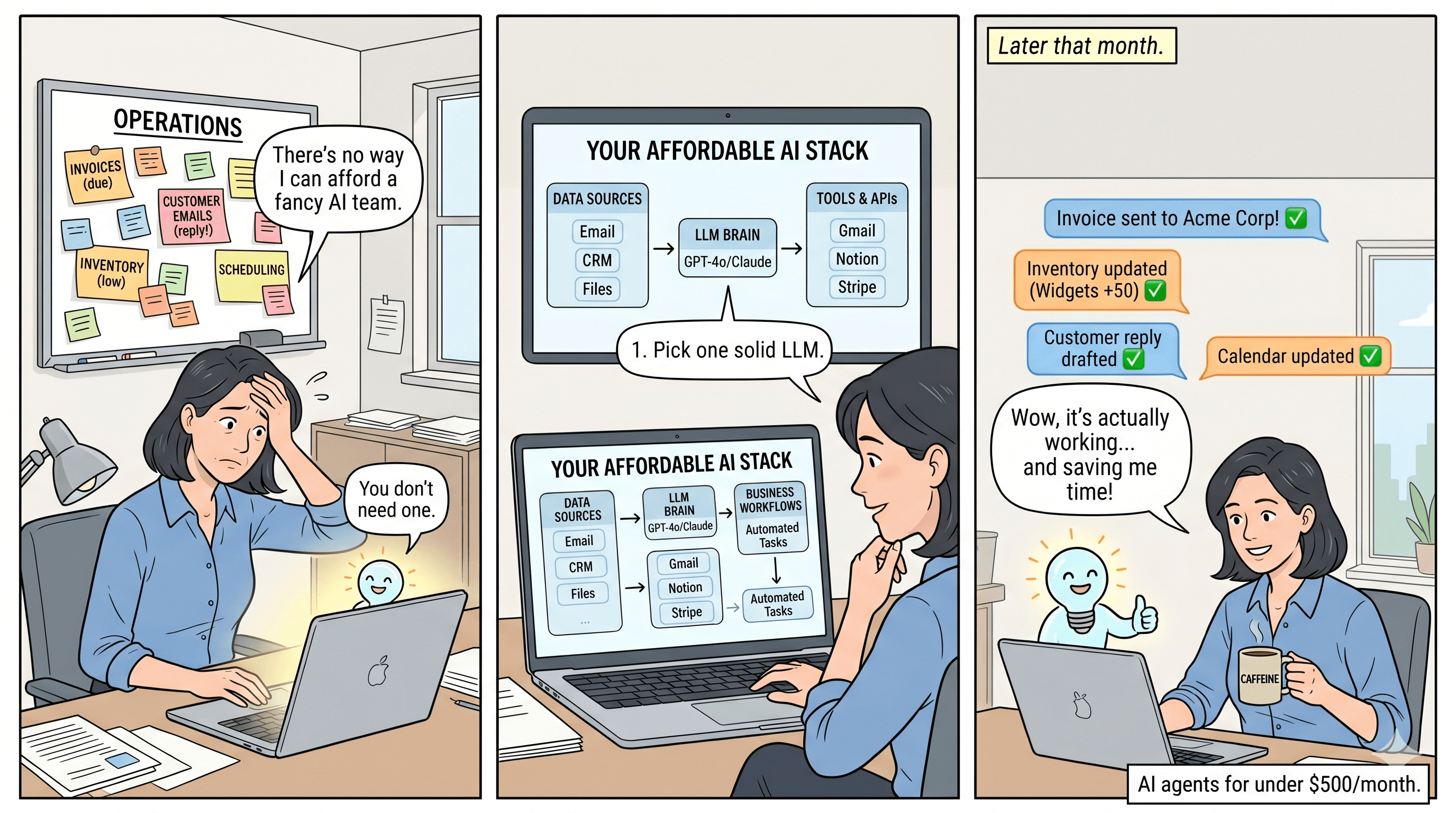
Before diving into the how, let’s clarify the what. An artificial intelligence agent stack is simply a collection of interconnected artificial intelligence tools and services that work together to automate tasks, make decisions, and handle workflows that previously required human intervention.
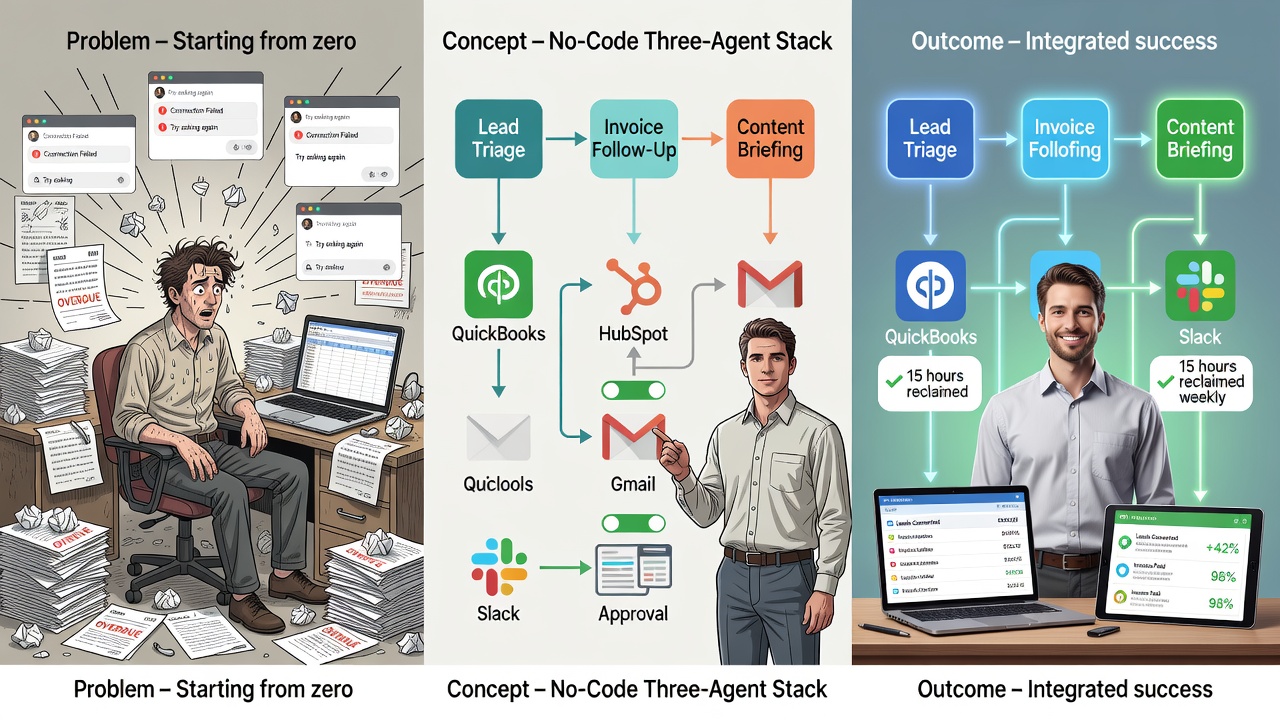
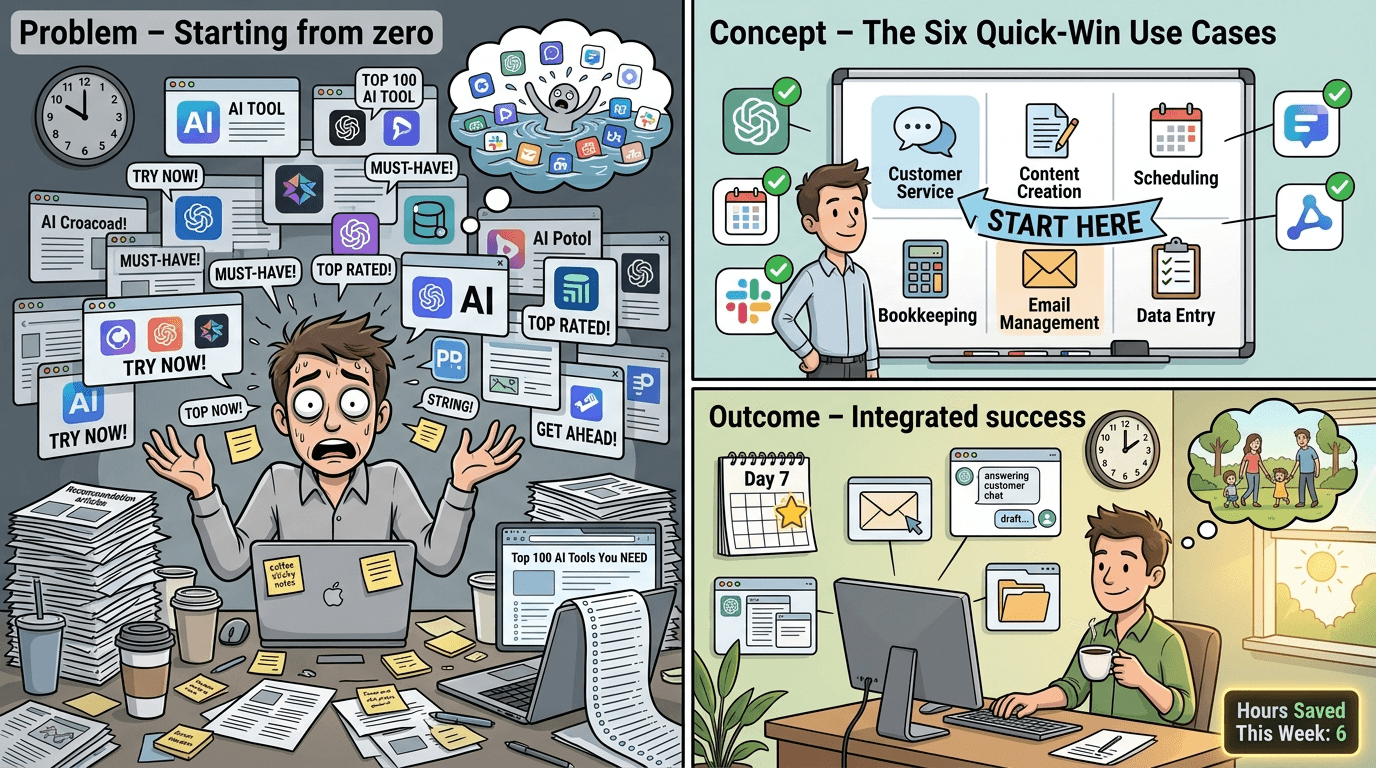
Think of it like building with LEGO blocks. Each tool in your stack serves a specific purpose, and when connected properly, they create something far more powerful than any single tool could achieve alone. According to industry experts, building an artificial intelligence agent stack “sounds complicated, but it’s not. You pick 3-5 specialized tools, connect them through simple integrations, and let them handle work that used to eat your entire day” [1].
The 2026 artificial intelligence agent landscape has evolved to the point where production-ready autonomous agents follow a consistent architecture. Every serious artificial intelligence agent sits on top of seven core layers: model, orchestration, tools/MCP, memory, observability, evaluations, and guardrails [7]. The good news? You don’t need to understand all of these deeply to get started—modern platforms handle much of this complexity for you.
The Economics: Why $500/Month Is the Sweet Spot
Let’s talk money, because that’s what matters for SMB decision-makers. The economics of artificial intelligence agent stacks have fundamentally shifted in favor of small businesses.
A complete solopreneur artificial intelligence stack in 2026 costs between $73 and $205 per month—representing a 95-98% reduction compared to hiring equivalent staff [5]. When you scale up to a more comprehensive setup for a growing SMB, you’re looking at $400-500 per month for capabilities that would have required multiple full-time employees or expensive contractors just two years ago [8].
One solo founder put it perfectly: “Most founders over-tool. They buy 20 subscriptions and use 3. My rule: every tool must save me 10+ hours per month or generate measurable revenue” [2]. This philosophy should guide your stack-building journey. Every dollar spent needs to earn its place through tangible time savings or revenue generation.
The math becomes compelling when you consider what you’re replacing. A fractional designer, virtual assistant, sales ops freelancer, and customer service representative could easily cost $7,000 or more per month. An artificial intelligence agent stack handling similar functions? Under $500 [8].
The Core Components of Your First artificial intelligence Stack
1. The Foundation: Your artificial intelligence Model Layer
Every artificial intelligence agent stack starts with a foundation model—the “brain” that powers your automation. In 2026, you have several excellent options at various price points.
For most SMB use cases, you’ll want access to a capable large language model through an API. The costs here have dropped dramatically, with many businesses spending between $20-100 per month on API calls depending on usage volume. The key is choosing a model that matches your specific needs rather than defaulting to the most expensive option.
Pieter Levels, who generates $250,000 per month as a solo operator, proves that stack complexity is optional. He runs his entire operation using PHP, SQLite, and a single DigitalOcean VPS [5]. The lesson? Start simple and scale complexity only when necessary.
2. The Orchestration Layer: Connecting Everything
Orchestration is where the magic happens—it’s how your various artificial intelligence tools communicate and work together. This layer determines how tasks flow from one tool to another and how decisions get made along the way.
No-code orchestration platforms have become remarkably sophisticated. You can now “build a custom artificial intelligence agent stack in hours, not months” using visual workflow builders that require zero programming knowledge [1]. These platforms typically cost between $30-100 per month and provide the connective tissue that makes your stack functional.
The production engineering category for artificial intelligence agents matured significantly in 2025-2026. Teams shipping real autonomous agents—customer support bots that survive restarts, coding agents that handle complex tasks—rely on robust orchestration that handles edge cases gracefully [6].
3. The Tools Layer: Specialized Capabilities
This is where you add specific capabilities to your stack. Think of tools as the specialized workers in your artificial intelligence workforce. Each one excels at particular tasks:
- Content generation tools for marketing copy, social media posts, and documentation
- Data analysis tools for processing spreadsheets, generating reports, and identifying trends
- Communication tools for email management, customer responses, and scheduling
- Design tools for creating graphics, editing images, and maintaining brand consistency
The canonical stack for 2026 includes Cursor (or similar artificial intelligence-assisted development tools), Claude or GPT-4 for reasoning tasks, and specialized tools for your industry-specific needs [5]. Budget approximately $100-200 per month for this layer, prioritizing tools that address your biggest time sinks.
4. The Memory Layer: Maintaining Context
One of the biggest advances in artificial intelligence agent technology is improved memory—the ability for your agents to remember context, learn from past interactions, and maintain continuity across sessions.
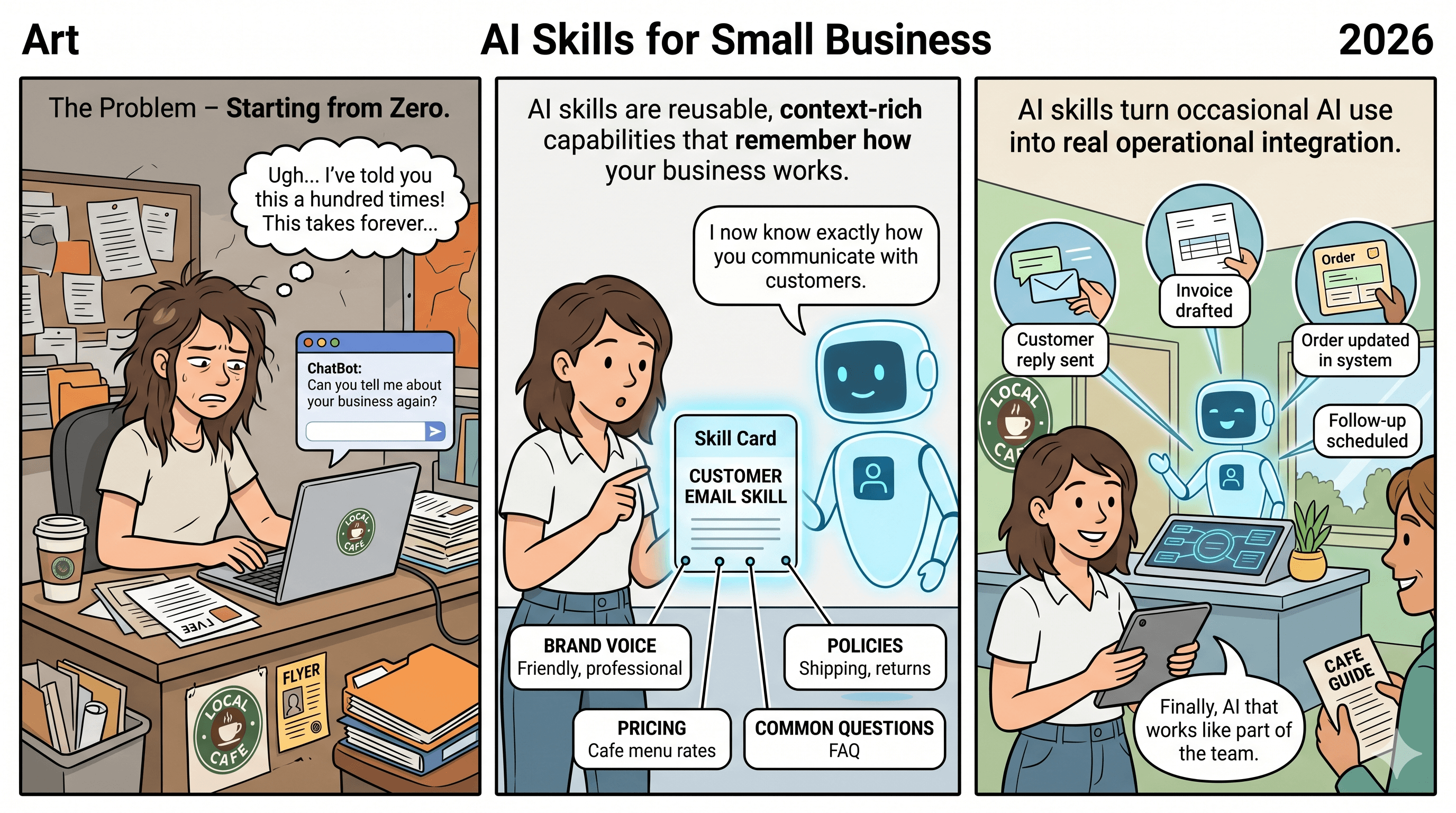
Modern memory solutions allow your artificial intelligence agents to recall previous customer conversations, remember your brand guidelines, and build on past work rather than starting fresh each time. This layer typically costs $20-50 per month and dramatically improves the quality and consistency of your artificial intelligence outputs.
5. The Observability Layer: Knowing What’s Happening
You can’t improve what you can’t measure. Observability tools help you understand how your artificial intelligence agents are performing, where they’re succeeding, and where they need adjustment.
For SMBs, this doesn’t need to be elaborate. Basic logging and monitoring capabilities often come built into your orchestration platform. As you scale, you might invest $30-50 per month in dedicated observability tools that provide deeper insights into agent performance.
Three Budget Tiers: Choose Your Starting Point
The Starter Stack: $75-150/Month
Perfect for solopreneurs and very small businesses just beginning their artificial intelligence journey:
- artificial intelligence Model Access: $20-50/month for API access to a capable LLM
- No-Code Automation Platform: $30-50/month for workflow automation
- One Specialized Tool: $25-50/month for your highest-priority use case
This minimal stack can handle basic content generation, email management, and simple customer interactions. A solo developer can ship a production-quality artificial intelligence product with approximately $50-80 per month in infrastructure and tools by choosing services that eliminate entire categories of work [4].
The Growth Stack: $250-350/Month
Ideal for growing SMBs ready to automate multiple business functions:
- artificial intelligence Model Access: $50-100/month for higher usage and premium models
- Orchestration Platform: $50-75/month for advanced workflow capabilities
- 3-4 Specialized Tools: $100-150/month covering content, design, data, and communication
- Memory/Context Solution: $25-40/month for improved continuity
This configuration handles most day-to-day business operations that don’t require human judgment, freeing your team to focus on strategy and relationship-building.
The Professional Stack: $400-500/Month
For established SMBs seeking comprehensive automation:
- Premium artificial intelligence Model Access: $100-150/month for maximum capability and volume
- Advanced Orchestration: $75-100/month with enterprise features
- 5-6 Specialized Tools: $150-200/month covering all major business functions
- Memory and Context: $40-50/month for sophisticated continuity
- Observability and Monitoring: $30-50/month for performance insights
At this level, you’re approaching the capabilities that one founder used to run a $2M ARR company with zero employees [2].
Implementation: Your 30-Day Roadmap
Week 1: Audit and Prioritize
Before spending a dollar, document where your time actually goes. Track every task for one week, noting:
- How long each task takes
- How often it repeats
- Whether it requires human judgment or follows predictable patterns
Tasks that are repetitive, pattern-based, and time-consuming are your prime automation candidates.
Week 2: Select Your Core Tools
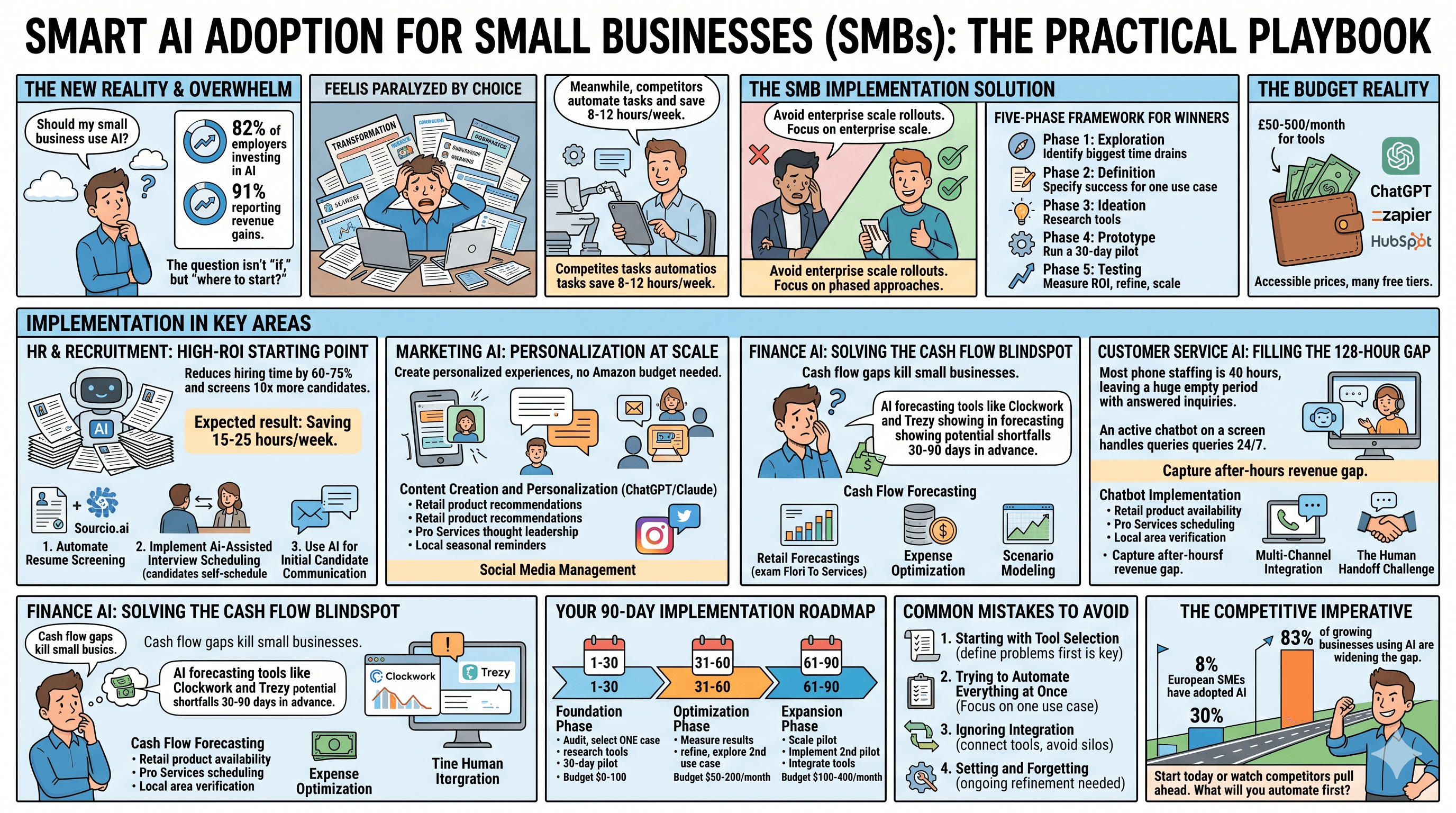
Based on your audit, choose your initial stack components. Start with the 80/20 principle—identify the 20% of tasks consuming 80% of your time and select tools that address those specifically.
Resist the temptation to over-tool from the start. Remember: “Every tool must save me 10+ hours per month or generate measurable revenue” [2]. If a tool doesn’t meet that bar, don’t add it yet.
Week 3: Build Your First Workflows
Using your no-code orchestration platform, create your first automated workflows. Start simple:
- Automated email responses for common inquiries
- Content drafts for social media posts
- Data entry and organization tasks
Test thoroughly before letting these workflows run unsupervised. artificial intelligence agents are powerful but imperfect—human oversight remains essential during the learning phase.
Week 4: Monitor, Adjust, and Expand
Review your first week of automation results. What’s working well? Where are the rough edges? Make adjustments, add guardrails where needed, and begin planning your next automation targets.
Common Pitfalls to Avoid
Over-engineering from day one: The most successful artificial intelligence implementations start simple and grow organically. Don’t try to automate everything at once.
Ignoring the human element: artificial intelligence agents work best when they augment human capabilities rather than attempting to replace human judgment entirely. Keep humans in the loop for decisions that matter.
Skipping the evaluation layer: Without proper evaluation and guardrails, artificial intelligence agents can produce inconsistent or inappropriate outputs. Build in checkpoints and quality controls from the start [7].
Chasing the newest tools: The artificial intelligence landscape evolves rapidly, but constantly switching tools creates more problems than it solves. Choose stable, well-supported platforms and stick with them long enough to see results.
The Bottom Line: Your Competitive Advantage Awaits
The democratization of artificial intelligence has created an unprecedented opportunity for small and medium businesses. Tools that were exclusively available to enterprises with massive budgets just two years ago are now accessible for less than $500 per month.
The businesses that thrive in the coming years won’t necessarily be the largest or best-funded—they’ll be the ones that most effectively leverage artificial intelligence to multiply their capabilities. A solo founder competing against companies with dozens of employees isn’t a fantasy anymore; it’s happening right now across every industry [2][8].
Your first artificial intelligence agent stack doesn’t need to be perfect. It needs to exist. Start with one workflow, prove the value, and expand from there. The tools are ready. The economics make sense. The only question is whether you’ll be among the early adopters who gain the advantage or among those playing catch-up later.
The $500 per month investment that once seemed like a gamble has become table stakes for competitive businesses. The question isn’t whether you can afford to build an artificial intelligence agent stack—it’s whether you can afford not to.
Sources
- [1] https://agent-finder.co/guides/how-to-build-your-own-ai-agent-stack-no-code-required - Guide on building no-code AI agent stacks
- [2] https://dailyaibite.com/solo-founder-ai-stack-500-month-setup/ - Solo founder’s $500/month AI stack breakdown
- [4] https://claudeguide.io/solo-ai-builder-stack-2026 - Solo AI builder’s essential tools for 2026
- [5] https://superframeworks.com/articles/solopreneur-ai-stack-2026 - Solopreneur AI stack cost analysis
- [6] https://dibi8.com/collections/ai-agent-tool-chain/ - AI agent tool chain components for production use
- [7] https://aiagentrank.io/blog/ai-agent-stack-2026 - 2026 AI agent stack reference architecture
- [8] https://nomixy.com/ai-agent-stack-economics-solopreneurs/ - AI agent stack economics for solo founders