· The Rapid Architect Team · AI · 11 min read
AI Skills for Small Business: What they are and Why they Matter
Discover how AI 'skills'—reusable, context-rich capabilities—are transforming small business operations in 2026, helping SMBs finally close the gap between occasional AI use and true operational integration.
Podcast Discussion
Introduction: The Hidden Cost of Starting From Zero
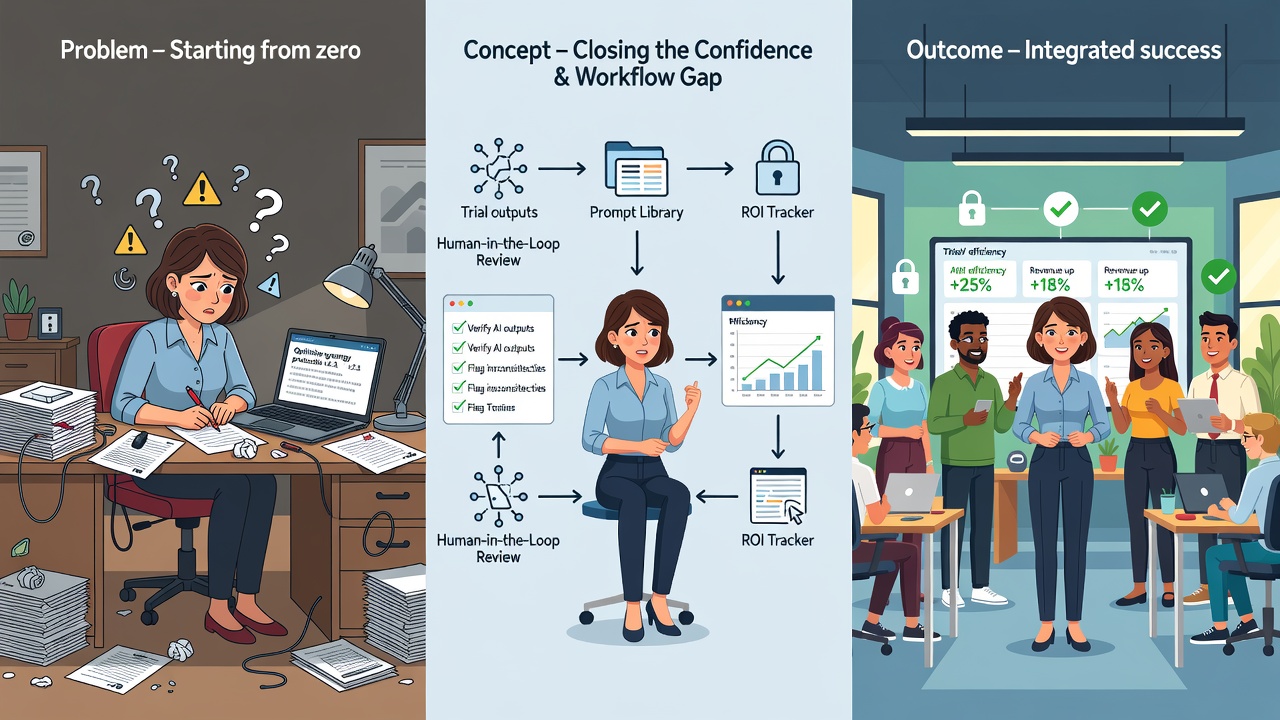
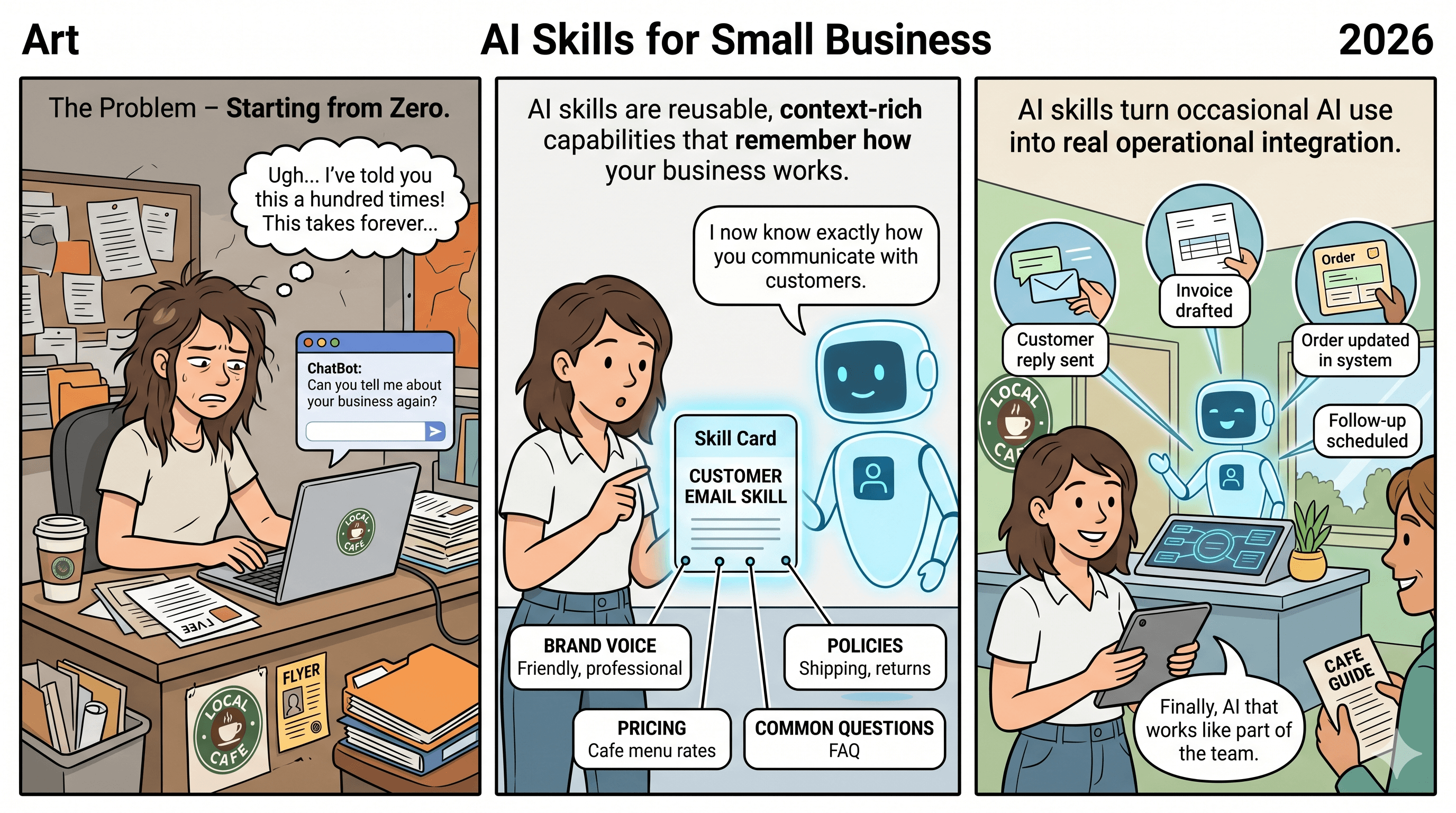
Here’s a question that might hit close to home: How many times this week has your artificial intelligence assistant asked you to explain something you’ve already told it dozens of times before? [3]
If you’re like most small and medium business owners, the answer is probably “too many to count.” You’ve invested in artificial intelligence tools, you’ve experimented with chatbots, and you’ve heard all the promises about how artificial intelligence will transform your operations. Yet somehow, every conversation feels like starting over from scratch.
This frustration points to one of the most significant developments in artificial intelligence technology that most SMB owners haven’t heard about yet: the concept of “skills” in artificial intelligence assistants. And according to recent industry analysis, this single innovation may be the key to finally closing the massive gap between businesses that merely use artificial intelligence and those that have truly integrated it into their core operations.
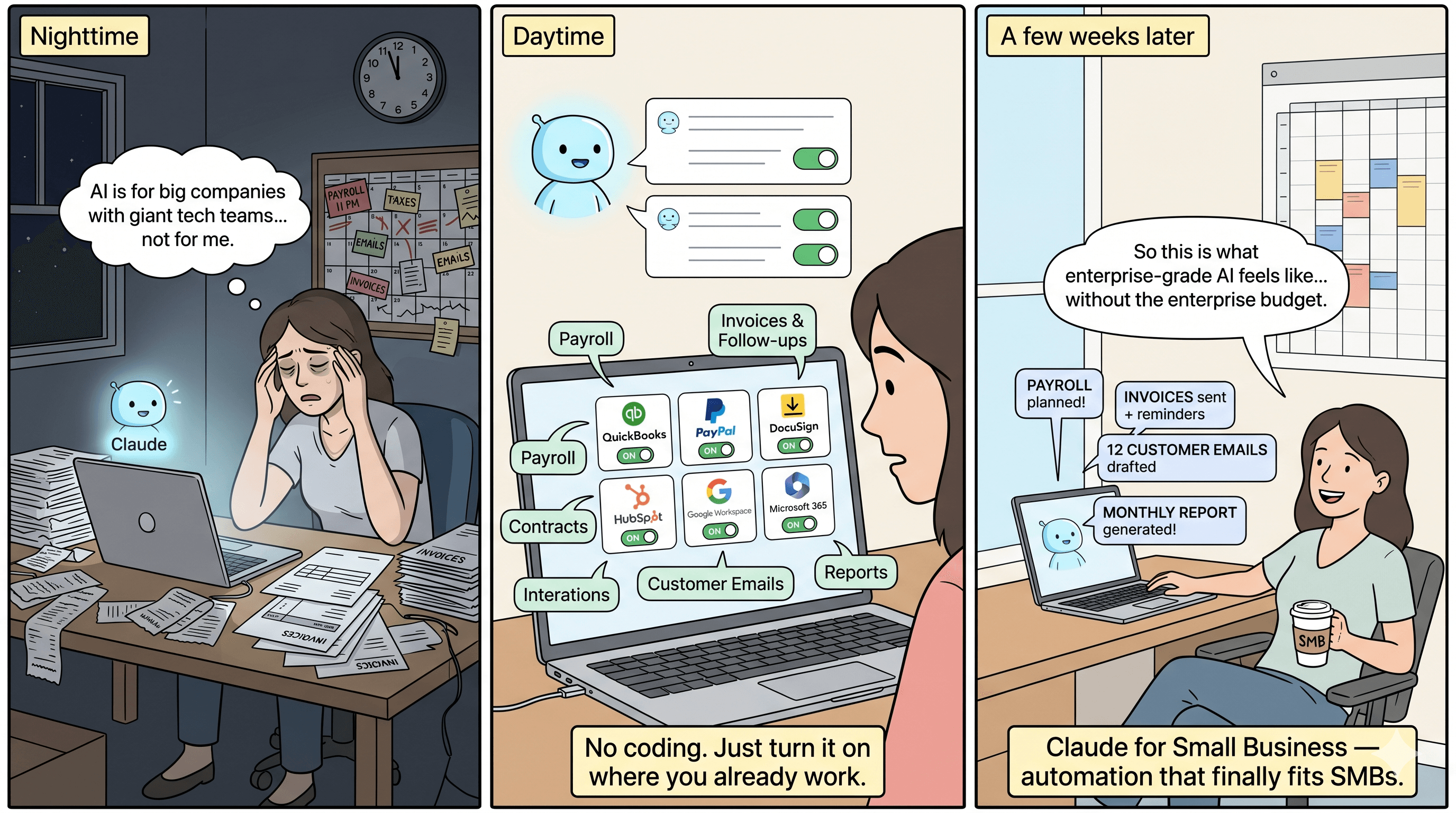
The numbers tell a striking story. Three quarters of small businesses say they use artificial intelligence, but only one in seven has integrated it into core operations—that’s a 62-point gap that has persisted stubbornly for over a year [1]. Understanding artificial intelligence skills isn’t just about keeping up with technology trends; it’s about determining whether your business will be among those that finally bridge this divide.
What Are artificial intelligence “Skills” and Why Should You Care?
Think of artificial intelligence skills as the difference between hiring a brilliant but forgetful consultant versus a dedicated team member who learns your business inside and out.
Traditional artificial intelligence interactions work like this: you type a prompt, the artificial intelligence responds, and then—poof—everything about that conversation vanishes into the digital ether. The next time you need help, you’re back to explaining your company’s tone of voice, your customer demographics, your pricing structure, and every other detail that makes your business unique.
artificial intelligence skills change this dynamic fundamentally. A “skill” is essentially a reusable set of instructions, context, and capabilities that an artificial intelligence assistant can access repeatedly without requiring you to re-explain everything each time. Industry observers have noted that this format has rapidly unified major artificial intelligence platforms, with one analysis calling skills “the new moat” that separates effective artificial intelligence implementation from mere experimentation [2].
For practical purposes, think of skills as teaching your artificial intelligence assistant how to do specific jobs the way your business does them. Instead of prompting “write a customer email,” you create a skill that knows:
- Your brand voice and communication style
- Your product catalog and pricing
- Your customer service policies
- Common questions and approved responses
- When to escalate to a human team member
Once that skill exists, anyone on your team can activate it with a simple request, and the artificial intelligence performs consistently every single time.
The Evolution From Chatbots to Capable Assistants
To understand why skills matter so much, it helps to see how artificial intelligence assistance has evolved—and where most small businesses got stuck along the way.
The Chatbot Era (2022-2024)
The first wave of accessible artificial intelligence tools gave businesses conversational interfaces that could answer questions and generate text. These were impressive but limited. As one industry analysis puts it bluntly: “The chatbot era is ending” [4]. These early tools were reactive—they waited for your input and responded, but they couldn’t take independent action or remember context between sessions.
The Prompt Engineering Phase (2024-2025)
As artificial intelligence capabilities grew, so did the complexity of getting good results. Business owners found themselves crafting elaborate prompts, saving them in documents, and copying-pasting them repeatedly. This worked, but it was inefficient and inconsistent. Different team members got different results, and there was no systematic way to improve over time.
The Skills Era (2025-Present)
The current transformation represents something fundamentally different. artificial intelligence systems can now plan multi-step tasks, decide what to do next, and execute actions on their own—not just answer questions [8]. The difference is stark: a chatbot replies to your message; a skilled artificial intelligence assistant books the appointment, sends the follow-up email, and updates your CRM.
This evolution matters because it finally makes artificial intelligence practical for the kinds of complex, context-dependent work that small businesses actually need help with.
Why Skills Are Particularly Powerful for SMBs
Large enterprises have entire departments dedicated to artificial intelligence implementation, custom software development, and process optimization. Small and medium businesses have always had to do more with less—which is precisely why the skills paradigm is so transformative for this segment.
Democratizing Sophisticated Automation
Recent developments have made artificial intelligence integration competitive for smaller players. What previously required custom development and significant technical resources can now be accomplished through well-designed skills that any business owner can create and modify [1]. You don’t need to hire a machine learning engineer; you need to clearly articulate how your business operates.
Preserving Institutional Knowledge
One of the persistent challenges for small businesses is that critical knowledge often lives in the heads of a few key people. When your best customer service representative is out sick, response quality drops. When your operations manager goes on vacation, certain processes slow down.
Skills capture this institutional knowledge in a format that artificial intelligence can use consistently. Your customer service skill embodies your best practices. Your operations skill reflects your refined processes. The artificial intelligence becomes a repository of your business intelligence, accessible to everyone on your team.
Reducing the “Context Tax”
Every time you have to re-explain your business context to an artificial intelligence tool, you’re paying what might be called a “context tax”—wasted time and mental energy that could go toward actual work. Industry analysts have pointed out that this constant re-starting is quietly costing businesses real money [3].
Skills eliminate this tax almost entirely. The context is built into the skill itself, ready to be deployed instantly whenever needed.
Practical Applications: Where Skills Deliver Real Value
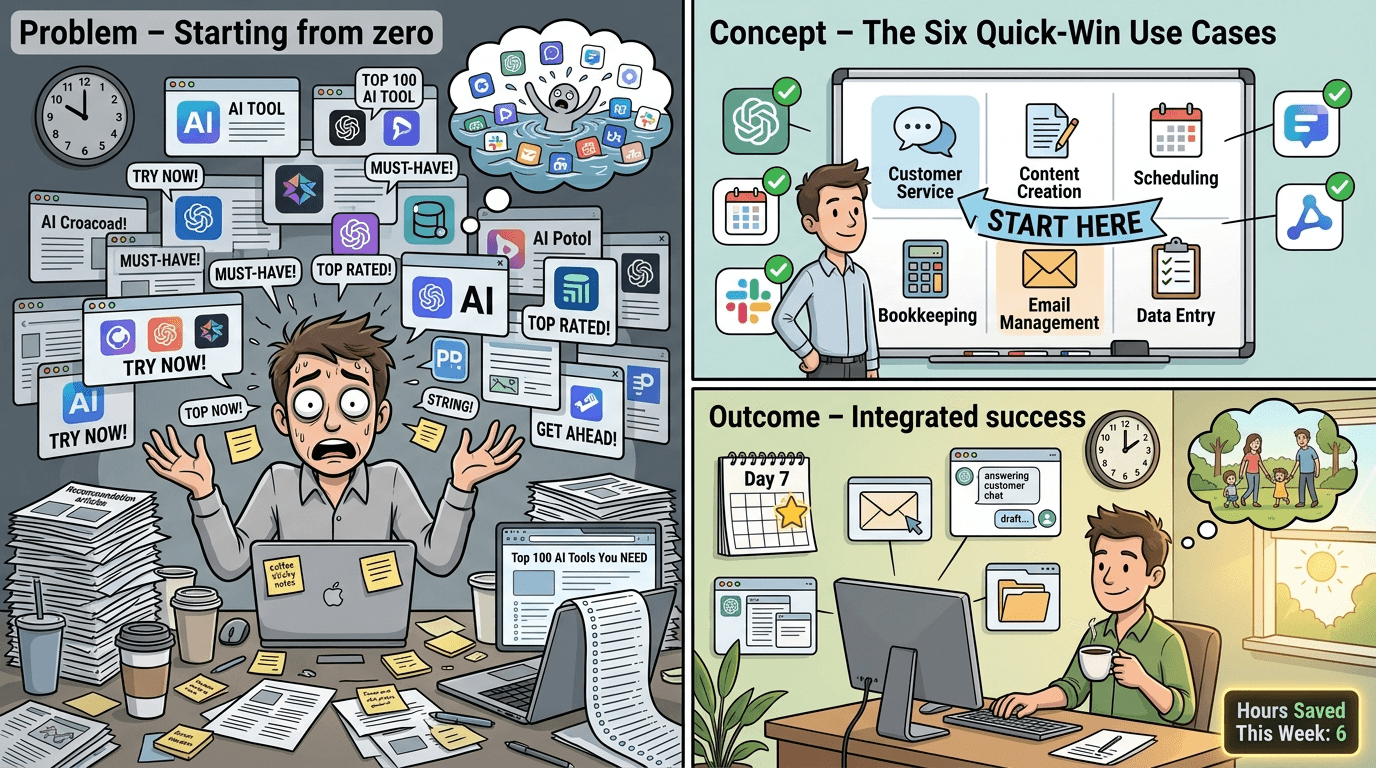
Let’s move from concept to concrete application. Here are the areas where artificial intelligence skills are delivering measurable results for small and medium businesses in 2026:
Customer Communication
Create skills for different types of customer interactions: initial inquiries, support requests, follow-ups, and win-back campaigns. Each skill contains your approved messaging, tone guidelines, and escalation triggers. The result is consistent, on-brand communication regardless of who on your team initiates it or what time of day the request comes in.
Content Creation
Rather than prompting “write a blog post about X,” develop content skills that understand your audience, your SEO priorities, your brand voice, and your content calendar. The artificial intelligence doesn’t just write—it writes like your business writes, with full awareness of your strategic goals.
Operations and Workflow Management
The most powerful applications move beyond simple question-and-answer into genuine workflow automation. Agentic artificial intelligence—systems that can plan and execute multi-step tasks independently—represents the cutting edge of this capability [8]. A skilled artificial intelligence assistant can process an incoming order, check inventory, update your systems, notify relevant team members, and trigger fulfillment processes without human intervention at each step.
Sales Support
Develop skills that help your sales team prepare for meetings, research prospects, draft proposals, and follow up on opportunities. These skills can incorporate your pricing rules, your qualification criteria, and your competitive positioning, ensuring every sales interaction reflects your strategic approach.
Financial Administration
While you’ll still want human oversight for financial decisions, skills can handle routine tasks like categorizing expenses, preparing reports, flagging anomalies, and generating invoices. The artificial intelligence learns your chart of accounts, your approval workflows, and your reporting preferences.
Building Your First Skills: A Practical Framework
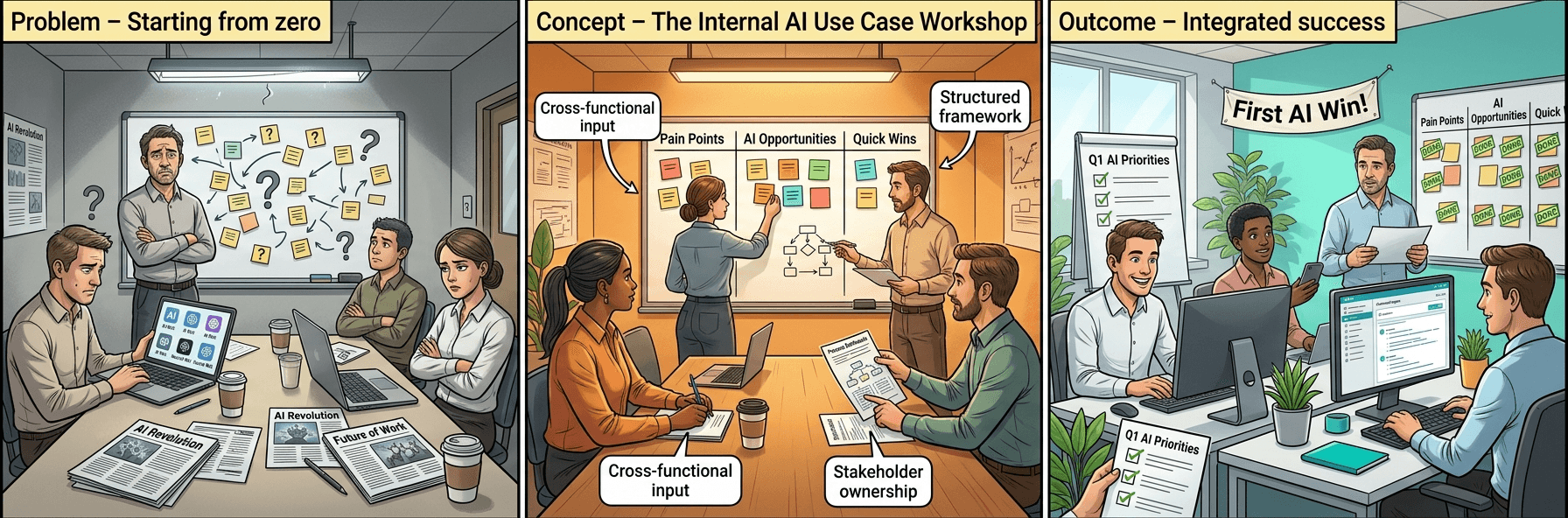
If you’re convinced that skills deserve attention, here’s how to approach implementation without getting overwhelmed:
Step 1: Identify High-Frequency, High-Frustration Tasks
Start by listing the tasks that consume significant time and cause consistent frustration. Good candidates for your first skills are tasks that:
- Happen frequently (daily or weekly)
- Follow a relatively consistent pattern
- Currently require re-explaining context each time
- Don’t require complex judgment calls
Step 2: Document Your Current Process
Before building a skill, write down exactly how you want the task performed. Include:
- The specific steps involved
- The context the artificial intelligence needs to know
- Examples of good outputs
- Common mistakes to avoid
- Conditions that should trigger human review
This documentation becomes the foundation of your skill.
Step 3: Start Simple and Iterate
Your first version doesn’t need to be perfect. Create a basic skill, test it with real tasks, and refine based on results. Most artificial intelligence platforms now make this iteration process straightforward—you’re adjusting instructions, not writing code.
Step 4: Expand Gradually
Once your first skill is working well, identify the next candidate. Over time, you’ll build a library of skills that collectively represent your business’s operational intelligence.
Practical playbooks emphasize that successful artificial intelligence implementation for small business means using these agentic workflows systematically rather than treating artificial intelligence as an occasional convenience [7].
Common Pitfalls and How to Avoid Them
Not every artificial intelligence implementation succeeds. Industry analysis of what actually works for small businesses in 2026 reveals several patterns worth noting [6]:
Pitfall 1: Over-Automating Too Quickly
The excitement of artificial intelligence capabilities can lead to automating processes that aren’t ready for it. Start with tasks where errors have low consequences, and gradually expand to higher-stakes applications as you build confidence and refine your skills.
Pitfall 2: Neglecting Human Oversight
Even sophisticated artificial intelligence skills need appropriate human checkpoints. Design your skills with clear escalation paths and regular review processes. The goal is augmentation, not replacement, of human judgment.
Pitfall 3: Failing to Update Skills Over Time
Your business evolves, and your skills need to evolve with it. Schedule regular reviews of your artificial intelligence skills to ensure they still reflect current processes, pricing, policies, and priorities.
Pitfall 4: Treating Skills as Set-and-Forget
The businesses seeing the best results treat their artificial intelligence skills as living assets that improve over time. When you notice an output that could be better, update the skill. When team members have suggestions, incorporate them. This continuous improvement mindset separates successful implementations from stagnant ones.
The Competitive Landscape: Why Timing Matters
There’s a strategic dimension to artificial intelligence skills that SMB owners should consider carefully. The question of whether artificial intelligence agents are a competitive necessity has a clear answer emerging from the data: small business owners who treat agent deployment as a “future consideration” are already falling behind [10].
This isn’t about chasing every technology trend. It’s about recognizing that artificial intelligence assistants are no longer a productivity experiment—they are infrastructure [9]. Just as businesses that delayed adopting email, websites, or cloud computing eventually found themselves at a structural disadvantage, businesses that delay building artificial intelligence capabilities may face similar challenges.
The encouraging news is that the barrier to entry has dropped dramatically. Recent developments have made sophisticated artificial intelligence integration accessible to businesses without enterprise budgets or technical teams [1]. The skills paradigm, in particular, puts powerful capabilities within reach of any business owner willing to invest the time to implement them thoughtfully.
Looking Ahead: The Trajectory of artificial intelligence Skills
artificial intelligence has changed more between 2024 and mid-2026 than it did in the five years before [5]. Businesses are no longer asking whether artificial intelligence matters—they’re asking which artificial intelligence to use, where it belongs in the business, and how to get real value without losing control.
The skills framework provides a compelling answer to these questions. By creating reusable, context-rich capabilities that reflect your specific business needs, you gain:
- Consistency across all artificial intelligence-assisted tasks
- Efficiency through eliminated repetition
- Scalability as your team grows
- Institutional memory that persists regardless of personnel changes
- Competitive capability that was previously available only to larger organizations
Conclusion: Your Next Step
The 62-point gap between artificial intelligence awareness and artificial intelligence integration represents both a challenge and an opportunity [1]. Most of your competitors are stuck in the same place you might be—using artificial intelligence occasionally, getting inconsistent results, and wondering whether the investment is worth it.
artificial intelligence skills offer a path across that gap. Not through massive technology investments or hiring specialized staff, but through the systematic capture and deployment of your business knowledge in a format that artificial intelligence can use effectively.
Start this week with a single skill. Choose one repetitive task that frustrates you, document how you want it done, and create your first reusable artificial intelligence capability. Test it, refine it, and then build the next one.
The businesses that will thrive in the coming years aren’t necessarily those with the biggest budgets or the most advanced technology. They’re the ones that learn to work effectively with artificial intelligence—teaching it their unique approaches, embedding their institutional knowledge, and deploying that intelligence consistently across their operations.
The tools are ready. The frameworks exist. The only question is whether you’ll be among the businesses that bridge the gap—or those that watch from the other side.
Sources
- [1] https://aifounders.cz/en/the-smb-ai-integration-gap-is-62-points-wide-anthropic-just-made-it-competitive/ - Analysis of the 62-point gap between AI awareness and integration in SMBs
- [2] https://www.thevccorner.com/p/ai-skills-complete-playbook-templates-prompts-2026 - Industry analysis on AI skills as the new competitive moat
- [3] https://www.linkedin.com/pulse/your-ai-keeps-starting-from-zero-2026-thats-quietly-costing-cjmjc - Discussion of the hidden costs of AI context loss
- [4] https://insights.reinventing.ai/articles/ai-agents-prompt-workflow-transformation-2026-04-29 - Analysis of the transition from chatbots to workflow automation
- [5] https://kersai.com/ai-for-business-may-2026-field-guide/ - Practical field guide on AI evolution and business applications
- [6] https://kaizenaiconsulting.com/ai-agents-small-business-2026-what-works/ - Research on what AI implementations actually work for small businesses
- [7] https://dkstudio.ai/insights/ai-for-smb - Practical playbook for SMB AI implementation
- [8] https://30elevate.com/en/blog/agentic-ai-explained/ - Explanation of agentic AI architecture for business
- [9] https://acadcalendar.com/ai-assistants-shaping-the-future/ - Analysis of AI assistants as business infrastructure
- [10] https://whitebeardstrategies.com/blog/are-ai-agents-really-a-competitive-necessity-for-small-business-in-2026/ - Strategic analysis of AI agent adoption as competitive necessity