· The Rapid Architect Team · AI · 11 min read
The Starting Line: How to Run an AI Use Case Workshop Internally for Your SMB
Ready to bring AI into your small or medium business but unsure where to begin? An internal AI use case workshop is your strategic starting point. This comprehensive guide walks you through planning, facilitating, and executing a workshop that transforms AI curiosity into actionable projects with genuine stakeholder buy-in.

Podcast Discussion
Introduction
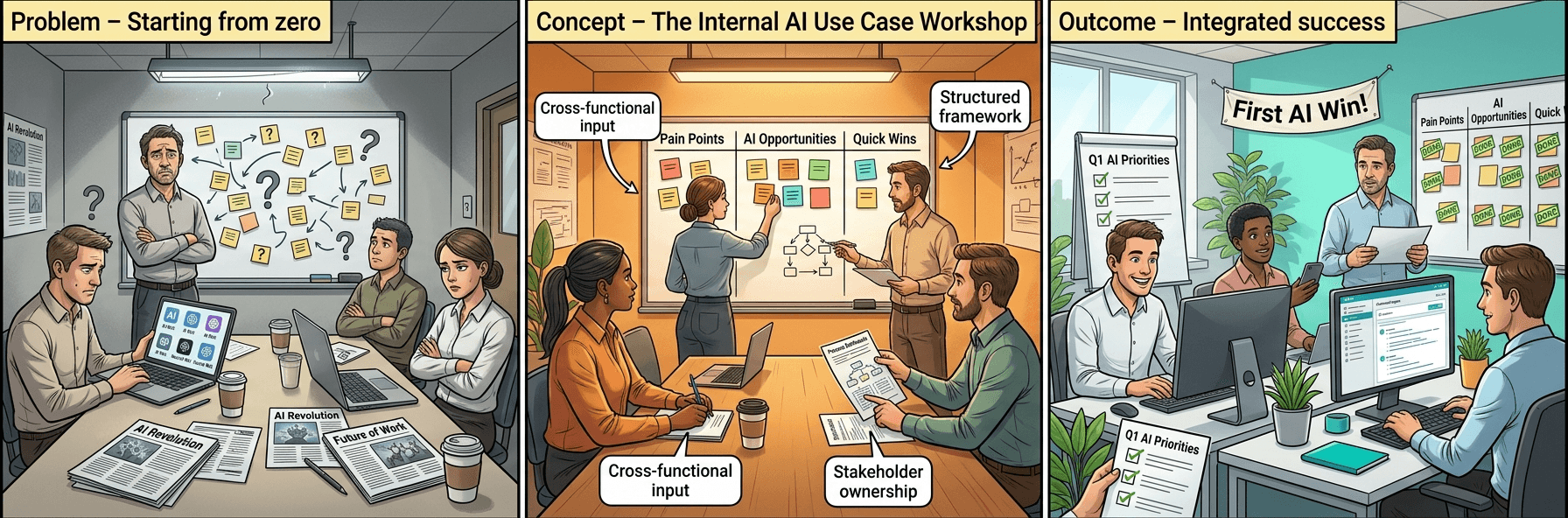
Here’s the thing nobody says out loud often enough: a lot of artificial intelligence workshops feel productive in the room and completely useless a week later [3]. People show up excited. Someone suggests using artificial intelligence for customer support. Sticky notes cover the whiteboard. Then everyone returns to their desks, and nothing happens.
If you’re leading a small or medium business in 2026, you’ve likely felt the pressure to “do something with artificial intelligence.” The technology has changed more between 2024 and May 2026 than it did in the five years before [9]. But for SMB decision-makers, the challenge isn’t understanding that artificial intelligence matters—it’s knowing which artificial intelligence to use, where it belongs in your business, and how to get real value without losing control [9].
The answer isn’t hiring expensive consultants or launching pilot projects that stall. It’s something far more accessible: running an internal artificial intelligence use case workshop that brings your team together, surfaces genuine opportunities, and creates the buy-in necessary to move from idea to execution.
This guide will show you exactly how to do it.
Why Internal Workshops Beat Top-Down artificial intelligence Mandates
When a large U.S. manufacturer approached artificial intelligence consultants to understand where artificial intelligence could make the biggest impact, they didn’t start with technology—they started with their people [1]. This approach works equally well for SMBs, perhaps even better.
The most successful artificial intelligence adoptions in 2026 share a common trait: they emerge from cross-functional collaboration rather than executive decree. An artificial intelligence workshop is typically a half-day or full-day session with a mixed group—operational staff who know what problems exist, technical staff who know what artificial intelligence can do, and leadership who need to make investment decisions [2]. Making that combination productive is a facilitation challenge as much as a technical one.
For SMBs, internal workshops offer three distinct advantages:
First, you discover real problems. Your employees encounter friction points daily that you might never see from the leadership level. A customer service representative knows which questions consume the most time. Your bookkeeper knows which reconciliation tasks are error-prone. These insights are gold for artificial intelligence implementation.
Second, you build organic buy-in. When people help identify artificial intelligence opportunities themselves, they become advocates rather than resisters. This psychological ownership proves crucial when implementation begins.
Third, you control costs. External consultants bring expertise but carry premium price tags. An internal workshop leverages your existing talent while building artificial intelligence literacy across your organization.
Pre-Workshop Preparation: Setting the Stage for Success
The work before the workshop often determines whether the session produces actionable results or evaporates into forgotten enthusiasm. Here’s how to prepare effectively.
Define Your Workshop Scope
Before sending calendar invites, clarify what you want to achieve. Pick recurring tasks instead of broad artificial intelligence topics [6]. Rather than exploring “how artificial intelligence could transform our business,” focus on specific operational areas: “How might artificial intelligence reduce our invoice processing time?” or “Where could artificial intelligence help our sales team prioritize leads?”
This focused approach prevents the common workshop failure mode where discussions become too abstract to act upon.
Assemble the Right Participants
Your workshop needs three perspectives represented: operational knowledge, technical understanding, and decision-making authority [2]. For an SMB, this might look like:
- Two to three front-line employees from different departments
- Your IT person or the most tech-savvy team member
- A manager or owner who can approve resources
- Someone skeptical about artificial intelligence (yes, really—their questions improve outcomes)
A group of six to ten people typically works best. Larger groups fragment attention; smaller groups lack diverse perspectives.
Prepare Background Materials
Send participants a brief pre-read—no longer than one page—that covers:
- What artificial intelligence can realistically do today (with examples from similar businesses)
- What artificial intelligence cannot do (managing expectations prevents disappointment)
- Two or three specific challenges you’re hoping to address
This preparation ensures participants arrive with relevant thoughts already forming, rather than spending workshop time on basic education.
Gather Existing Data
Collect information about your current operations before the workshop. Pull reports on where your team spends time, which processes generate the most errors, and which customer touchpoints receive complaints. This data grounds discussions in reality rather than speculation.
Workshop Structure: A Practical Half-Day Format
Most SMBs can’t afford full-day sessions away from operations. This half-day format—roughly four hours—balances thoroughness with practicality.
Opening: Establishing Context (30 minutes)
Start by acknowledging the elephant in the room: artificial intelligence feels overwhelming, and that’s normal. Share that 89% of artificial intelligence rollouts stall at the pilot stage [5], not because the technology fails but because organizations lack clear processes for moving forward.
Explain the workshop’s purpose: to identify specific, achievable artificial intelligence applications for your business. Emphasize that no idea is too small. Often, the most valuable artificial intelligence applications aren’t flashy—they’re the boring automations that save fifteen minutes per person per day.
Set clear ground rules:
- Every department’s challenges matter equally
- Technical feasibility comes later; right now, focus on problems worth solving
- Criticism of ideas waits until the evaluation phase
Discovery Phase: Surfacing Use Cases (60 minutes)
This is where the real work begins. Divide participants into pairs or trios, mixing departments to cross-pollinate perspectives. Give each group this prompt:
“Think about your daily and weekly work. What tasks do you do repeatedly that feel like they should be automatic? Where do you spend time looking for information that should be easy to find? What customer requests could you handle faster if you had better tools?”
Have groups document their ideas on index cards or sticky notes—one idea per card. Aim for quantity over quality at this stage. A good group session should generate twenty to forty potential use cases across the room.
After fifteen minutes of group work, have each team present their top three ideas to everyone. As facilitator, capture common themes on a whiteboard. You’ll often find multiple groups identifying similar friction points, which signals high-priority opportunities.
Reality Check: Technical Feasibility (30 minutes)
Now bring in the practical constraints. For each major use case category, discuss:
- Data availability: Do you have the information artificial intelligence would need to learn from?
- Integration complexity: How would artificial intelligence connect with your existing systems?
- Regulatory considerations: Are there compliance issues (HIPAA, financial regulations, etc.)?
This isn’t about killing ideas—it’s about understanding implementation requirements. A use case that requires data you don’t collect isn’t impossible; it just has additional steps.
Teach one default tool stack rather than overwhelming participants with options [6]. For many SMBs in 2026, this means focusing on artificial intelligence capabilities already built into tools you use: Microsoft Copilot for Office users, Google’s artificial intelligence features for Workspace customers, or industry-specific artificial intelligence additions to your existing software.
Scoring and Prioritization (45 minutes)
Not every good idea deserves immediate action. Use a simple scoring framework to rank your use cases [1]. For each potential artificial intelligence application, rate on a scale of 1-5:
Impact Score:
- Time savings (hours per week the artificial intelligence could reclaim)
- Error reduction (how many mistakes this process currently generates)
- Customer experience improvement (direct impact on satisfaction)
Feasibility Score:
- Data readiness (do you have what the artificial intelligence needs?)
- Technical complexity (how hard to implement?)
- Change management (will people actually use it?)
Multiply Impact by Feasibility to get a Priority Score. This isn’t scientific precision—it’s a structured way to compare options and build consensus.
Have the group vote on their top three priorities. This democratic element increases buy-in and often surfaces insights leadership might miss.
Action Planning: From Ideas to Execution (45 minutes)
Here’s where most workshops fail. They generate excitement without creating accountability [3]. Prevent this by ending with concrete commitments.
For your top-ranked use case, define:
The pilot scope: What’s the smallest version of this project that would prove value? Perhaps it’s automating one type of customer inquiry rather than all customer support.
The owner: Who specifically will drive this project forward? Not a committee—a single person with authority and accountability.
The timeline: When will you have a working proof of concept? For most SMB artificial intelligence projects, thirty to sixty days is realistic.
The success metrics: How will you know if this works? Define specific, measurable outcomes before you begin.
The next meeting: Schedule a follow-up session before anyone leaves. Make managers ask for one real example the following week [6].
Common Workshop Pitfalls and How to Avoid Them
Even well-planned workshops encounter obstacles. Here are the most frequent problems and their solutions.
The Technology Rabbit Hole
Participants sometimes get lost debating specific artificial intelligence tools rather than focusing on business problems. When this happens, gently redirect: “That’s a great implementation question. Let’s capture it for later and first make sure we agree this problem is worth solving.”
The Skeptic’s Veto
One vocally skeptical participant can derail discussions if not managed well. Rather than dismissing their concerns, channel them productively: “Those are important risks. Can you help us think through what safeguards would address them?” This transforms potential obstruction into valuable risk assessment.
The Executive Hijack
If a senior leader dominates conversation, others self-censor. Consider having executives observe the first round of ideation without participating, then join for discussion. Alternatively, use anonymous idea submission via sticky notes before verbal sharing.
The Perfection Paralysis
Some groups want to analyze endlessly before committing to action. Combat this by emphasizing that the first pilot is an experiment, not a permanent commitment. Companies successfully scaling artificial intelligence in 2026 treat early projects as learning opportunities, not bet-the-company decisions [4].
Post-Workshop: Maintaining Momentum
The workshop ends, but your artificial intelligence journey is just beginning. Here’s how to convert workshop energy into lasting change.
Document Everything
Within 48 hours, distribute a summary document including:
- All use cases identified (not just the top picks)
- Scoring results and priority rankings
- Action items with owners and deadlines
- Parking lot items for future consideration
This documentation prevents the “what did we decide again?” problem that plagues many post-workshop efforts.
Start Small, Learn Fast
Only 25% of enterprises have moved artificial intelligence pilots to production [7]. SMBs can beat those odds by starting with genuinely small pilots. Your first artificial intelligence project shouldn’t require new infrastructure, major investment, or months of development. Look for quick wins that build confidence and capability.
For example, one accounting firm started by using artificial intelligence to draft initial responses to common client questions. The artificial intelligence didn’t send anything directly to clients—it created drafts that accountants reviewed and personalized. This low-risk approach delivered immediate time savings while building staff comfort with artificial intelligence assistance.
Build on Success
After your first pilot shows results, use that success to fuel the next project. Document what worked, what didn’t, and what you learned. Share these lessons company-wide. Success stories from colleagues prove far more persuasive than external case studies.
Create a Regular Rhythm
Schedule quarterly mini-workshops to reassess priorities and identify new opportunities. artificial intelligence capabilities evolve rapidly, and use cases that weren’t feasible six months ago may become straightforward. Regular reassessment keeps your artificial intelligence strategy current.
The 90-Day Post-Workshop Roadmap
To transform workshop outcomes into operational artificial intelligence, follow this proven timeline [5]:
Days 1-30: Foundation
- Finalize your pilot use case based on workshop priorities
- Identify or acquire necessary artificial intelligence tools
- Train the core team on basic artificial intelligence concepts
- Establish data access and governance protocols
Days 31-60: Pilot Execution
- Launch your first artificial intelligence application with a small user group
- Collect feedback continuously
- Iterate rapidly based on what you learn
- Document everything for future reference
Days 61-90: Evaluation and Expansion
- Measure results against pre-defined success metrics
- Decide whether to expand, modify, or pivot
- Plan your second artificial intelligence initiative based on lessons learned
- Begin building toward artificial intelligence fluency across the organization
Conclusion: Your artificial intelligence Journey Starts With a Conversation
Running an internal artificial intelligence use case workshop isn’t just a practical first step—it’s a statement about how your SMB approaches innovation. You’re saying that good ideas can come from anywhere in the organization, that new technology should serve business needs rather than drive them, and that your team has the capability to embrace change thoughtfully.
The businesses thriving with artificial intelligence in 2026 aren’t the ones that made the biggest bets earliest. They’re the organizations that built sustainable practices for identifying opportunities, testing solutions, and scaling what works [4]. An internal workshop establishes that foundation.
Your competitors are asking the same questions you are: Where does artificial intelligence fit? How do we start? Will our people embrace it? The difference between organizations that successfully adopt artificial intelligence and those that continue struggling isn’t budget or technical sophistication—it’s the willingness to begin.
Schedule your workshop. Gather your team. Start the conversation.
The artificial intelligence transformation your business needs might be hiding in the frustrations your employees experience every day. The only way to find out is to ask.
Sources
- Xorbix - The Enterprise AI Workshop Playbook
- AI Solutions Wiki - How to Facilitate an AI Workshop
- TechBullion - How to Run an AI Workshop That Actually Moves From Idea to Execution
- RIVER Group - The AI Adoption Playbook: 2026 Edition
- iEnable - AI Adoption Roadmap: The 90-Day Framework
- Gather Shot - How to Run and Host an AI Workshop for Your Team
- AI Assembly Lines - How to Start an AI Transformation in 2026
- Kersai - AI for Business in May 2026: A Practical Field Guide
- AI
- ML
- software development
- business efficiency
- automation
- AI Trends
- AI workshop
- SMB AI adoption
- AI pilot projects
- stakeholder buy-in
- AI use case identification
- small business AI strategy
- AI prioritization framework
- business process automation
- artificial intelligence implementation
- fractional CTO
- AI/ML solutions