· The Rapid Architect Team · AI · 9 min read
Beyond the Hype: How SMBs Can Drive Real ROI from AI Agents in 2026
In 2026, small and medium businesses are moving past AI experimentation to focus on measurable gains like time savings, efficiency boosts, and revenue growth. This post explores implementation realities, change management, costs, and workflow targeting while highlighting affordable models that make AI accessible for SMB decision-makers.
Podcast Discussion
Introduction: From Flashy Pilots to Proven Payoffs
Picture this: Your team spends hours every week chasing invoices, updating inventory spreadsheets, and handling repetitive customer queries. You have heard the buzz about artificial intelligence agents that can automate everything, but after months of testing chatbots and prototypes, results feel elusive. Many SMB owners find themselves in this exact spot in 2026. The conversation has shifted dramatically from what artificial intelligence can theoretically achieve to what specific workflows improve and by how much. Research shows organizations now prioritize clear, trackable business value over agent counts or demo volume.
This evolution matters because value only emerges when artificial intelligence makes tasks cheaper, faster, safer, or higher quality than existing methods. Emphasis on measurable gains such as time savings, efficiency improvements, and revenue boosts replaces vague experimentation. For SMB decision-makers without large IT teams, the stakes are high. Challenges include real-world implementation beyond tool selection, managing organizational change, controlling costs, and ensuring artificial intelligence targets the right workflows. At the same time, cheaper models and agents are lowering barriers, enabling broader adoption beyond early Fortune 500 experiments.
This comprehensive guide draws on 2026 research to help you navigate these realities. You will learn how to calculate honest returns, avoid common pitfalls, and implement artificial intelligence that delivers visible wins. By focusing on practical steps and named workflow improvements, your business can achieve sustainable gains without unnecessary risk. Additional considerations for SMBs include regulatory compliance in data handling and ensuring artificial intelligence tools align with industry-specific standards to prevent potential legal issues down the line.
The Shift from Pilots to Production: Focusing on Measurable Gains
The pilot phase for artificial intelligence agents is largely over by mid-2026. Harder production questions now dominate discussions among business leaders. Instead of celebrating the number of agents deployed, successful SMBs track named workflow improvements such as reduced invoice processing time or faster customer onboarding cycles.
Value appears only when tasks become cheaper, faster, safer, or higher quality than current methods. This principle drives decisions away from capability demos without outcome tracking. Production savings from orchestration platforms are compared directly against pilot results, ending the era of unmeasured experimentation.
For example, an SMB in retail might move from testing a general chatbot to deploying a narrow agent that handles inventory updates across three specific systems. The measurable gain could be 15 hours saved per week, translating directly to cost reduction and allowing staff to focus on sales activities that boost revenue. Sources confirm that ROI frameworks now emphasize cost reduction, time savings, quality gains, and revenue impact rather than experimentation volume [1].
This focus ensures resources go toward initiatives with clear payoffs. SMBs that adopt this mindset avoid the trap of broad deployments that deliver little value and instead build momentum through successive, documented wins. Furthermore, tracking these metrics over extended periods reveals compounding benefits, such as improved employee satisfaction from reduced drudgery, which indirectly supports retention and lowers hiring costs.
Understanding Honest Net ROI (HNROI) Calculations
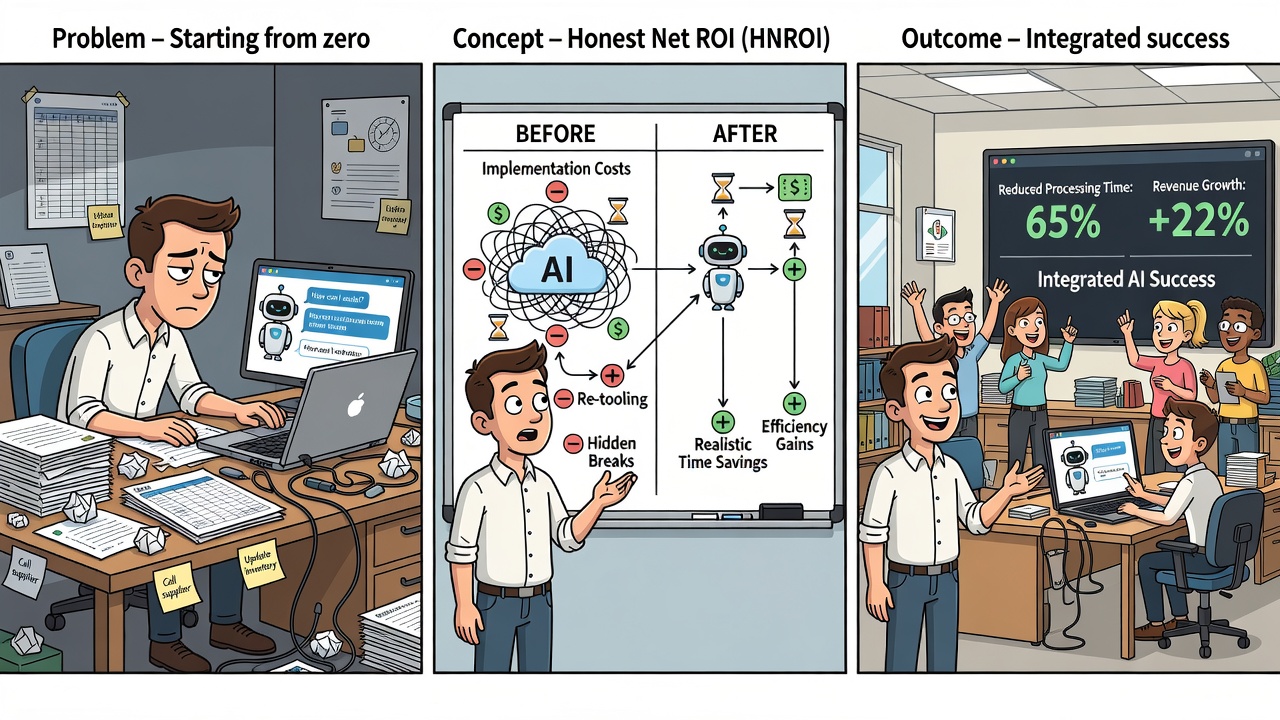
Calculating returns requires subtracting implementation, re-tooling, and hidden automation breaks to reveal realistic outcomes. Honest Net ROI, or HNROI, provides this grounded view by factoring in all related expenses.
Traditional ROI might highlight impressive time savings on paper. HNROI adjusts for staff training time, integration costs, and expected disruptions during rollout. Organizations that ignore these elements often encounter K-shaped return curves where some teams see benefits while others face setbacks due to under-estimated expenses.
A practical HNROI worksheet for SMBs includes columns for baseline task time, projected savings per task, training hours, software fees, and process redesign costs. Monthly tracking of named workflow improvements replaces counting agents in use. This method helps decision-makers see true net gains such as 20 percent efficiency boosts after all deductions.
Research underscores that real net ROI materializes only after subtracting change-management costs and impacts on existing teams [3]. By using this approach, SMBs can set realistic expectations and prioritize projects with the strongest signals of positive returns. Expanding on this, consider incorporating scenario planning into your HNROI model to account for variables like market fluctuations or seasonal demand spikes that could affect realized savings.
Implementation Challenges Beyond Tool Selection
Roughly 40 percent of agentic artificial intelligence projects fail when teams attempt to move from chatbots to full planning-and-action systems. Success requires workflow integration, not just model choice. Many organizations remain stuck in non-scaling pilots because they overlook operational realities.
Narrow agents targeting precise processes scale more reliably in production than broad agents. Structured implementation guides stress moving past tool selection into the details of how artificial intelligence fits daily operations. For instance, selecting an affordable model is only the starting point. The real work involves mapping data flows, testing integrations with existing software, and establishing fallback procedures when automation encounters edge cases.
Practical examples for SMB owners include starting with one high-volume repetitive workflow like invoice processing. Define success metrics such as reduced error rates or hours reclaimed before deployment. This targeted method minimizes failure risk and builds internal confidence through early wins. Sources note that most organizations need to focus on operational reality rather than broad experimentation [8]. In-depth planning here also involves auditing current data quality, as poor inputs can undermine even the best artificial intelligence agents.
Change Management and Costs Are Core ROI Factors
Real net ROI only materializes after accounting for change-management expenses and effects on teams and processes. Under-estimating these leads to disappointing outcomes. Budget 30 to 50 percent of total project cost for change management and process redesign to avoid shortfalls.
Change management involves communicating benefits to staff, providing training, and redesigning roles so employees feel supported rather than replaced. Without this investment, adoption stalls and projected savings evaporate. Cheaper, accessible models and agents are lowering barriers, enabling broader adoption beyond early Fortune 500 experiments and supporting governance at scale [10].
For an SMB with limited resources, this might mean phased rollouts where one department tests the system first. Staff feedback loops help refine the agent while building buy-in. The result is smoother transitions and sustained efficiency gains that contribute to revenue boosts through freed-up capacity. Leaders should also prepare for cultural shifts, fostering an environment where continuous learning becomes part of the company ethos.
Targeting the Right Workflows for Maximum Impact
Generic deployments deliver little value. Savings and ROI tie directly to specific, named workflows. Process-level orchestration that chains steps across tools succeeds when it replaces or augments defined business processes rather than attempting wide coverage.
Identify high-volume repetitive tasks such as customer onboarding or inventory updates. These offer clear baselines for measuring improvements. A manufacturing SMB, for example, might target inventory updates that currently take four hours daily. A narrow agent could reduce this to one hour, yielding measurable time savings and fewer stockouts that protect revenue.
Sources emphasize that savings link directly to named workflows rather than generic automation [4]. SMBs should avoid the temptation of broad agents and instead chain precise steps that integrate with current tools. This approach ensures artificial intelligence augments existing strengths while delivering quantifiable efficiency. Additional analysis of workflow interdependencies can prevent unintended bottlenecks elsewhere in operations.
Leveraging Cheaper Models and Agents for Accessibility
Cheaper models and agents are highlighted for accessibility, making advanced capabilities available to SMBs without Fortune 500 budgets. These options support testing at low cost before scaling to more robust systems after measurable gains appear.
Lower-cost models allow SMBs to experiment with narrow agents on specific tasks without large upfront commitments. Once time savings or quality improvements are documented, investment can increase confidently. This accessibility democratizes artificial intelligence and reduces the risk associated with early adoption.
Practical guidance includes using affordable options first to validate workflows. Track results monthly and scale only after clear evidence of gains. This strategy aligns with broader adoption trends where accessible tools drive production deployments across more organizations [9]. Monitoring emerging open-source alternatives further enhances long-term cost control.
Practical Steps for SMBs: A Step-by-Step Guide
Start with one high-volume, repetitive workflow such as invoice processing or customer onboarding. Define success metrics before any deployment.
Build a simple HNROI worksheet that includes staff training time, integration costs, and expected time savings per task.
Favor narrow agents over general-purpose ones because they integrate faster and show clearer ROI.
Budget 30 to 50 percent of total project cost for change management and process redesign.
Use lower-cost models first to test accessibility. Scale only after measurable gains appear.
Track named workflow improvements monthly instead of counting agents or models in use.
These steps translate research into low-risk, high-visibility wins that SMBs can implement without large IT teams. Following them consistently leads to compounding efficiency and revenue benefits over time. Regular reviews of these steps allow for agile adjustments as new artificial intelligence capabilities emerge.
Real-World Examples Demonstrating Measurable Gains
Consider a mid-sized accounting firm that targeted invoice processing. By deploying a narrow agent on this single workflow, the team reduced average handling time from 12 minutes to 4 minutes per invoice. After subtracting training and integration costs via HNROI, net monthly savings reached 22 hours, which staff redirected to advisory services that increased revenue by 8 percent within six months.
Another example involves a retail SMB automating inventory updates. The narrow agent chained data across their point-of-sale and supplier systems. Measurable outcomes included a 30 percent drop in stock discrepancies and 10 hours weekly reclaimed for customer engagement. Change management efforts ensured staff embraced the tool, preventing the K-shaped outcomes seen in less prepared organizations.
These cases illustrate how focusing on specific workflows, honest cost accounting, and affordable models produces tangible results. Sources highlight similar patterns where production deployments outperform pilots when implementation realities are addressed [2]. Exploring variations across sectors, such as healthcare billing or logistics routing, reveals similar patterns of success when narrow targeting is applied.
Conclusion: Turning artificial intelligence Potential into Sustainable Business Wins
The era of artificial intelligence experimentation without accountability is ending. For SMB decision-makers, success in 2026 hinges on prioritizing measurable gains in time savings, efficiency, and revenue over broad pilots. By addressing implementation challenges, investing in change management, controlling costs, and targeting the right workflows, businesses can realize genuine returns.
Cheaper models and agents make this accessible, allowing you to start small, prove value, and scale confidently. Begin today by selecting one workflow, building your HNROI worksheet, and tracking named improvements. The organizations that act with this disciplined focus will pull ahead, turning artificial intelligence from a buzzword into a reliable driver of growth.
The path forward is clear. Focus on outcomes, not experiments. Your next competitive advantage awaits in the workflows you improve today.
Sources
- https://aivanguard.tech/ai-agent-roi-framework-2026/
- https://automatonagency.com/insights/ai-automation-roi-what-to-expect
- https://kersai.com/agentic-ai-roi-2026-business-owners-cios/
- https://infogion.com/ai-data/agentic-ai-roi-enterprise/
- https://www.summitpartners.com/resources/ai-trends-what-leaders-need-to-know-q3-2026
- https://mefai.com/how-to-implement-ai-in-your-business-2026/
- https://www.pwc.com/us/en/tech-effect/ai-analytics/ai-predictions.html
- https://www.techaheadcorp.com/blog/agentic-ai-in-production-narrow-vs-broad-ai-agents/
- https://skycrumbs.com/blog/enterprise-ai-agent-deployment-2026
- https://www.lyzr.ai/blog/enterprise-ai/